10 Prettiest Small Towns In Switzerland
In Lauterbrunnen, waterfalls drop off cliffs that rise nearly a kilometer into the sky, with Staubbach Falls alone falling 297 meters past the village church. Two hours east in Stein am Rhein, the walls of the old town are painted end to end with 15th and 16th-century frescoes. Car-free Zermatt sits under the iconic Matterhorn, while Morcote spills down toward Lake Lugano under palm trees and camellias. This is the range that makes Switzerland one of Europe's most photographed countries, with glacier-carved valleys, frescoed medieval squares, and Italianate lakefronts, often a single train ride apart. These 10 small towns are where that beauty shines brightest.
Lauterbrunnen

The village of Lauterbrunnen is mostly a single street that runs through a deep, narrow valley with cliffs rising 900 meters on both sides. The valley is U-shaped and was carved by glaciers; one of the deepest in the Swiss Alps. Visible from the cliffs are 72 waterfalls sending water into the valley. Some are as thin as threads of silver, while others are roaring cascades. The most famous, Staubbach Falls, drops 297 meters in a near-vertical plunge beside the village church, sending spray across the meadows like a permanent mist. Around the church are traditional wooden chalets with dark timber and flower boxes, and a village train station built in 1890 and electrified in 1914.
This village is a popular destination, leaning towards overtourism, but the views explain why. Spring brings maximum water flow to the falls, making the dramatic effect even more so. When summer hits, the meadows are filled with wildflowers. During winter, the cliffs turn into a frozen amphitheater. Lauterbrunnen has no ski infrastructure of its own and only modest accommodation, which keeps it quieter than resort towns. Its importance lies in the village's access to difficult-to-reach destinations, like Mürren and Wengen, the car-free villages sitting on top of the cliffs.
Wengen

After a few minutes on a cogwheel railway that takes riders 400 meters above the Lauterbrunnen Valley, visitors arrive in the car-free village of Wengen. It has the same waterfalls and sheer rock walls visible, but this time from above. The village's location, only accessible by that railway, offers views of the Eiger, Mönch, and Jungfrau, creating one of the finest mountain panoramas in the Bernese Oberland. Wengen has similar traditional chalets with wooden balconies and geranium-filled window boxes. No cars means no traffic noise, just the sound of cowbells and the occasional train whistle.
During the winter, the village is a ski destination connected to the Jungfrau Ski Region, with snow-covered chalets and mountain views. The same slopes become green hiking trails during the summer, giving the opportunity for wide alpine views no matter the season. For those heading back down to Lauterbrunnen, there's a forest trail that takes about 90 minutes of hiking through incredible scenery to get back down to the valley.
Zermatt

Zermatt is another car-free mountain village, but this one looks up at the Matterhorn. Widely considered the most recognizable and most photographed mountain peak in the country, if not the Alps, the Matterhorn has a near-perfect pyramid shape and is one of the most popular mountaineering peaks in the world. Beyond this peak, Zermatt is surrounded by dozens of 400-meter peaks. Though the area has one of the longest winter seasons in the Alps, summer brings 400 kilometers of hiking trails through valleys of crystal-clear lakes, chamois, ibex, edelweiss, and alpine roses.
Visitors arrive by shuttle train from Täsch and get around on foot, by electric taxi, or by horse-drawn carriage. Walking around the town showcases 500-year-old wooden houses and narrow lanes lined with weathered timber facades. Before heading to the ski resorts, the Matterhorn Museum is worth a stop, featuring regional history and the stories of mountaineers climbing the summit. Matterhorn Ski Paradise is Europe's highest ski resort with three main ski regions. Glacier Paradise features the world's highest gondola at 3,883 meters and leads directly to Italy's border, allowing you to ski into Breuil-Cervinia.
Stein am Rhein

Near the border with Germany, where the Rhine River flows out of Lake Constance, is the town of Stein am Rhein. This medieval town has an old town center with a collection of winding alleys, a historic market square (the Rathausplatz), and buildings whose facades are covered in elaborate frescoes painted in the 15th and 16th centuries. The town developed around the former Benedictine monastery of St. George's Abbey, founded in 1007 and still located along the river, now housing a museum. Above town sits the Hohenklingen Castle, a 13th-century fortress that now has a highly recommended restaurant: Burg Hohenklingen.
Stein am Rhein has the Rhine River running through the middle of town, right where Lake Constance begins. With the water shimmering at the edge of the old town, the area is surrounded by beautiful landscapes offering hiking and cycling through gentle hills. Summer is the best time for boat trips on the Rhine and outdoor cafes set up in the market square. The frescoes are vivid in any season, and the town is small enough to explore in a few hours but visually rewarding enough to justify a full day. The combination of medieval art, riverside setting, and the compact scale creates a living museum worth seeing.
Murten

The medieval walled town of Murten is located on the edge of Lake Murten and has ramparts that visitors can walk along. The town is one of the best-preserved medieval fortifications in Switzerland, with the Bern Gate, or Berntor, dating from 1239 and the castle, Schloss Murten, built in 1255. The old town features cobblestone streets, historic stone arcades housing boutiques and cafes, colorful building facades with traditional Swiss details, hidden courtyards, and decorative fountains. The castle at the edge of the old town stands on a rocky spur overlooking the lake.
From the rampart walls, visitors look out over the old town's tiled roofs and the lake beyond. The surrounding Three-Lakes region (Murten, Neuchâtel, and Biel) is known for gentle landscapes and vineyard-covered hills. These vineyards turn golden in the autumn, but during the summer, the town has flower displays all along the arcades. No matter the season, the town walls are open daily from sunrise to sunset.
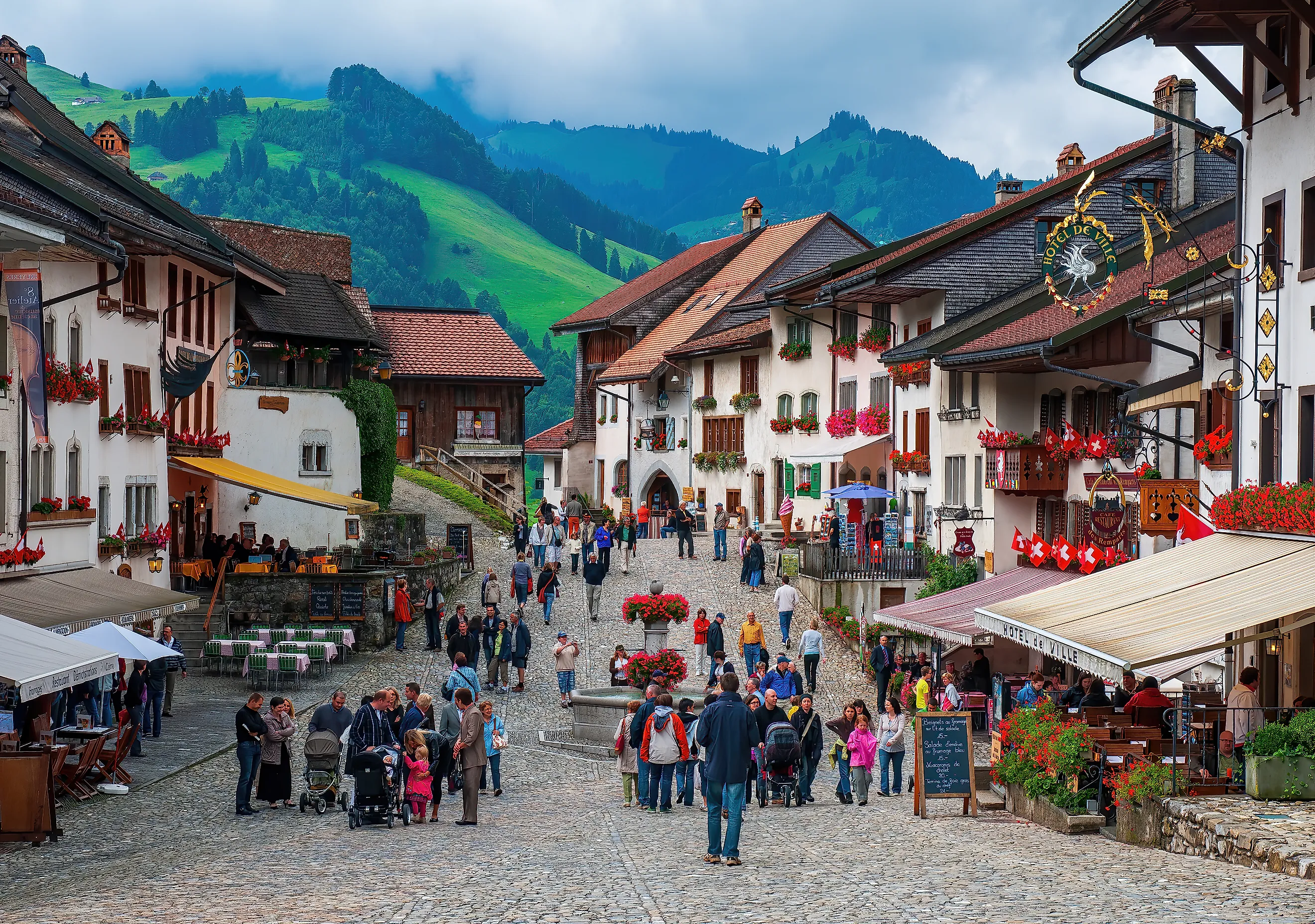
Gruyères

Just 35 kilometers south of Murten is the town of Gruyères, where the globally known cheese of the same name is produced. It's also another historic walled town with a castle and lake views, but while Murten is on a flat plateau, Gruyères is in the rolling Pre-Alps. The castle, Château de Gruyères, is a 13th-century hilltop fortress that dominates the skyline with its blend of Gothic and Renaissance styles across the walls, towers, and a moat. Inside are grand halls, intricate stained-glass windows, and a collection of historical tapestries and knightly armor. The view from the castle ramparts encompasses rolling hills, the Alps in the distance, and the village below.
The village itself has old wrought-iron signs, elegant house architecture, and tasteful decoration of balconies, windows, doors, and terraces. Gruyères is another car-free village, with a single cobblestone main street that ends at the castle gates. Despite the tourists, Gruyères has remained a rural town whose economy is still based on cattle breeding and cheese production. While visiting the castle, don't be surprised to hear the sound of cowbells drifting up from the meadows below.
Appenzell

Appenzell sits somewhat isolated in the alpine foothills of northeastern Switzerland, with a culture and dialect distinct from the rest of the country. This traditional, leaning towards stubborn, town preserves rural lifestyles like traditional folk music, cattle herding, and Talerschwingen, a unique form of rhythmic yodeling using a coin dropped into a ceramic bowl. The town is famous for its brightly painted facades decorated with colorful frescoes depicting biblical scenes, local legends, and craft traditions. The town still practices Landsgemeinde, where citizens vote by raising their hands in an open-air assembly, a centuries-old tradition of direct democracy that continues today.
The capital of Switzerland's smallest canton, Appenzell has narrow cobblestone streets winding through the painted gabled houses. Distinctive signs known as Tafeen hang outside shops, inns, and restaurants. The Löwen pharmacy has medicinal herbs painted on its shutters, while the town hall, or Rathaus, has a facade painted by August Schmid in 1928. The town sits at the foot of the Apstein massif at about 780 meters elevation. The Säntis peak dominates the horizon at 2,502 meters tall. Surrounding the town are rolling green hills dotted with dairy farms.
Bergün / Bravuogn

This Romansh-speaking village in southeastern Switzerland has two officially recognized names: Bergün in German and Bravuogn in Romansh. Located in the Albula Valley, the town has houses in the Engadine style lining a rising main street, their facades decorated with bay windows, window grilles, and scratched-plaster designs, or sgraffiti. Bravuogn has been awarded as one of the most beautiful villages in the country. The village sits on the Albula line of the Rhaetian Railway, a UNESCO World Heritage railway celebrated for connecting isolated Alpine communities while preserving the natural landscape.
The surrounding mountains include Piz Kesch, the highest peak in the Albula Alps at 3,418 meters, popular amongst hikers and mountaineers. A 15-minute drive south into the mountains brings visitors to the Lai da Palpuogna, a crystal-clear mountain lake. In winter, the high-altitude landscape features the 6-kilometer Preda-Bergün toboggan run, which serves as Europe's longest illuminated night-sledding track. Following a closed pass road, the route offers an exhilarating descent beneath the stone viaducts of the Rhaetian Railway.
Morcote

Feeling more like a town in Italy than a Swiss Alpine village, Morcote is an Italian-speaking, Mediterranean-influenced village on Lake Lugano. Another village to be voted the most beautiful village in Switzerland (this time in 2016), the town cascades down a hillside towards the lake. Stone houses with shuttered windows and flower-draped balconies create postcard scenes at every turn. The lakeside row of houses has magnificent arcades built from noble stones and columns recovered from ancient houses abandoned during the years 1300 to 1500. The Church of Santa Maria del Sasso sits at the top of a 404-step monumental staircase, with Renaissance-Baroque style and 16th-century frescoes.
Sitting on the shores of the lake, the village is surrounded by subtropical vegetation not usually expected when one thinks of Swiss villages. From the church terrace, the view encompasses the lake, surrounding villages, and the Alps far in the distance, creating a northern backdrop. The Scherrer Park features palm trees, camellias, cypresses, bamboo, and other exotic plants in a garden setting with architectural works inspired by various cultures. Morcote balances tourism with authentic village rhythms: morning markets, afternoon siestas, and evening passeggiatas along the waterfront.
Lungern

The Golden Pass scenic train line between Lucerne and Interlaken rounds a bend and suddenly reveals Lungern, an Obwalden village where an impossibly turquoise lake mirrors the surrounding Alps. Lake Lungern, often called the "jewel of Lungern", fills a glacial basin at 688 meters elevation, its emerald waters reflecting the mountains and sky. The village sits a bit higher, at 750 meters, and has traditional wooden chalets with dark timber and flower boxes, scattered along the hillside and lake shore. The neo-Gothic Pfarrkirche Herz-Jesu Church, consecrated in 1893, stands overlooking the village with striking sandstone columns. The Alter Kirchturm, or Old Church Tower, remains as a landmark after the original church was damaged in 1887.
A short hike from the village center is the Dundelbach Waterfall, plunging 150 meters down in two stages, with the upper part being the tallest and most dramatic. The waterfall is located on the southern shore of Lake Lungern, which offers swimming, boating, and hiking in the summer. Spring and autumn offer pleasant hiking weather and fewer crowds. Winter transforms the lake into a winter wonderland. Lungern feels more peaceful and less crowded than larger tourist hubs like Interlaken, providing a sandy beach and protected swimming areas.
Pretty Towns in Every Corner
Even with Switzerland being world-renowned for its scenery, these 10 towns prove that Swiss beauty is not monolithic. It's a waterfall plunging beside a village church, a frescoed medieval square, a car-free terrace beneath the Eiger, and an Italianate lake village cascading down a hillside. Each town offers a different answer to the question of what makes Switzerland beautiful. And whichever town is the goal, take the scenic route, whether by train, cogwheel railway, or lakeside boat, and let the landscape deliver the town.