The Largest Aquariums In The World
One tank at the Chimelong Spaceship holds 56,450,136 liters of water, more than five of the six other aquariums on this list hold in their entirety. Every entry here is ranked by the total water volume across all exhibit tanks at a single ticketed facility. Figures come from Guinness World Records certifications, where they exist, and from each institution's own published totals, where they do not, and all are current as of 2026. Three of the seven are indoor marine theme parks whose operators publish a park-wide water total rather than a display-only figure, and those totals are used here as published. Beyond the numbers, these attractions are among the world's most distinctive and impressive aquatic displays.
Chimelong Spaceship

The Chimelong Spaceship opened in Zhuhai, China, in September 2023 and holds the Guinness World Record for the largest aquarium, with a water capacity of 75,350,969 liters (16.6 million US gallons). It stands on Hengqin Island within the Chimelong International Ocean Resort, next to Chimelong Ocean Kingdom, and its volume surpassed that of its sister park. The building encloses 397,064 square meters and holds seven Guinness titles, including the largest indoor theme park and the largest aquarium tank, the latter a single vessel of 56,450,136 liters (12.4 million US gallons).
The park's principal attraction is a marine science walkthrough divided into 10 zones and biomes, with nearly 300 species in the tanks and roughly 150,000 marine animals across the site. Universe Paradise, an upper-level amusement park, carries rides including Deep Sea Submarine. The Bermuda Storm simulator pairs a 304-seat motion platform with a 1,682-square-meter curved projection screen, both of which are record holders in their own right. A further resort phase is slated for completion around 2027.
SeaWorld Yas Island

SeaWorld Yas Island in Abu Dhabi holds more than 58 million liters (15.3 million US gallons) across five indoor levels. It opened in May 2023 and took the Guinness World Records title for the largest indoor marine-life theme park in 2024, less than a year later. The park is divided into eight realms, and one of them, Endless Ocean, houses the region's largest multi-species habitat, with about 68,000 animals behind a 20-meter-high viewing window.
One Ocean, the central hub, sits beneath a 360-degree LED screen rather than a conventional theater. Rides include the Manta Coaster and SeaSub, a four-passenger submersible certified for use inside an aquarium. Bottlenose dolphins occupy the Tropical Ocean realm, while penguins live in the Antarctic region of the Polar Ocean, which also includes the Arctic. The park houses the Yas SeaWorld Research and Rescue Center, the region's first dedicated marine rescue and rehabilitation facility.
Chimelong Ocean Kingdom

Chimelong Ocean Kingdom opened on Hengqin Island in March 2014 and held the Guinness World Records title for the largest aquarium for 9 years, until the Spaceship opened next door. It holds 48,750,000 liters (12.9 million US gallons), still placing it third. The park is built around a central lake, Hengqin Ocean, and its Whale Shark Aquarium is a single 22.7 million-liter (6 million US gallons) tank. The same 2014 record set included the largest underwater viewing dome, where visitors walk beneath swimming sharks and manta rays.
Eight themed ecological zones surround the whale shark tank, among them Dolphin Cove and Polar Horizon. Polar bears and beluga whales inhabit the cold-water regions, while freshwater species inhabit the Amazon region. Amusement rides include the Polar Explorer and the Walrus Splash. The park recorded 12.63 million visitors in 2024, placing it among the most-visited theme parks worldwide.
Singapore Oceanarium

The Singapore Oceanarium on Singapore's Sentosa Island opened in July 2025 on the site of the S.E.A. Aquarium, which had run since November 2012 and closed that April. The most recent published total for the facility is more than 45 million liters (12 million US gallons), a figure dating to the S.E.A. Aquarium; no updated total has been released for the rebuilt attraction, so its exact margin over Georgia Aquarium remains unconfirmed. It houses over 100,000 marine animals across 22 themed zones, up from ten in the earlier layout.
The largest tank is the Open Ocean Habitat, at 18 million liters (4.8 million US gallons), which houses reef manta rays and giant groupers. Ocean Wonders runs one of the largest Kreisel tanks anywhere, stocked with moon jellies. Singapore's Coast covers local marine life and mangrove ecosystems. The site now operates as a marine research and education institute alongside the public attraction.
Georgia Aquarium

The Georgia Aquarium in Atlanta claims to hold more than 41.6 million liters (11 million US gallons), tying it with L'Oceanogràfic. Opened in November 2005, it held the Guinness World Records largest aquarium record until 2012 and is still the largest aquarium in the United States and the Western Hemisphere, with more than 500 species across seven major galleries.
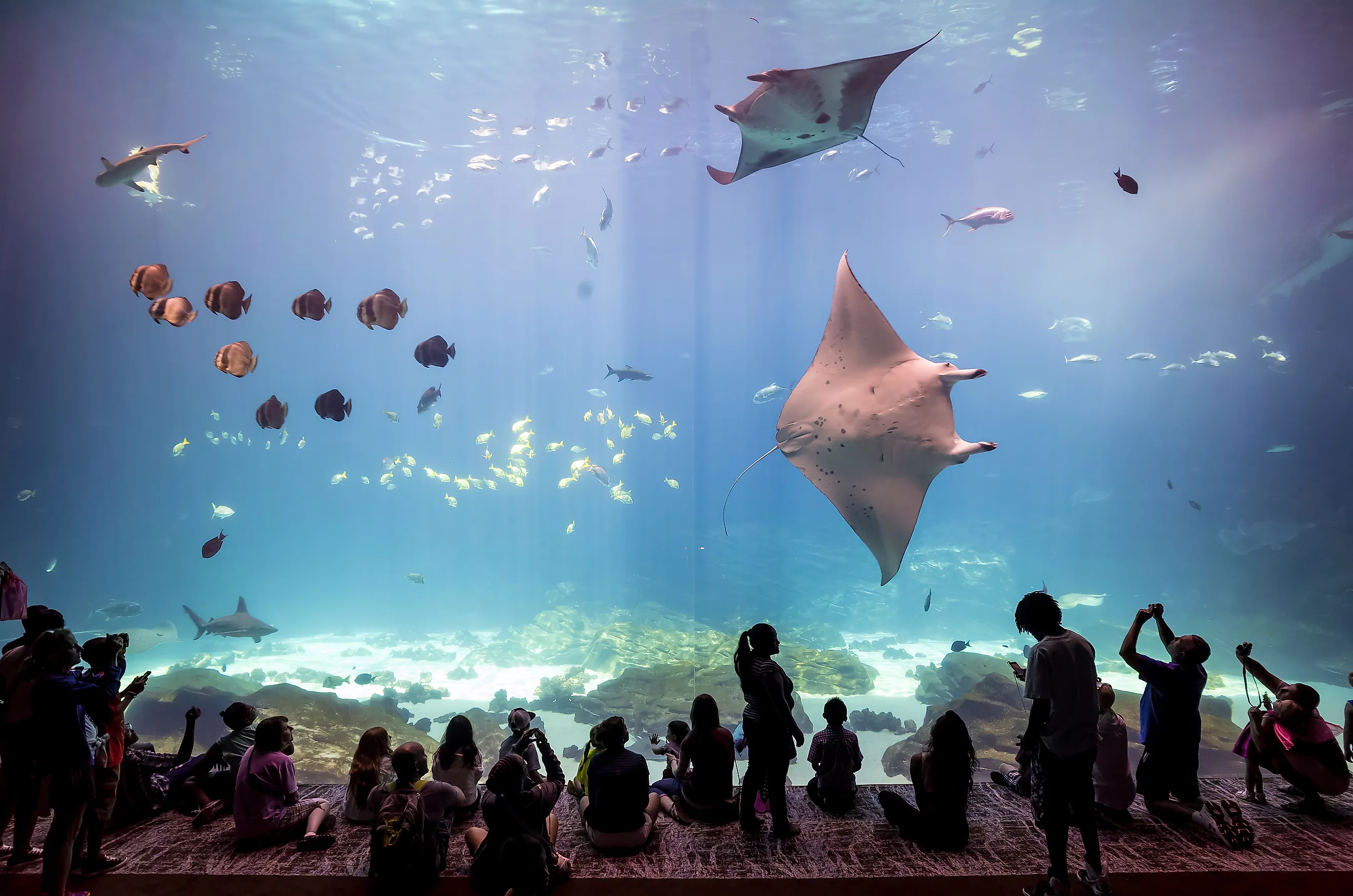
Ocean Voyager is the signature exhibit, a 23.9-million-liter (6.3 million US-gallon) habitat crossed by a 100-foot underwater tunnel and home to whale sharks and manta rays. The Georgia Aquarium is the only facility in the United States that keeps whale sharks. Smaller galleries include River Scout and Cold Water Quest, home to sea otters and albino alligators. The aquarium recycles roughly 99 percent of its water.
L'Oceanogràfic

L'Oceanogràfic in Valencia, Spain, is tied for fifth on the same 11 million US-gallon figure as the Georgia Aquarium. It opened in February 2003 as part of the City of Arts and Sciences complex and remains Europe's largest aquarium, covering 110,000 square meters. Félix Candela designed the water-lily roof over the main building.
A 26-million-liter dolphinarium accounts for well over half the complex's total volume. The Oceans tank holds 7 million liters (1.8 million US gallons) behind a 70-meter acrylic tunnel, with sand tiger sharks and roughtail stingrays overhead. Beluga whales inhabit the Arctic, and the on-site Submarine Restaurant seats diners inside a tank. Seawater for the aquariums is pumped from La Malva-rosa beach.
Port of Nagoya Public Aquarium

The Port of Nagoya Public Aquarium holds 27 million liters (7.1 million US gallons). Its South Building opened in October 1992, and the North Building followed in 2001, the latter structure holding most of the water. The North Building's show pool measures 60 meters wide and 12 meters deep, with a capacity of 13.4 million liters (3.5 million US gallons); it was the largest dolphin show tank in the world when it opened and remains the largest in Japan. That building takes cetacean evolution as its theme, pairing whale fossil replicas and skeletal specimens with living belugas and an orca. The South Building traces the route of the Antarctic icebreaker Fuji through five exhibits, ending on Antarctic marine life. The aquarium houses about 50,000 animals from 500 species and is known for its breeding work with bottlenose dolphins and loggerhead sea turtles, as well as Japan's first beluga birth in 2004.
What These Rankings Do and Do Not Show
The top of this list is less a contest between aquariums than one between building programs. Four of the seven opened or have reopened since 2012, two of them in 2023, and each new record has come from a larger enclosed building rather than a larger single tank. The ranking order is also ever-shifting and potentially debatable. Moscow Oceanarium sits just below Nagoya at 25 million liters, and the Singapore Oceanarium's rebuilt volume has never been published. The Okinawa Churaumi Aquarium is another popular contender whose absence on this list is defensible. It opened in 2002 with whale sharks behind what was then the largest acrylic panel in the world, boasts 77 tanks that hold about 10 million liters combined, roughly a third of Nagoya's total, so its standing rests on one celebrated exhibit rather than on volume. That gap is the clearest illustration of what this measurement does and does not capture. It also explains the divide running through the list, between purpose-built public aquariums, where nearly all the water is display volume, and indoor theme parks, where the published total covers an entire ticketed park. The two can be compared by a single number, but only once that number is defined.