10 Main Streets Where California Comes Alive
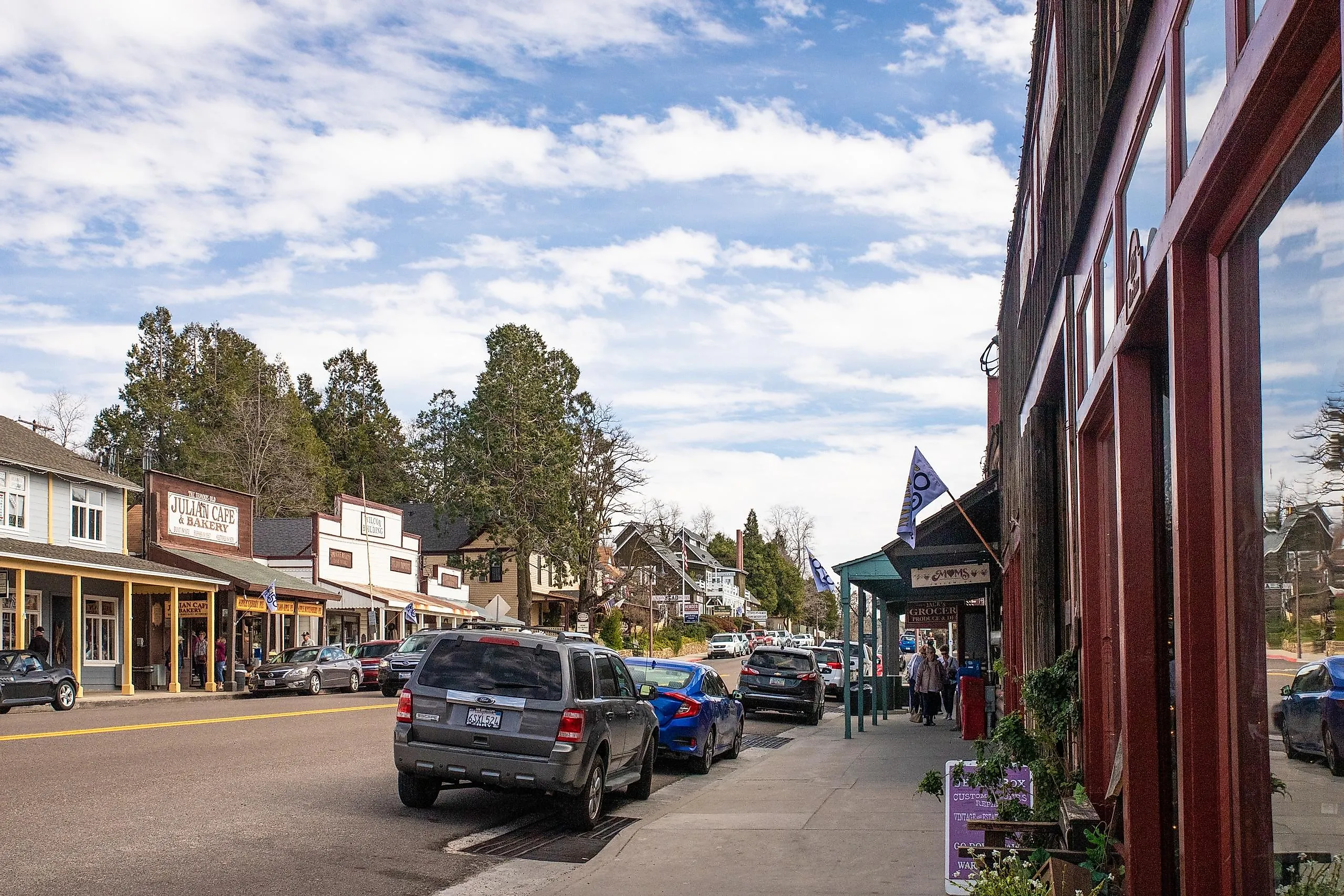
Walk Julian's Main Street on a weekend and you smell apple pie before you reach the first bakery. You get that same payoff on all ten of these California Main Streets. People here spend the whole day on foot. Shoppers browse Ferndale's ornate Victorian storefronts and pull up a stool in Nevada City's brick saloons. Winemakers pour in Los Olivos and gallery owners hang local work in Mendocino. You meet the locals right there on the sidewalk. Here is how to spend your time on each street.
Carmel-by-the-Sea

A 1900s flyer from the Carmel Development Company promised that professors, artists, and music students would find their people here. That pitch worked. The firm laid out Carmel-by-the-Sea in 1902, and artists have shaped Ocean Avenue ever since. Independent galleries and boutiques cluster around Carmel Plaza, including Zantman Art Galleries and its rooms of bright canvases. Walk down to the white crescent of Carmel Beach, where the Frank Lloyd Wright-designed Clinton Walker House sits on the point above the sand. Order an Italian seafood plate at Dametra Cafe. Then finish at Carmel Mission, founded by Junipero Serra in 1770 as the second of California's 21 missions.
Nevada City

Fire nearly ended Nevada City before it started. The great blaze of 1851 destroyed roughly 125 buildings, about half the town, and several more fires followed through the decade. Residents rebuilt in brick and stone with iron shutters, and that stubborn choice is why the buildings along Broad Street still stand today. The National Exchange Hotel opened in 1856 and has operated as a hotel ever since, one of the oldest west of the Rockies. Across the way in Calanan Park, relics from the Gold Rush years sit on display. The Earth Store on Broad Street sells maps, books, binoculars, and science-minded gifts. A few doors down stands the Nevada Theatre, the oldest surviving theater building in California, open since 1865.
Ojai

Glass magnate Edward Drummond Libbey wanted downtown Ojai to look like Spain, so he paid for the row of stucco archways and the bell tower over the post office that visitors still recognize today. Serendipity Toys has sold playful things to Ojai kids since 1979. Around the corner, curators have installed local history and art inside the Ojai Valley Museum, set in a former Catholic church. Oak trees shade the tennis courts and walking paths of Libbey Park, and a fountain there is worth a bench and a book. Wine travelers usually point their cars toward the Sta. Rita Hills or Paso Robles, but Ojai holds its own. Boccali Vineyards and Winery pours in an outdoor space with a view across the valley.
Julian

Prospector Fred Coleman found gold in a local creek in early 1870, and San Diego County had its only gold rush. The miners had exhausted the gold by the 1880s, but the people of Julian did not empty out the way boomtowns usually do. The soil and climate favored apples, planted here from the 1870s, and growers turned apples into the town's second act. Bakers along Main Street now trade on pie. The Julian Pie Company bakes it with a patio out front, and Mom's Pie House does the same a few steps away. Bibliophiles can lose an afternoon at the Julian Book House, a vintage shop with a reading patio and coffee close enough to the pie to matter. At the Julian Museum and Pioneer County Park, exhibits cover the mining years and the Bailey family who helped found the place.
Mendocino

People call Mendocino the Town of Water Towers, and once the coastal fog lifts you understand why. Wooden towers stand all over town, some tall, some squat, some leaning toward collapse. The town counted more than 100 of them at its peak, and plenty remain. Builders set most of Main Street's shops along the north side on purpose, leaving the south side clear for the long view over Mendocino Bay and the Pacific Ocean. At the Ford House Visitor Center and Museum, displays walk you through the town's past, including the wild mushrooms this coast is known for.
Mendocino Headlands State Park borders the town on three sides, with gentle trails, rocky shoreline, and pockets of hidden sand. The Highlight Gallery, a short uphill walk from Main Street, displays handmade furniture, ceramics, sculpture, jewelry, and textiles. Grab a table at the Trillium Cafe and Inn for dinner over the water.
Sutter Creek

Loggers worked Sutter Creek first, but the miners who struck gold made the real fortunes and won the town its nickname, Jewel of the Mother Lode. The Central Eureka Mine, whose headframe still stands within sight of town, ranked among the three largest gold mines on the Mother Lode. Miners spent that wealth on Main Street, where filigreed balconies extend over the sidewalks. The town's wine scene deserves more attention than it gets, and the Scott Harvey Wines tasting room is a good place to test that claim with knowledgeable pours. The Monteverde General Store comes with an odd, human backstory of an owner who promised to return and never did, and it once drew housewives and stump speeches alike. The Sutter Creek Theater rounds things out as a small, personal venue for plays and music.
Cambria

Main Street divides Cambria into an East Village and a West Village, and the East Village walking tour passes nearly 30 preserved homes and storefronts dating to the 1870s. Once you have had your fill of the old buildings, head for the Moonstone Beach Boardwalk and hunt for the agates and quartz that wash ashore. Reward the effort with a slice of olallieberry pie at Linn's, or a globally minded plate at Robin's, a Central Coast favorite going strong for more than 30 years. Close the day on the bluff trail through Fiscalini Ranch Preserve, where Monterey pines edge the ocean.
Los Olivos

Los Olivos fits some of the best food and wine in the state into a four-block downtown. The Main Street stretch has a rustic, tree-shaded feel, with tasting rooms lined up shoulder to shoulder. Work your way down Grand Avenue and you will pass more than 30 of them within a few walkable blocks. Carhartt Family Wines pours in a homey room with a garden patio out back. Epiphany Cellars sits about 200 feet away, with couch seating and a shared table built for lingering over a glass. Gallery Los Olivos displays local pastels, oils, watercolors, sculpture, and wearable art daily. End the day in a rocking chair on the porch of the Inn at Mattei's Tavern, a restored tribute to old California.
Sonoma

Mariano Vallejo laid out the eight-acre plaza in Sonoma in the 1830s, and townspeople have gathered there ever since. Vallejo was the Mexican military commander whose decisions helped steer California toward U.S. statehood, and reminders of him stand right in the square. A bronze monument marks the 1846 Bear Flag Revolt, and nearby stands Mission San Francisco Solano, founded in 1823 as the last of California's 21 missions. Visitors come today for wine country ease. The Girl and the Fig serves fine wine on an outdoor patio, and a few steps on, the Sonoma Cheese Factory has supplied the valley's food and wine culture since the 1930s. Pack a picnic or simply sit a while, and it is easy to see why crowds still fill the largest historic plaza in California.
Ferndale

Ferndale grew rich on dairy and poured that butterfat money into storefronts, churches, and homes so elaborate that people nicknamed them Butterfat Palaces. Much of Main Street falls within a historic district on the National Register, its 1880s buildings preserved into one unbroken streetscape. Browse the Golden Gait Mercantile, a quirky shop with more than 50 years behind it, then catch a show at the Ferndale Repertory Theatre, the oldest and largest resident community theater on California's North Coast. Exhibits at the Ferndale Museum cover the dairy heritage, and the 1909 Carnegie Library still operates as a public library, the only working Carnegie library in northwestern California.
Where California Really Lives
The coast gets the postcards, and it deserves them. But you will find the state's oldest stories a few miles inland, on streets that residents fought to keep. In Nevada City, the brick and iron shutters along Broad Street survived the fires. In Ojai, the white stucco arches of the arcade turn pink when the sun drops behind the Topa Topa range. The people in each of these towns kept their Main Street alive on purpose, and they hand that reward to anyone willing to park the car and walk it.