The US Towns Where Retirees Outnumber Workers
The cleanest way to identify these places is median age, because once a town's median passes 65 more than half the residents are already past retirement age. Only a handful of American communities clear that line, and the top of the list is startling: The Villages in Florida has a median age of 73.6, and Laguna Woods in California sits at 74.5, with the gated village inside it averaging 78. For comparison the national median age is 39.1, a record high reached in 2024. These are not towns with a lot of older people in them. They are towns where the working-age population is the minority and a large share of it commutes in.
What makes the list more interesting than a ranking is that two entirely different processes produce the same result, and only one of them was anybody's plan. Some of these towns were built this way on purpose. The rest got here by watching everybody young leave.
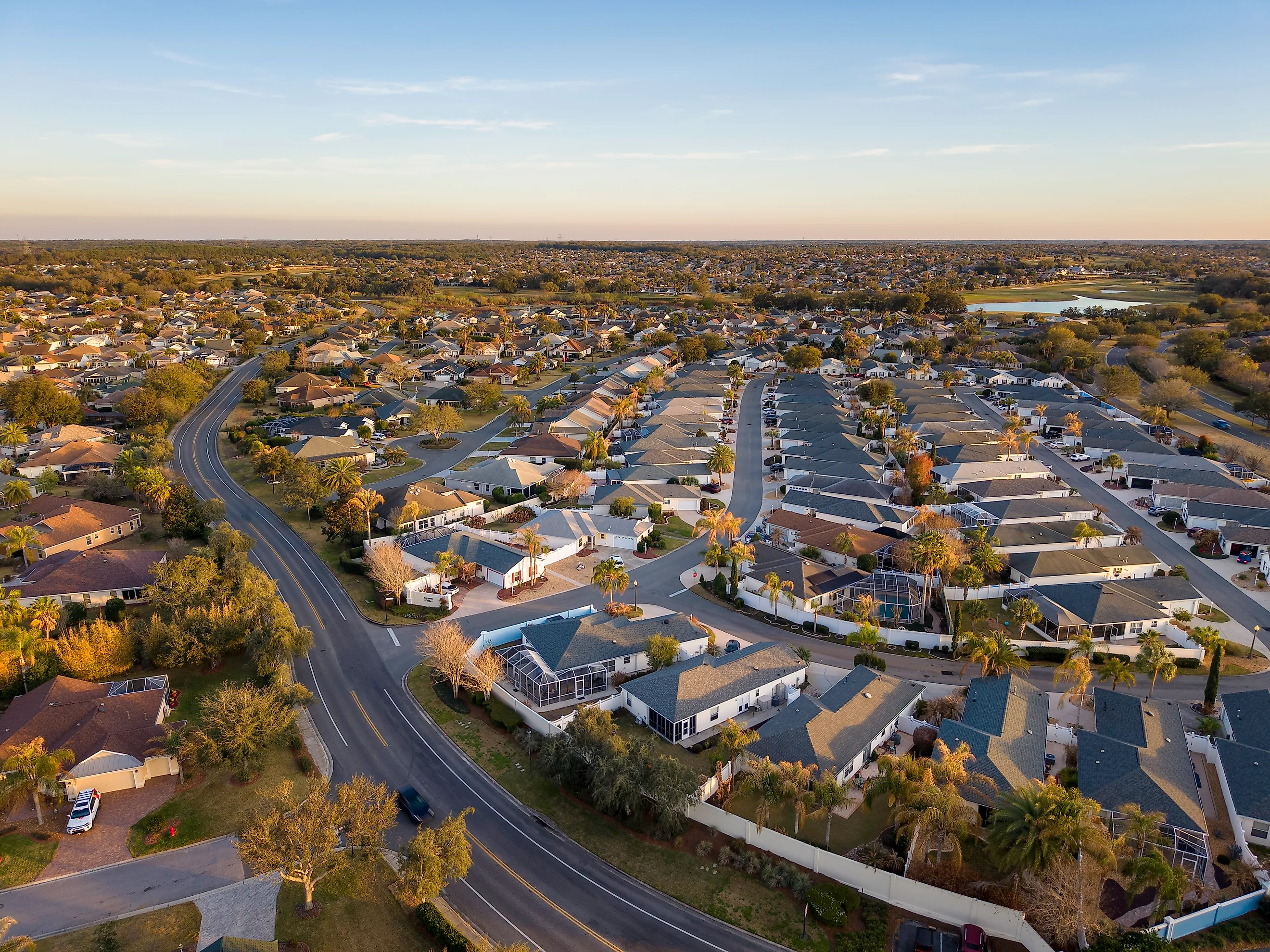
The Villages, Florida

The Villages is the largest retirement community in the country at 32 square miles, spread across three Florida counties, and it holds the highest median age of any American city at 73.6 according to the latest American Community Survey data. Nothing else is close.
Its effect on the surrounding county is easier to grasp than the town figure. Sumter County has a median age of 68.1, making it the oldest county in the United States, and the Census Bureau notes it beats the youngest county in the country, Madison County in Idaho at 20.9, by nearly 48 years. Published figures for the share of Sumter residents over 65 range from about 53 percent to over 60 percent depending on the survey year and source, but every version puts it comfortably over half.
It is also, by several measures, one of the fastest-growing metropolitan areas in the country, which is an unusual thing for a place with that demographic profile and tells you the inflow is continuous.
Laguna Woods, California

Laguna Woods is the most concentrated example in the country, and an unusual case of a town that exists because a retirement community wanted a city government of its own. Laguna Woods had a median age of 74.5 as of 2021, with a population around 17,600 in California, and about ninety percent of its 3.34 square miles is taken up by Laguna Woods Village alone.
That village is age-restricted to residents 55 and over, holds more than 18,000 people, and reports an average resident age of 78. It was developed by Ross Cortese, a former fruit stand operator who moved into building retirement communities and had already succeeded with Leisure World in Seal Beach in 1961.
The city itself was incorporated on March 24, 1999, becoming Orange County's 32nd, after residents voted for it. A private gated community effectively voted itself into being a municipality.
The Rest Of The Top Of The List
Census ACS data for 2024 puts the oldest American cities with at least 5,000 residents in a tight cluster, and the names repeat a pattern. Desert Palms in California, Leisure World in Maryland, Laguna Woods, Timber Pines in Florida, and Sun City West in Arizona all appear near the top.
Every one of those is a purpose-built, age-restricted development rather than an ordinary town that happened to age. None of them grew old. They were built old, and the same handful of developers and business models turn up behind most of them.
How This Is Even Legal
Age-restricted housing sounds like it should run into fair housing law, and it would if not for a specific carve-out. The Housing for Older Persons Act allows communities to exclude residents under a certain age, most commonly 55, provided they meet federal requirements on the share of units occupied by qualifying older residents.
That exemption is the legal foundation of every community named in the previous section. Without it none of these places could maintain the demographic that defines them, and the median ages at the top of this list simply would not exist. It is a narrow piece of housing law holding up an entire category of American town.
The Other Way It Happens

The second mechanism produces similar numbers by the opposite route, and it is far more widespread than the first. A rural town does not need to attract a single retiree to end up with a majority-retired population. It only needs its young people to leave and its older ones to stay put.
This is the story across a great deal of the rural Midwest, Great Plains and Appalachia. School enrollment falls, the hospital consolidates, the jobs thin out, and each graduating class leaves for somewhere with work. The people who remain get older every year by definition, and nobody arrives to reset the average.
The Census Bureau's 2024 figures capture the scale of the shift. Older adults now outnumber children in nearly 45 percent of American counties, and the national median age has reached a record 39.1.
Why The Two Look Different On The Ground
The statistics converge and the places do not resemble each other in the slightest, which is the part a ranking by median age completely hides.
A purpose-built community has a tax base, new construction, medical infrastructure built to match its population, and a continuous stream of arrivals. The Villages is growing fast. Demand for services is high and so is the ability to pay for them.
A rural town that aged by subtraction has the opposite of all of that. The population is shrinking rather than growing, the tax base is contracting while the demand for health and social services rises, and the young workers needed to staff those services are exactly the people who left. One is a market. The other is a squeeze.
Florida Is Not The Whole Story

Florida does lead the country, with 19.1 percent of its population aged 65 or older, the highest share of any state. Charlotte County, which contains Punta Gorda, and Citrus County both rank near the top nationally.
But the Census Bureau makes a point worth repeating, which is that a state median tells you very little about the places inside it. Florida has one of the largest gaps between its oldest and youngest counties of any state, containing both the oldest county in the nation and counties younger than the national median. Virginia has the biggest internal spread of all at 38.3 years, and Connecticut the smallest at 7.3.
The oldest cities list also reaches well beyond Florida, into Arizona, Maryland and California, and the rural aging pattern shows up in states nobody associates with retirement at all.
What The Numbers Do Not Show
Two caveats belong on any list like this, and both of them cut toward caution rather than confidence.
Small populations produce unreliable medians. Loving County in Texas reports a median age in the eighties, but its population is tiny enough that the margin of error swamps the figure. Any ranking of the oldest places in America needs a population floor, which is why most credible lists set one at 5,000 residents.
And median age is a proxy for the headline claim rather than a measurement of it. A median above 65 means more than half the residents have reached retirement age, not that all of them have retired, and plenty of people over 65 are still working. The honest version of the claim is that in these towns the majority of residents are past traditional retirement age, which is a slightly narrower statement and the one the data actually supports.
The Honest Ranking

By median age among American cities, The Villages leads at 73.6 and Laguna Woods follows at 74.5 depending on which survey year you use, with Desert Palms, Leisure World, Timber Pines and Sun City West filling out the top group. By county, Sumter in Florida is the oldest in the nation at 68.1.
Every name in that first list is a development that was designed this way and is legally permitted to stay this way. The far larger number of American towns where retirees outnumber workers never appear on any ranking, because they are small, scattered, and got there by watching everybody under 40 leave.