The US Towns Sitting Above The Tree Line
There are none, and the gap is not close. The highest town in the United States is Alma, Colorado, and depending on which official figure you use it sits at either 10,361 or 10,578 feet, while the tree line in the Colorado Rockies runs somewhere between 11,000 and 12,000 feet. So America's highest settlement is several hundred vertical feet short of the last trees, and every other town in the country is further below that again. What makes the question worth asking anyway is that a legally incorporated municipality does exist above the tree line, one town's boundary reaches 12,060 feet, and an actual inhabited town above the trees was built and then dismantled.
Here is how close America gets, and the three technicalities that complicate the answer. Two of them involve paperwork and one of them involves a town that no longer exists.
Where The Tree Line Sits

The tree line is not a fixed altitude, which is the first thing that makes this question awkward. It is the elevation above which conditions stop supporting upright trees, and it falls as you move away from the equator. In the Colorado Rockies it generally runs between about 11,000 and 12,000 feet, in the northern Rockies of Montana it is considerably lower, and in Alaska it can drop to a few thousand feet or to sea level in parts of Alaska.
What sets it is not cold alone but growing season, wind and desiccation. Above the line, summer is too short for a tree to produce and harden new growth before winter, and constant wind strips moisture from needles faster than frozen roots can replace it. The result is krummholz, the stunted twisted mats of spruce and fir that mark the transition, which are technically trees and functionally shrubs.
Alma, Colorado Is As High As It Gets

Alma is the highest incorporated municipality in the United States with permanent residents, sitting in Park County, Colorado, below a ring of fourteen-thousand-foot peaks. It was incorporated on December 2, 1873, grew on gold and then silver, and had 296 residents at the 2020 census. Its post office is the highest in the country.
Its elevation is genuinely disputed, which is a strange thing to be true of the highest town in America. The town's own website and most local coverage give 10,578 feet. Wikipedia's infobox and the state municipal list give 10,361. That is a 217-foot discrepancy in the headline number for a place whose entire identity is its altitude.
Either way it sits in forest. Alma is surrounded by lodgepole and spruce, and the tree line is several hundred feet above the town on the slopes around it.
Leadville Holds A Different Title

Leadville comes up constantly in this conversation and it holds a real but narrower record. At 10,157 feet it is the highest incorporated city in the United States, a distinction it has held since it incorporated on February 18, 1878.
The difference between the two is purely administrative. Alma is legally a town and Leadville is legally a city, so both claims are accurate and neither cancels the other. Leadville is also far larger, with a real main street, a mining history that produced several American fortunes, and about 200 feet less altitude.
The Town Above The Tree Line Has Nobody In It
Here is the first technicality, and it is a good one. Carbonate, Colorado is technically the highest-elevation municipality in the United States. It is also completely empty, and has been since before 1890.
Carbonate was a mining town that failed, and the census has recorded no year-round residents there since the 1890 count. It was never formally dissolved, so it remains on the books as a municipality with an elevation higher than Alma's and a population of zero. Alma's claim is always carefully worded as the highest municipality with permanent residents, and Carbonate is the reason for that wording.
Winter Park's Boundary Reaches 12,060 Feet
The second technicality involves a ski area and a map. In 2006 the town of Winter Park, Colorado annexed a ski area, and by doing so acquired the highest elevation within municipal boundaries of any town in the United States, at 12,060 feet.
That figure is genuinely above the tree line. What it is not is a place anyone lives. The town center sits far lower in the valley, and the 12,060-foot point is a patch of alpine terrain that happens to fall inside a line on a map drawn for tax and planning purposes.
By administrative boundary, then, an American town does extend above the trees. By any definition involving houses, it does not.
Climax Was The Real Thing, And It Is Gone
The third technicality is the only genuine example, and it no longer exists. Climax, Colorado sat near the top of Fremont Pass at around 11,300 feet, unambiguously above the tree line, and people lived there.
It was a company town built for the Climax molybdenum mine, one of the largest of its kind in the world, and at its peak it had housing, a school and a post office. It was also the highest post office in the country before Alma inherited the title. When mining operations were restructured the town was cleared away, and the site is now mine infrastructure and open tundra.
Climax is the answer to the question in the headline, and the answer comes with a past tense. It is also the only American settlement that ever cleared the tree line with families in it rather than equipment.
Why Nobody Lives Up There

The reasons are practical rather than legal, and they were more binding when these towns were founded than they would be now.
Trees are the resource that makes a mountain settlement possible. They supply building material, fuel for heating and mine timbers, which in a nineteenth-century mining district is the entire construction economy. A town above the tree line has to import every stick of it uphill.
Then there is shelter. The tree line is also roughly the wind line, and the same conditions that stop spruce growing make winter above it substantially harder on people, buildings and roads. Snow does not settle politely up there, it moves.
And there is the growing season, which above the line is effectively nil. Every settlement on this list was founded on mineral wealth rather than agriculture, but food still had to come from somewhere, and the somewhere got further away with every hundred feet of altitude.
The Places That Are Above It

Plenty of American buildings sit above the trees. They are simply not towns.
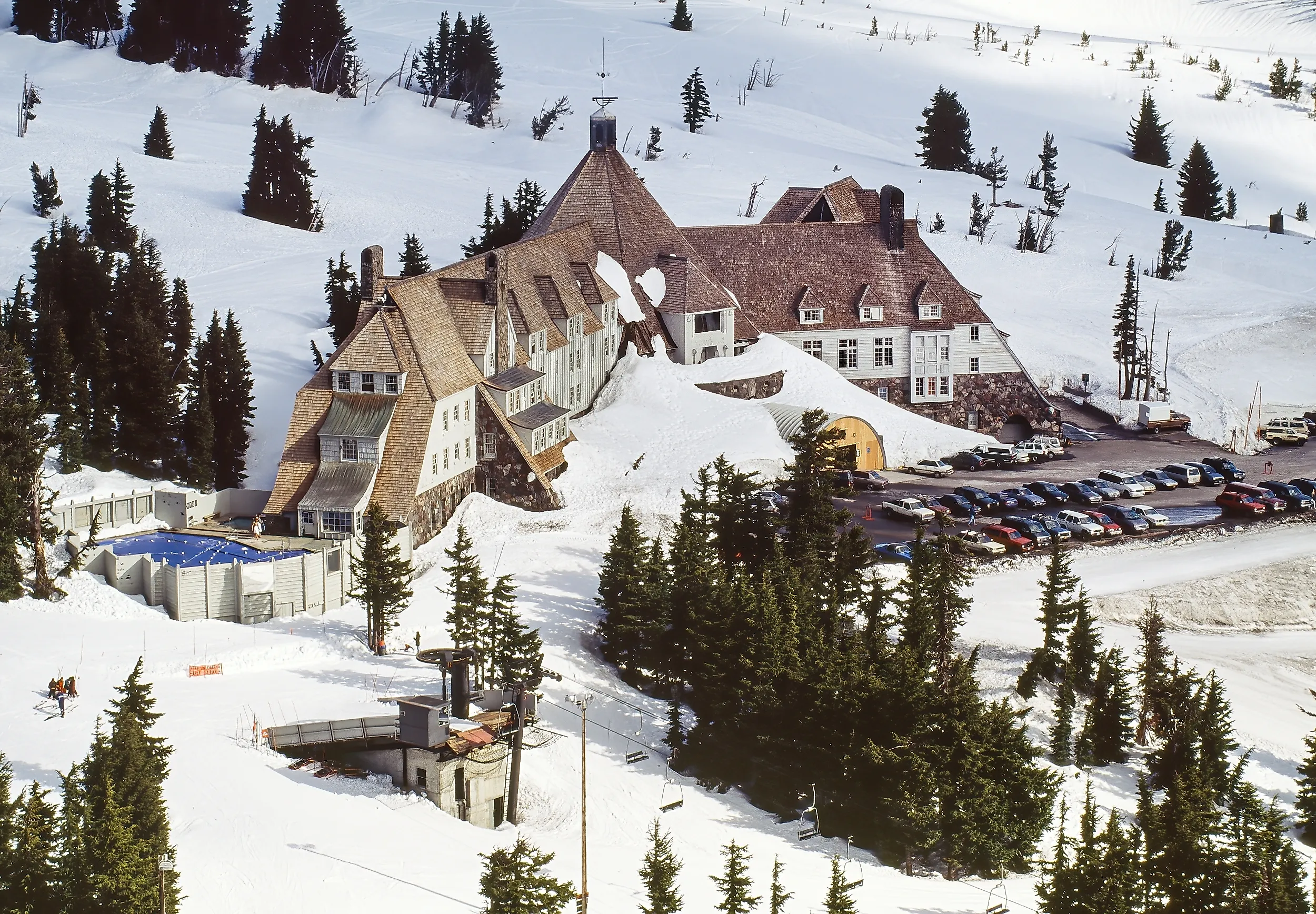
Research stations, ski patrol huts, high mountain lodges, the summit facilities on Pikes Peak and Mount Blue Sky, and a long list of Forest Service and weather installations all operate above the line. So does Timberline Lodge on Mount Hood in Oregon, which is named for exactly where it sits and which has never pretended to be a settlement.
The distinction is between a structure and a community. You can put a building anywhere and supply it. Sustaining a place where people are born, go to school and grow old requires a different kind of foothold, and in the United States that foothold stops at the trees.
The Honest Answer

No inhabited American town sits above the tree line today. Alma is the highest with permanent residents and sits comfortably in forest, and Leadville, the highest incorporated city, is lower still.
Carbonate is legally higher and has been empty for 136 years. Winter Park's boundary crosses the line but only its ski terrain does. And Climax genuinely cleared it, with houses and a school, until the company that built it took it apart.
Which makes the real answer to the question a short one. The United States had exactly one town above the tree line, it existed because somebody was mining molybdenum, and when the mining changed there was no other reason for anybody to be up there at all.