11 Ohio Towns With Unforgettable Main Streets
On one of these main streets you can walk a half-mile of riverfront painted end to end with murals. On another, the whole downtown turns into Victorian England every December, with more than 100 life-sized figures staged along the sidewalks. A third throws a festival built entirely around melons, with watermelon sherbet you can only get three days a year. These eleven Ohio downtowns are worth a day not for what they used to be, but for what there is to do on them now. Here is where to start.
Gallipolis

A boatload of French aristocrats and artisans landed here in October 1790, fleeing the Revolution and a land deal that turned out to be a swindle. They built their cabins on the riverbank that is now Gallipolis City Park, and the town has held that ground ever since. It was the second settlement in the Northwest Territory, after Marietta, and the French names on the older buildings still tell you who got here first.
The park anchors downtown, with Second Avenue running up from the river toward the Ariel Opera House, home to the Ohio Valley Symphony. A block over, the Mothman Museum keeps the 1960s sightings alive with case files and props for anyone curious about the legend that put the region on the map. Come in December and the park turns into "Gallipolis in Lights," a display the town has been stringing up for decades, and the locals turn out for it the way other towns turn out for a parade.
Tipp City

Tipp City still answers to its old name on its main street. The storefronts along Main Street sit inside the Old Tippecanoe City Historic District, brick buildings from the canal era that never got smoothed over, and the antique shops and restaurants that fill them keep the block busy on a Saturday. Every September the Mum Festival takes the downtown over with a parade, food booths, and displays that trace back to the region's long history of growing chrysanthemums.
When the festival crowds clear out, Charleston Falls Preserve sits just outside town with wooded trails and a waterfall dropping into a limestone gorge that most people do not expect to find in this part of Ohio. Spend the morning on the trail and the afternoon working down Main Street, and you have the whole town in a day.
Cambridge

Wheeling Avenue, the center of downtown Cambridge, was part of the National Road, the first federally funded highway in the country, and the brick storefronts that grew up along it still carry that traffic-stop feel. The buildings are walkable and well kept, and they pair easily with the heritage sites scattered through Guernsey County.
From November through January the street becomes Dickens Victorian Village, with more than 100 life-sized figures staged in scenes out of 19th-century England. Families walk the displays after dark when the lights are on, stop at the Welcome Center to warm up, and make a whole evening of it. The figures come down in winter, but the architecture that holds them is worth the walk in any season.
Portsmouth

The best main street in Portsmouth is a wall. After the 1937 flood, the Army Corps of Engineers walled the town off from the Ohio River with a 20-foot concrete barrier, and for decades it cut downtown off from the water. In 1993 the muralist Robert Dafford started painting it. The result runs more than 2,000 feet along Front Street through the historic Boneyfiddle District, roughly sixty panels tracing 2,000 years of local history, from the Adena and Hopewell mound builders to hometown cowboy star Roy Rogers.
Interpretive signs line the sidewalk across the street, so you can read your way down the wall one panel at a time. When you reach the end of Front Street, the old storefronts of Boneyfiddle pick up where the murals leave off, with restaurants and a brewery built into the 19th-century buildings.
Troy

Troy is built around a square, with the Miami County Courthouse standing at the center of it and the main street fanning out into shops, cafes, and restaurants. The courthouse gives the block its anchor, a domed limestone building that draws the eye from every approach, and the storefronts around it stay busy with the kind of independent businesses that make a downtown worth lingering in.
The square doubles as the town's gathering ground. Summer brings the Troy Strawberry Festival, which fills the streets and the riverbank along the Great Miami with vendors and crowds in the hundreds of thousands. The rest of the year it is quieter, red brick and benches and a place to sit, but the bones are the same.
Mount Vernon

The Woodward Opera House on South Main Street is the oldest surviving 19th-century theater of its kind in the country, and it sets the tone for the whole downtown. Restored after decades dark, it sits among the brick commercial blocks around Public Square, where tree-lined sidewalks and preserved storefronts give Mount Vernon the full courthouse-town layout.
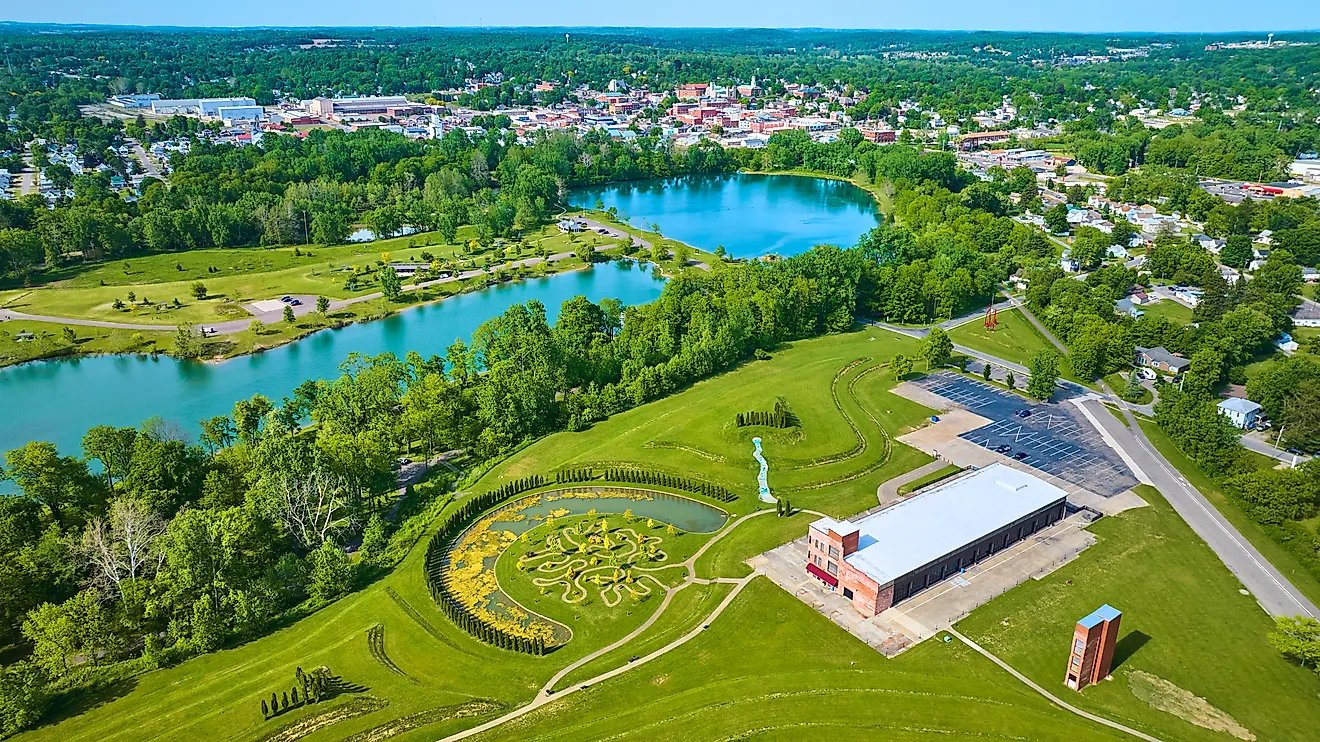
A short walk from the square, Ariel-Foundation Park turns the grounds of a former glass plant into open space, with lakes, trails, and the surviving industrial ruins left standing on purpose. The Rastin Observation Tower rises out of the old factory site, and the climb gives you the town from above. Between the opera house and the park, Mount Vernon balances small-town downtown against room to walk.
Vermilion

Vermilion runs its main street right down to Lake Erie, ending at Main Street Beach and a replica of the harbor lighthouse the town lost to the lake decades ago. The original guided ships through generations of local lake captains, and the stand-in keeps that history in view at the foot of downtown.
Back along the main corridor, Victory Park is the green the locals call the Village Green, with a white gazebo that hosts summer concerts and a sheltered platform for watching the trains roll past. A parallel street holds the Vermilion History Museum, set in a 1904 building that once housed a newspaper print shop and still keeps the antique printing equipment inside. In fall the town throws the Woollybear Festival, named for the caterpillar, and the parade draws tens of thousands to a town of a few thousand.
Millersburg

Hotel Millersburg has been taking in travelers on West Jackson Street since 1847, which makes it the third-oldest continuously operating hotel in the state. Grover Cleveland signed the guest book in 1900, and the hotel's tavern still carries his name. The whole downtown around it is listed on the National Register of Historic Places, the gateway block to Ohio's Amish Country, and on courthouse business days you will see horse-and-buggy hitching posts in use across the street.
That courthouse is the Victorian Gothic Holmes County Courthouse, built in the late 1800s from locally quarried stone. End the day a few doors down at Millersburg Brewing Company, where the taps run to better than twenty pours of beer, cider, porter, and stout alongside straightforward pub food. The brewery shares the older commercial buildings with antique shops and galleries, the modern tenant on a 19th-century block.
Milan

Thomas Edison was born in Milan in 1847, in a brick house a couple of blocks off the village square, and the town has been the birthplace of invention ever since. The Edison Birthplace Museum keeps the home as it was, with period furnishings, family belongings, and a bronze statue of the inventor out front. Down the same street, the Milan Museum fills a seven-building complex with the story of the town's canal-port heyday, when Milan shipped so much wheat downriver that it ranked among the busiest grain ports in the world before the railroads passed it by.
The town's biggest day comes over Labor Day weekend, when the Milan Melon Festival takes over the square. It has run since 1958, built around the muskmelons the local fields are known for, with a parade, a long-running 5K, and the watermelon sherbet and cantaloupe ice cream you can only get those few days. In summer, Small Town Summer Nights brings smaller evenings of games, local makers, and food trucks to the same downtown.
Granville

Settlers from Granville, Massachusetts laid this town out in 1805 and brought New England with them, which is why Broadway feels more like Vermont than the Midwest. Two inns hold down the street. The Buxton Inn opened as a tavern in 1812 and is the oldest continuously operating inn in Ohio, a red building with a two-story porch where William Henry Harrison once rode his horse up the steps into a ballroom party. Across the way, the Granville Inn went up in 1924, a Jacobethan Revival pile of sandstone and pitched roofs built with Denison University money.
The college keeps the street busy year-round, with restaurants and bars filling the storefronts between the two inns. A short walk off Broadway, Opera House Park marks the spot where the Granville Opera House stood until it burned in 1982, and the Robbins Hunter Museum occupies an 1842 Greek Revival home full of antiques, with a daffodil garden that draws people every spring.
Oberlin

Oberlin's main street runs right up against the college that made it, and the standout on the block is the Allen Memorial Art Museum, an Italian Renaissance building holding more than 15,000 works that range from Old Masters to Warhol, one of the strongest college art collections in the country. North and South Main Streets carry the rest of downtown, an easy walk from Tappan Square, the 13-acre green at the center of town that doubles as the campus quad and the place where the town gathers.
The town wears its abolitionist history openly, interpreted at the Oberlin Heritage Center, and in summer the Chalk Walk turns the sidewalks into temporary murals. Main Street Antiques runs a collection of vintage decor and jewelry laid out more like a museum than a shop, and The Feve, across from the square, keeps students and locals at the same tables over burgers and microbrews.
Where Ohio's Main Streets Hold Up
What ties these eleven towns together is not scenery, it is staying power. Gallipolis still sits on the riverbank its founders cleared in 1790. Granville's oldest inn has poured drinks since 1812, and Milan's melon festival has run since the Eisenhower years. These downtowns survived because the towns kept using them, the courthouse square in Troy, the opera house in Mount Vernon, the painted floodwall that gave Portsmouth its riverfront back. They are the kind of main streets you measure in generations, not weekends, and they are all within a day's drive of wherever you are in the state.