12 Most Overlooked Ohio Towns For 2026
The Meigs County Courthouse in Pomeroy sits so deep in the hillside that all three floors open onto ground level. That kind of oddity turns up across the state. Greenville keeps Annie Oakley's guns two blocks off its public square. Lithopolis got a Tudor-Gothic library because a publishing heiress wanted one built there. Caldwell fits a courthouse, a jail museum and a pizza counter inside nine-tenths of a square mile. Twelve Ohio towns carry that much history and get only a sliver of the attention they deserve!
Greenville

The treaty that ended the Northwest Indian War was signed here in August 1795, at Fort Greene Ville, opening the Ohio country to settlement. The Garst Museum holds more than 300,000 artifacts covering that treaty and the fort that preceded it. It also houses the National Annie Oakley Center. The Darke County sharpshooter's guns, medals and clothing are all there, two blocks off the square, in a town that was doing history before Ohio was a state.
On the eastern outskirts, Bear's Mill still grinds. Gabriel Baer bought the half-built mill in 1849, imported three French buhr stones, and put the place into operation on New Year's Day 1850. Those same stones make the flour sold in the shop today, and the four-story frame building on Greenville Creek is the oldest industrial structure in Darke County. Head west instead and you reach Shawnee Prairie Preserve. Its 118 acres of prairie, wetland and woods make it the largest park in the county district. An 18th-century log house and blacksmith shop open most Saturdays between May and September. Then there is Maid-Rite on North Broadway, where Louise Maher bought the business for $500 in 1934 at the age of 20 and kept her loose-meat sandwich recipe secret for the rest of her life. Customers have been sticking chewed gum to the brick exterior for decades. Nobody in the family can say why it started.
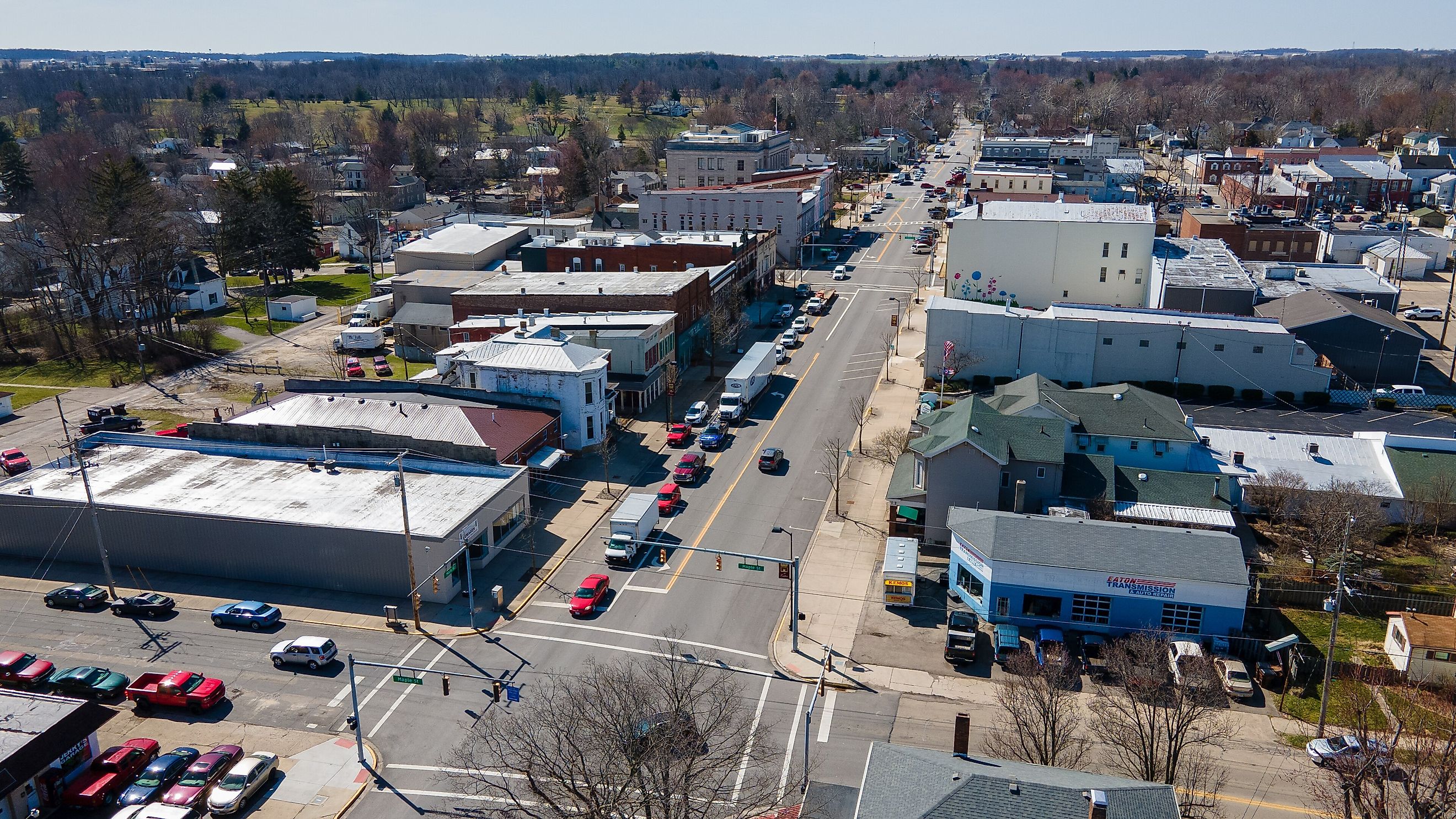
Eaton

Roberts Covered Bridge is the oldest covered bridge in Ohio and one of only six double-barreled spans left in the country, meaning it was built with two separate wagon lanes under one roof. Orlistus Roberts began it in 1829 and died before it was finished. His apprentice, James Campbell, completed the job. Arsonists nearly destroyed the bridge in August 1986, so the salvaged trusses were moved into town in 1990 and rebuilt beside Crystal Lake, where the walking paths and picnic grounds now sit a few steps from the portal.
A mile west, Fort St. Clair Park covers the ground where Kentucky militia camped in November 1792 and were attacked at dawn by warriors under Little Turtle. The earthworks are gone and the site is wooded parkland now, with a monument and a stone shelter. Eaton also holds Preble County's first winery. Olde Schoolhouse Vineyard and Winery occupies an original 1890s one-room brick schoolhouse, with the old pasture replanted as the vineyard and more than 20 wines made on site.
Urbana

Volunteers in a hangar at Grimes Field have spent two decades building a bomber. The Champaign Aviation Museum started in 2005 with three flatbed loads of B-17 wreckage and is assembling it into the Champaign Lady, a B-17G intended to fly again. The museum's B-25, the Champaign Gal, already carries passengers. Downtown, the Monument Square District holds the diners, boutiques and antique shops, and the Gloria Theatre stands a short walk south on Main.
The Gloria has a longer story than its marquee suggests. It opened as the Clifford in 1905 and burned in 1941. Manufacturer Warren Grimes rebuilt it that same year and reopened it on Christmas Day as the Gloria, named for his daughter. Volunteers brought it back as a working venue in 2015. South of town lies the strangest thing in Champaign County: Cedar Bog, which is not a bog at all but a fen, fed by cold groundwater rather than rain. Roughly 450 acres survive of an original 7,000, left behind by the last glaciers, and a mile of boardwalk crosses it. Showy lady's slipper orchids bloom in May and massasauga rattlesnakes live in the sedge. The National Natural Landmark keeps limited hours, so call before driving out.
Pomeroy

Pomeroy runs along a single long shelf of land between steep Appalachian hills and the Ohio River, and the terrain shaped everything about it. Ripley's Believe It or Not picked up the village twice, once for a street grid with no four-way intersection and once for the courthouse. Meigs County commissioners bought the plans for the Scioto County courthouse for $15 and built their copy between 1845 and 1848 for another $5,200, cutting it into the slope so that each of its three floors reaches ground level on its own. No exterior staircase was needed. In 1863, more than 200 of Morgan's Raiders captured at Buffington Island were held inside it.
Down at the water, the paved Pomeroy Levee works as the village's front porch, hosting the farmers' market and riverside concerts through the warm months. The Court Grill has been operating a block up at 112 Court Street since 1933. The kitchen turns out pizza and wings, the taps stay cold, and blues acts work the room most weekends.
Upper Sandusky

Plenty of people have seen this town without knowing it. Frank Darabont shot the opening courtroom scenes of The Shawshank Redemption in the third-floor courtroom of the Wyandot County Courthouse in 1994, and filled the gallery with Wyandot County residents. The building itself is worth the visit regardless: Yost and Packard designed it, it went up in 1899 and 1900 in Beaux-Arts Classicism, and a three-flight marble staircase climbs the foyer. A copper Lady Justice stands atop the dome, and the time capsule placed inside her during a 2009 restoration contains a copy of the film. The prison woodshop scenes were filmed a few blocks away at 226 South Eighth Street, now a small museum of props and costumes.
The town's older history is heavier. The Old Mission Church went up in 1824 and served the Wyandot congregation until 1843. That year the federal government forced the nation west to Kansas, the last removal of a Native people from Ohio. The county historical society keeps period rooms and Wyandot artifacts in a 19th-century mansion two blocks from the square. Harrison Smith Park spreads along the Sandusky River with shaded shelters and a pool. Dinner is Don Tomasso's Italian Kitchen on West Wyandot Avenue, chef-owned and running for about a decade.
Lithopolis

Mabel Wagnalls Jones was a concert pianist and novelist who lived on Long Island, and her parents were both born in a Fairfield County village of roughly 350 people. She built them a monument. Her father Adam had co-founded the publisher Funk and Wagnalls. Dedicated on May 30, 1925, the Wagnalls Memorial is a Tudor-Gothic complex of locally quarried stone that village workmen hauled to the site on horse-drawn skids. The auditorium seats about 300, and the wooden seats lift to reveal racks built for storing top hats. Two original Norman Rockwell paintings hang near the service desk, letters from Harry Houdini are displayed outside the auditorium, and Mabel's Steinway sits in the reading room.
The rest of the village fits in a few blocks around it. Das KaffeeHaus von Frau Burkhart roasts its own beans and turns out Bavarian pretzels in a room modeled on a German coffee house, an unexpected thing to find five minutes from a library castle. Wilson Park, on the opposite block, hosts outdoor concerts through the summer and maintains a shaded playground.
Wellington

Archibald Willard watched a parade cross the Wellington square and went home to paint The Spirit of '76, the most reproduced patriotic image in American art. That was around 1875. He is buried in Greenwood Cemetery here, and the museum named for the painting sits at 201 North Main in a brick warehouse built in 1870 to store cheese, back when the surrounding countryside supported some 40 cheese factories. The third floor was engineered to drain meltwater from the ice used for cooling. It now holds part of a collection running past 4,000 artifacts, and the museum keeps weekend hours from April through October.
Fort's Old Town Tavern occupies a 19th-century storefront around the corner on West Herrick, where the hand-built mahogany bar and the fireplace do most of the decorating. For open ground, the Wellington Reservation covers 541 acres of grassland and wetland on the south edge of the village. More than four miles of crushed stone and asphalt trail loop past an observation mound, and the 21-acre lake behind the South Reservoir takes kayaks and rental paddle boats between Memorial Day and Labor Day.
Cadiz

Clark Gable was born in Cadiz on February 1, 1901, and the town has never let go of it. The Clark Gable Foundation reconstructed the birthplace house and opened it as a museum in 2001, furnished in period style, with his boyhood sled inside and his 1954 Cadillac in the garage. The other Cadiz story is underground. Coal made Harrison County in the 20th century and then left it. The History of Coal Museum keeps the record from the lower level of the Puskarich Public Library. Mining tools, lamps and photographs of strip operations fill the room, and a 99-seat theater runs films on the industry. Admission is free.
Christopher's Farm Goods and Provisions, a few doors along the same street, cooks to order and sells produce from nearby farms out of a cooler by the counter. South of town, Sally Buffalo Park is the municipal centerpiece. Fishing lakes, wooded trails, campsites and cabins take up most of it, and a stage fills with local bands over the summer. Sally Buffalo Days takes over the whole park at the end of September.
Hillsboro

On the morning of December 25, 1873, somewhere between 75 and 115 women walked out of the Presbyterian church in Hillsboro and into the town's drugstores and saloons, where they sang hymns and prayed until the sellers gave up. Eliza Jane Trimble Thompson led them. She was the daughter of Governor Allen Trimble and the wife of a local judge, and the campaign she started spread to more than a hundred Ohio towns within months. The Woman's Christian Temperance Union traces its origins to it. The Highland House Museum, in an 1840s Federal brick house on East Main, keeps the crusade exhibits along with handmade textiles and early kitchens.
Locals call the center of town uptown, because every street climbs toward the courthouse square, and one of the drugstores up there still has the tin ceiling installed in 1895. Hillsboro sits on the seam where the flat farmland of southwestern Ohio breaks into Appalachian hills, which is why the county's state parks pull so much of the traffic. The city keeps its own version on Diamond Drive. Liberty Park holds 18 holes of disc golf, a walking and biking trail and a dog park. At the back sits Harmony Lake, the city reservoir, open for fishing with an ODNR license.
Bluffton
Swiss Mennonites settled this corner of Allen County in the 1830s and 1840s, and the inheritance is still visible. The Swiss Community Historical Society opens its restored 1840s homestead for Swiss Day each June. Bluffton University, affiliated with Mennonite Church USA, gives the village of about 4,000 a college-town current through the school year. Shirley's Gourmet Popcorn Company anchors South Main, making small batches by hand in the store in dozens of sweet and savory flavors. The company's birthday weekend in June closes Main Street for games, with the proceeds going to reading programs.
A few storefronts down, World Goods Et Cetera runs on volunteers and sells fair-trade textiles, pottery, jewelry and home goods. The Bluffton University Nature Preserve covers 160 acres of hardwood forest, wetland and meadow just outside the built-up blocks, with crushed limestone paths and a swinging bridge over Riley Creek. Come in August and the Bluffton Ohio Historical Society runs History Day, a morning of displays and question-and-answer sessions with the families behind vanished local businesses, usually with free samples from an old bakery recipe.
Wauseon

Barney Oldfield was born in Wauseon in 1878 and became the first driver to cover a mile in a minute on a circular track, in 1903. Fulton County has not forgotten him. The Museum and Welcome Center of Fulton County opened in 2018 as a recreation of the county's first courthouse. Its permanent galleries tell the stories of the families who settled here, Oldfield included. The town's racing streak outlived him, too. Oakshade Raceway, a few minutes out of town, still runs dirt-track features on summer weekends, and the noise carries.
Reighard Park handles the daytime end of things, with a large wooden playground, sports courts, a disc golf course and picnic shelters. Out in the farm country south of town, where County Roads C and 19 meet, Knotty Vines Farm and Winery pours award-winning wines made on the property, with a covered patio that looks straight down the rows of the vineyard.
Caldwell

The whole village fits inside 0.89 square miles, which is why 1,691 residents can live at a density most Ohio farm towns never reach. Noble County was the last of Ohio's 88 counties to be created, in 1851, and Samuel Caldwell donated part of his farm for the new county seat in 1857. The courthouse that resulted is newer than the village: built in 1933 and 1934 of red brick manufactured at nearby Ava to hold down costs, it remains the largest building in Caldwell. Four murals inside include one of John Gray, widely held to be the last surviving veteran of the Revolutionary War. Another shows Lieutenant Commander Zachary Lansdowne. He was in command when the airship USS Shenandoah broke apart over Noble County in September 1925.
The old county jail and jailer's residence, an 1882 brick and stone building on the courthouse square, now serves as the Noble County Historical Society museum. Tours take in the cells, the family quarters and an exhibit on the Shenandoah crash. Sam's Pizzeria works the square with pies, wings and subs, and everything above is within a two-minute walk of everything else. For water, Caldwell Lake sits on the eastern edge of the village, and Wolf Run State Park lies three miles north with a 220-acre lake and a stretch of the Buckeye Trail.
Two Kinds Of Overlooked
Ohio’s overlooked towns reward travelers who take the next exit. Greenville preserves Annie Oakley’s story, Pomeroy pairs a cliffside courthouse with Ohio River views, and Lithopolis surprises visitors with the castle-like Wagnalls Memorial Library. From Wellington’s dairy heritage to Cadiz’s coal-mining history, these communities offer distinctive museums, parks, restaurants, and landmarks without the crowds. They may sit beyond the usual travel routes, but each gives visitors a specific reason to stop and explore.