The State Parks With Natural Springs You Can Swim In
State parks across the United States protect swimming holes fed by springs that discharge millions of gallons of water daily from deep underground aquifers. These outflows carve distinct pools that are often exceptionally clear and provide a reliable, natural swimming hole. For example, in Florida's Ichetucknee Springs State Park, a river is formed by waters flowing out of nine springs. Swimming areas along this river range from those meant for casual swimming to those with hidden dangers that only experienced swimmers can manage. In Idaho's Thousand Springs State Park, several springs feed water into the Snake River as it flows through the narrow canyon that can be accessed only through steep hiking trails or staircases.
These sites rely on specific geological thresholds to maintain their clarity and flow. This stability depends on the integrity of the recharge zones and the filtration capacity of the underlying rock layers, which must remain undisturbed to prevent sediment intrusion and preserve the constant discharge rates. Within this framework of protected geology, six state parks stand out for offering direct access to swim amidst these natural and protected landscapes.
Balmorhea State Park, Texas

In the arid expanse of West Texas, a 1.3-acre pool holds 3.5 million gallons of water bubbling up from the San Solomon Springs at a steady rate of 15 million gallons per day. This thermal oasis maintains a temperature between 72 and 76 degrees Fahrenheit, creating a swimming environment that defies the surrounding desert climate.

The pool reaches depths of 25 feet in its central circular section, allowing scuba divers to descend toward the submerged spring vents where the water originates. Two rectangular arms extend from the main basin, tapering to depths of three to five feet for wading. The water's clarity reveals the sandy bottom and the constant upward motion of the spring flow, a visual signature distinct from stagnant ponds or river-fed lakes. Visitation peaks during summer months, and capacity limits often require visitors to check reservation availability to preserve water quality.
Ichetucknee Springs State Park, Florida

Nine distinct springs merge to form a six-mile river that maintains a constant 72-degree temperature throughout the year, creating Florida's premier "natural lazy river." To reach the site, visitors walk along a 0.5-mile shaded path to reach Blue Hole Spring. Designated zones for swimming at Head Spring and the deeper Blue Hole offer contrasting experiences within the same hydrological system. Head Spring provides a shallow, sandy-bottomed pool ideal for casual swimming, while Blue Hole is a deep, first-magnitude vent where the upward boil pushes back against swimmers and cave diving requires certification.

The water's visibility often surpasses 60 feet, revealing the aquatic vegetation and sandy riverbed without the turbidity common in surface-runoff rivers. To manage the high volume of visitors, the park separates swimmers from tubers in designated lanes, ensuring safety amidst the recreational traffic.
A hardwood hammock canopy shades the river, reducing solar heating and preserving the water's cool temperature even during humid summer afternoons. Access points remain limited to specific trails, buffering the surrounding ecosystem from excessive foot traffic.
Johnson's Shut-Ins State Park, Missouri

The East Fork of the Black River carves through 1.5-billion-year-old igneous rock, creating natural flumes and pools that function as a geological water park. Here, the river forces itself through narrow chutes of rhyolite and diabase, smoothing the volcanic rock into surfaces that resemble manufactured slides.
The water depth fluctuates with seasonal rainfall and upstream dam releases, creating a dynamic environment where swimmers navigate between rock walls that channel the current into gentle eddies or rapid shoots.

Scour holes, carved by millennia of water flow, drop suddenly into deep pools beneath the surface, requiring visitors to test depths before entering. The surrounding terrain consists of rugged St. Francois Mountains, and access to the swimming areas requires hiking over uneven rock, a physical barrier that limits crowd density compared to roadside attractions. The acoustic environment is dominated by the sound of rushing water rather than human activity, a direct result of the park's topography.
Edward Ball Wakulla Springs State Park, Florida

One of the largest and deepest freshwater springs on the planet anchors this park, with a main vent plunging approximately 185 feet into the earth. The discharge rate of 400,000 gallons per minute from the aquifer creates a sapphire-colored basin visible from the surface, maintaining a steady 69 to 70 degrees Fahrenheit.
Swimming is permitted in a designated area near the spring run, where the depth presents a unique visual phenomenon; swimmers float over an abyss that disappears into darkness. Manatees and alligators inhabit the deeper, off-limits sections of the spring run, utilizing the thermal stability of the water during colder months. This coexistence requires strict adherence to park boundaries to ensure safety for both humans and wildlife.

The sheer volume of water flow prevents stagnation, maintaining a level of purity that supports a dense population of aquatic life visible to snorkelers near the surface. Lodge operations and boat tours run alongside the swimming area, offering views of the spring from above the waterline.
Thousand Springs State Park, Idaho

A series of massive springs erupts from the base of the Snake River Canyon within Thousand Springs State Park, discharging hundreds of millions of gallons per day from the Eastern Snake Plain Aquifer. The water, maintaining a constant 58 degrees Fahrenheit year-round, flows from fissures in the basalt cliff face directly into the Snake River, creating distinct turquoise pools at the canyon floor.
Accessing these swimming holes requires a descent into the canyon; visitors must navigate steep trails or staircases from the rim parking areas down to the river level, a drop of several hundred feet that isolates the springs from the highway above. The clarity of the water is exceptional, allowing visibility of the submerged basalt formations and the aquatic vegetation that thrives in the cool, oxygen-rich flow. Unlike surface ponds, these springs are fed by groundwater that has filtered through miles of volcanic rock, ensuring a purity that remains unaffected by surface runoff. The park's units include Ritter Island, Niagara Springs, and Box Canyon, whose spring discharges at a rate of about 180,000 gallons per minute, ranking it among the largest springs in the country.

The park manages several distinct units where boardwalks and designated swimming areas provide entry points into the cold, fast-moving discharge, while other units restrict access to viewing only. The surrounding canyon walls, composed of layered basalt flows, create a microclimate that supports riparian vegetation distinct from the arid sagebrush steppe above.
Ponce De Leon Springs State Park, Florida

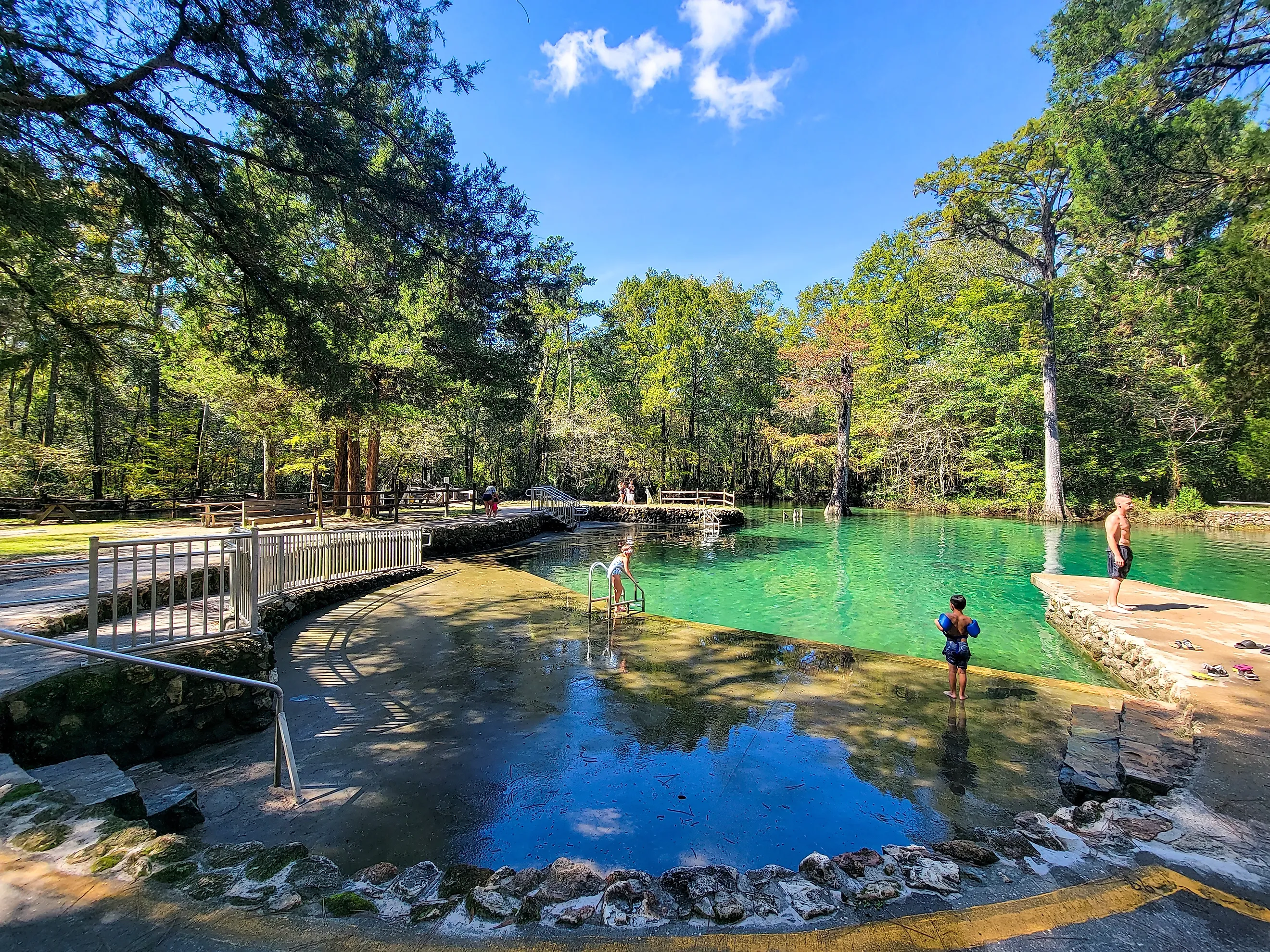
A circular pool with direct visibility into an underwater cave entrance captures the discharge of 14 million gallons of water daily from a main vent in the Florida Panhandle. The spring head maintains a constant temperature of about 68 degrees Fahrenheit, cooling the air in the immediate vicinity.
The swimming area consists of a sand-lined basin where depths average three feet across the majority of the surface, dropping sharply to about 25 feet near the submerged vent openings, where two underground flows converge. These openings, visible through the crystal-clear water, create a complex underwater topography that attracts snorkelers, though diving is prohibited due to the unknown extent of the cave systems. Access to the water is immediate; a boardwalk loops around the spring head, separating visitors from the fragile shoreline vegetation while providing viewing platforms over the deepest sections, eliminating the need for a hike.

The water flows out of the pool into a short, unnamed run that quickly joins the surrounding wetlands before feeding into the Choctawhatchee River system, creating a calm surface ideal for wading and leisure swimming without the strong currents found in larger spring-fed rivers. Infrastructure includes a concession stand and rental facilities for kayaks and canoes, allowing visitors to paddle the adjacent waterways after swimming in the main pool. The park operates on a standard day-use fee structure, with no reservation required for swimming, though parking capacity often reaches limits during summer weekends.
Ancient Rock, Constant Water
The 25-foot pool at Balmorhea and the 185-foot vent at Wakulla mark the range of these swimming holes, yet every site depends on the same conditions: constant temperature, high flow rates, and filtration through ancient rock. Fees and reservation policies vary by state and change frequently, making it essential to check the specific agency website before travel. Safety in these environments depends on respecting natural hazards inherent in spring systems, including sudden depth changes and wildlife presence. Through these state parks, swimmers reach the same hydrological wonders found in protected federal lands, often with far greater accessibility and proximity.