The State Parks Protecting The Last Of A Habitat
A small selection of state parks across the country protect remnants of habitats and populations that logging, development, pollution, or disease have almost entirely erased. A canyon herd in the Texas Panhandle carries genetic markers distinct from every other bison population on the continent. A tract of land in Michigan protects the last remaining old-growth beech-maple forest in the state.
Grassroots and wildlife agency conservation efforts have kept these habitat and population fragments intact. Due to these efforts, visitors can now experience these remnant ecosystems in five state parks.
Torreya State Park, Florida

Steep limestone bluffs along the Apalachicola River hold the only wild population of the Florida torreya (Torreya taxifolia) left on Earth. An estimated 600,000 of these conifers grew in the river valley during the early 1800s, and were prized for fence posts, shingles, and riverboat fuel.
A fungal blight swept through the population in the late 1950s. Within a decade, almost no mature adults remained and the species never recovered. The Florida Park Service now puts the wild survivors at roughly 200 trees, confined to an approximately 40-mile stretch of ravines in Gadsden and Liberty Counties.
The Florida Park Service now works with the Atlanta Botanical Garden to grow seedlings from the surviving trees and replant them directly into the ravine habitat. This effort has produced 26 wild trees between 2020 and 2024.
Rock Bluff, exposed by the river's erosion within the park, remains one of the few places to see the species rooted in its native ground rather than in a botanical collection.
Warren Woods State Park, Michigan
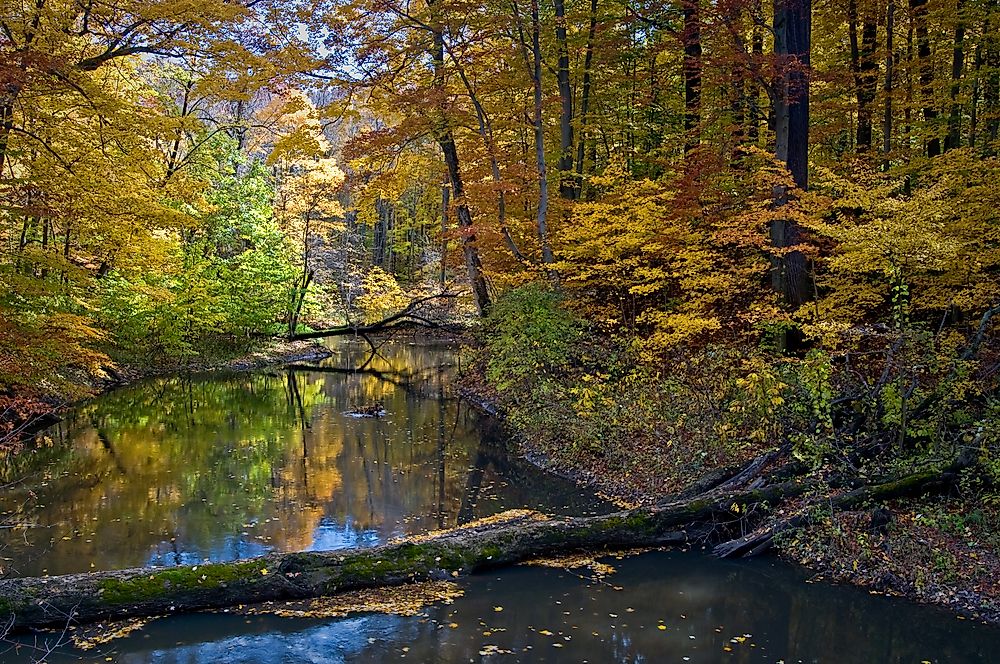
Edward Kirk Warren began buying parcels of Michigan's last climax beech-maple forest in 1879 after he realized that the surrounding stands of virgin beech and sugar maple were disappearing under the axe across the rest of the state. Today, about 200 of the park's 311 acres remain uncut old growth, with beech and maple specimens reaching 125 feet in height and trunks more than five feet in diameter.
Sunlight filters through a canopy that has developed without interruption for centuries, a condition foresters call a climax community because the forest has reached ecological stability and no longer shifts toward a different dominant species.
The National Park Service designated the tract a National Natural Landmark in 1967, and it is still widely described as the last known stand of its type in the state. A short trail crosses the Galien River on a pedestrian bridge, where visitors can immerse themselves in this remnant ecosystem.
Big Oak Tree State Park, Missouri

Nickels and dimes from school children helped save the only sizable uncut remnant of the floodplain forest that once covered Missouri's Bootheel.
A single bur oak, nearly 400 years old, drew statewide attention in the 1930s when the Mississippi Valley Hardwood Company prepared to log the surrounding tract. In response, members of the public, including children, raised enough money during the Great Depression to purchase a 920-acre buffer around the 80-acre core.
The National Park Service now describes that 80-acre core as the only sizable tract of essentially virgin wet-mesic bottomland habitat remaining from a forest that once spanned millions of acres across Missouri. Farmers draining the area for row crops almost wiped out that entire ecosystem.
Canopy trees average 120 feet tall, with several topping 140 feet, and the Missouri Department of Conservation counts one national and two state champion trees among species including pumpkin ash, overcup oak, and persimmon.
A boardwalk guides visitors down through a three-foot change in elevation that shifts the forest from oak and hickory into bottomland and bald cypress swamp. This ecosystem is now the only one of its kind within the Missouri state park system.
Caprock Canyons State Park, Texas

The last, purebred descendants of the Southern Plains subspecies of bison graze the canyon country of Caprock Canyons State Park and are the last remaining population of their kind.
Genetic testing in 1996, before the Texas Parks and Wildlife Department took the herd in, revealed markers found in no other bison population in North America. This confirmed that the animals were not hybridized cattle-bison crosses common elsewhere, but purebred descendants of the Southern Plains subspecies.
Fewer than 1,000 bison remained across the continent by 1888, down from tens of millions after European settlers slaughtered them en masse. The herd in Caprock Canyons stands as one of only five foundation herds that supplied breeding stock to every subsequent conservation effort.
These purebred bison are the official Texas State Bison Herd, and they are the direct descendants of orphaned bison calves that Mary Ann Goodnight convinced her rancher husband, Charles Goodnight, to capture and save during a massive commercial hunting slaughter in 1878.
The calves were raised on the Goodnights' ranch in Texas, growing to a herd of over 200 animals at their height. The herd was donated to the state and moved to Caprock Canyons in 1997 to roam a portion of their native range.
Illinois Beach State Park, Illinois

Six and a half miles of Lake Michigan shoreline inside Illinois Beach State Park make up the only natural beach ridge and dune and swale complex remaining in Illinois.
Waukegan Harbor and North Point Marina interrupted the sand supply that once fed the entire shoreline south toward Chicago. Their operations eroded nearly every other stretch of the state's 63 miles of lake frontage, leaving this 4,160-acre park as the sole surviving example of the landform.
Thousands of years of dropping lake levels built the parallel ridges and low, wet swales that give the habitat its name. This habitat created conditions suitable for more than 650 recorded plant species, including the prickly pear cactus growing at a latitude where few would expect to find it.
The South Unit's nature preserve earned National Natural Landmark status in 1980. Rising lake levels since 2014 stripped away large sections of beach entirely, prompting a breakwater restoration project intended to hold the shoreline in place for the piping plovers now nesting there again.
Remnant Ecosystems in U.S. State Parks
These five parks protect habitats and populations that remain fragile and in need of consistent monitoring and quick intervention. In remnant populations, even small condition changes can threaten collapse.
Wildlife and park agencies must manage that risk year to year, through sustainable forestry, breeding and seedling propagation programs, and habitat conservation or restoration.
However fragile, each of these populations has already outlasted the era that nearly erased them. Torreya cuttings raised in cultivation now produce cones of their own. Caprock's bison herd, once down to a few dozen animals, now numbers in the hundreds. What often began as efforts from community members has held long enough to turn into official protection.