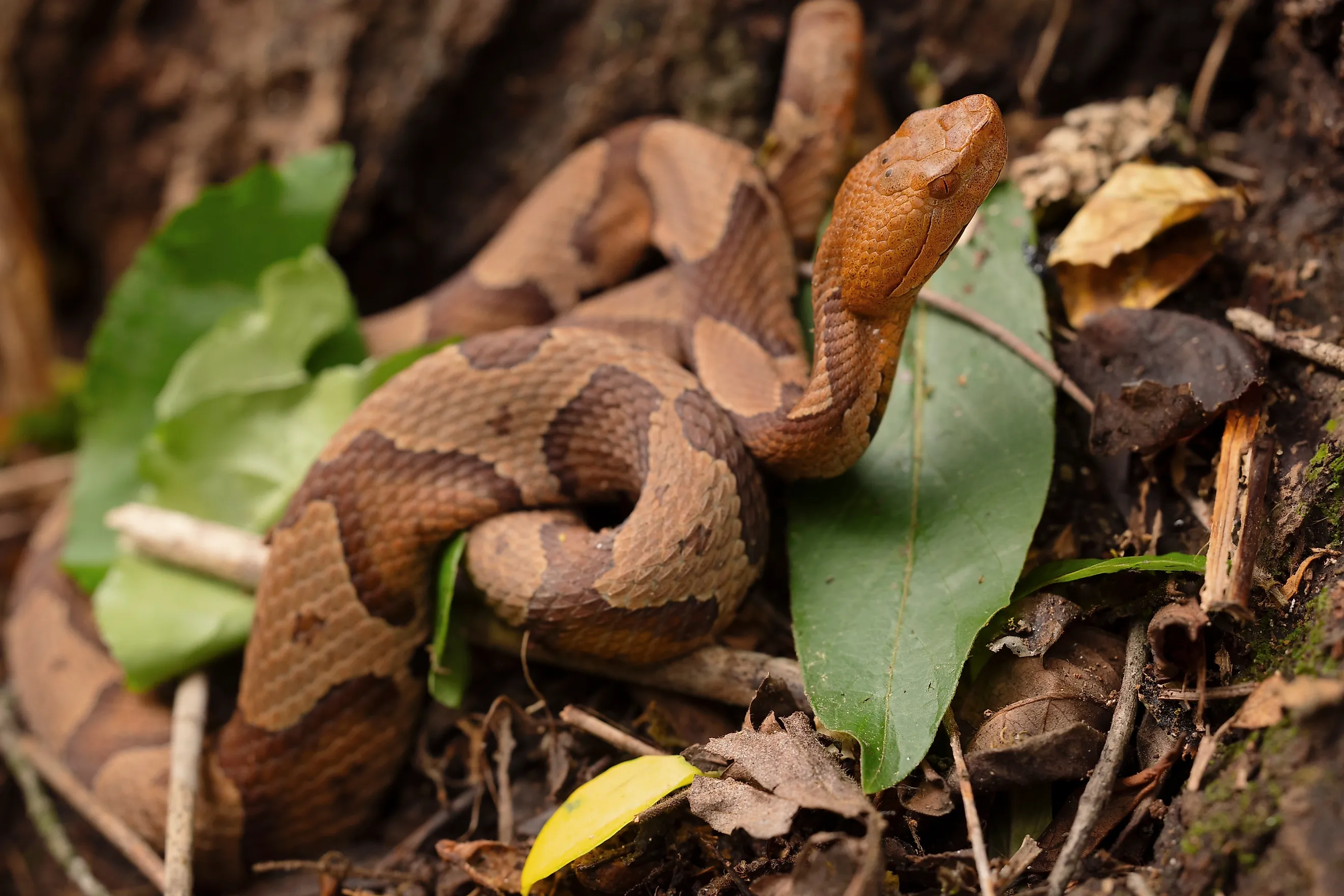
Why Copperheads Den In Compost Piles
A compost pile is the only structure in a garden that manufactures its own heat. Microbial decomposition drives the core of an active pile to between 130 and 160 degrees Fahrenheit, which is not warmth borrowed from the sun or a building but heat generated on site, continuously, from the inside. That would be ideal for a copperhead except for one problem. At those temperatures it would cook. The piles that actually become dens are the ones nobody has touched in a year.
An Active Pile Would Kill Them

Start with the number that rules out the obvious assumption. A properly built hot pile reaches 130 to 160 degrees Fahrenheit within days, which is the range the EPA identifies for thermophilic activity. It is hot enough to kill weed seeds, plant pathogens, insect eggs and fly larvae.
Snakes function between roughly 68 and 95 degrees and die of overheating faster than of cold. A copperhead entering the core of a working compost pile would not come out.
Most Piles Are Not Hot

The distinction that makes this work is between managed composting and what most people actually have.
Hot composting is an actively managed process requiring volume, balanced inputs, moisture and repeated turning. A pile left alone decomposes at ambient temperature over months to years, which is called cold composting, and it never reaches those numbers.
The neglected heap at the end of the garden is the den. The carefully turned bin is not.
The Curing Phase Is The Sweet Spot
Even a pile that did heat properly passes through a stage that suits a copperhead very well indeed.
Once the easy material is consumed, temperatures fall into a months-long curing phase at around 80 to 110 degrees. The pile is finished when readings hover around 70 to 90 and no longer rise after turning.
Seventy to ninety is squarely inside a copperhead's functional range. A pile at that temperature in November is warmer than the ground around it and will stay that way for weeks.
The Gradient Is The Real Attraction

Heat alone would be useful. A range of temperatures inside one structure is better. Any pile has a hot center and cooler margins, with the difference increasing the larger it is. An ectotherm can therefore thermoregulate by moving a few inches rather than by traveling between sun and shade.
That is the same reason copperheads use rock piles and riprap, except a compost heap generates the gradient itself rather than borrowing it from the afternoon.
It Solves The Moisture Problem

Compost needs to stay damp to work, which happens to solve the thing that kills brumating snakes in dry dens.
Snakes choosing a hibernaculum that is too dry risk dehydration, and prolonged exposure to dry conditions can be fatal. Stone walls fail on exactly this point, being effectively deserts.
A pile holding enough moisture for microbial activity holds more than enough for a snake. It is warm, damp and loose all at once, which very little in nature manages.
Then There Are The Rodents

The food supply arrives with the structure, and compost guidance is explicit about why.
Composting advice warns against adding meat, dairy or cooked food precisely because those are the primary attractants for rodents and raccoons, and notes that only a properly hot pile above 130 degrees is inhospitable to pests.
Which means a cold pile is a rodent habitat by definition. Warm, damp, full of food scraps and easy to tunnel through is a description of ideal mouse accommodation.
Loose Material Beats Solid Cover

The physical structure of a pile offers something a slab or a wall cannot. Leaves, clippings, straw and part-decayed material form an endless network of interconnected voids that a snake can move through in any direction. There is no fixed entrance to find and no single crevice to compete for.
Copperheads use old sawdust piles and slab piles for the same reason, which North Carolina's wildlife agency lists among the reliable places to find them.
Depth Is Still The Weakness

For all its advantages, a compost heap has the same limitation as a stone wall.
A hibernaculum needs to sit below the frost line and stay above freezing through the whole winter. A pile sitting on the ground surface does neither once the heat generation stops, and in a hard northern winter it will freeze through.
Which makes compost a far better autumn staging post and shoulder-season refuge than a true overwintering site, except in the southern part of the range where frost depth is negligible.
Turning It Is The Fix And The Hazard

The management advice and the safety advice point the same way, which is convenient.
A pile turned regularly stays hot, denies rodents a home and never becomes a refuge. A pile left for a season becomes exactly the structure described above.
The hazard is in the turning itself. Driving a fork into an undisturbed heap in October, in copperhead country, is reaching blind into cover with a sharp implement, which is the one method of handling a venomous snake nobody recommends. Gloves, boots and a look first.
The Short Version

Copperheads use compost piles because a neglected heap offers a temperature gradient it generates itself, enough moisture to prevent dehydration, loose material to move through in any direction, and a resident rodent population drawn by the same conditions. Nothing else in a garden does all four.
What it cannot reliably do is get them through a northern winter, because it sits on the surface and freezes. And the version that would be warmest, a properly managed hot pile at 130 degrees and above, is the one arrangement that would kill the snake outright.