The Tallest Structures Ever Built In America
One World Trade Center rises 1,776 feet above Lower Manhattan, a height chosen for the year the Declaration of Independence was adopted, and no building in America has ever stood taller. Nine more clear 1,380 feet, measured from ground to peak with rooftop spires and antennas counted in. Manhattan and Chicago hold every one of them, but not all are still standing. Offices, hotels, and apartments among the most expensive ever built all appear, held up by bundled steel tubes, X-braced exoskeletons, and concrete cores poured thick enough to stop a bomb. These structures trace how far American builders have pushed the upper limit.
One World Trade Center, New York

Called a supertall building, One World Trade Center is the main structure of the rebuilt World Trade Center complex. It is located in Lower Manhattan, New York City, and became the tallest building in the country on April 30, 2012. David Childs of Skidmore, Owings and Merrill designed the tower, working from the site master plan that Daniel Libeskind won the competition to produce. That plan includes memorial gardens commemorating the two towers that once stood on the same site, and it set the symbolic height the finished building kept.
The overall height of the tower is 1,776 feet (541 meters), a nod to the year the Declaration of Independence was adopted. Also known as the Freedom Tower, the structure features three observation deck levels and communication platform rings that make up the spire along with the 408-foot (124-meter) mast. The spire gives the tower the extra edge it needs to be the tallest building in the Western Hemisphere, and at its core, concrete reinforces its strength. The base is fortified, with 28-inch (71-centimeter) concrete walls that protect the lobby.
The center is open to the public, including the observatory and the 9/11 Memorial and Museum. The Oculus is a major draw, with several access points and a design that is reminiscent of a hand releasing a dove. Every year on September 11, a skylight allows the rays of the sun to illuminate the "Wedge of Light" and project two columns of light. The rays hit between 8:46 am, when the first plane crashed into the North Tower, and 10:28 am, when the tower came down.
Willis Tower, Chicago

Chicago's Willis Tower was completed in 1974 and was first known as the Sears Tower. At a main roof height of 1,451 feet (442 meters) and broadcast antenna masts that extend the overall height to 1,729 feet (527 meters), the Willis Tower is the second-tallest building in America. It is occupied up to a height of 1,354 feet (412.5 meters). Before the construction of One World Trade Center, it was the tallest building in the country for many decades.
It was built for office occupancy and other types of tenants, using the bundled method. The basic design features nine 75-foot-by-75-foot tubes at the building's base. The tubes rest on concrete caissons, which in turn sit firmly in bedrock. The building's frame came pre-assembled in sections and was put in place part by part. The Skydeck observation deck occupies the 103rd floor, where the Ledge glass balconies were added in 2009 and extensively renovated in 2021. The observation deck, which is also the tallest in the country, has glass balconies that can each support up to 10,000 pounds.
1 World Trade Center (North Tower), New York

The original North Tower of the World Trade Center complex was 1,368 feet (417 meters) tall, with its broadcast antennas adding a further 360 feet. With its combined height of 1,728 feet (526.5 meters), it would have been very close to a tie with the Willis Tower today. The North Tower and South Tower featured express and local elevators. The express elevators could hold up to 55 people each. It took more than 425,000 cubic yards of concrete to build the original complex, including the towers.
The North Tower was completed in December 1970 and the South Tower in July 1971. The South Tower was 1,362 feet (415.1 meters) tall and did not have an antenna array. The entire Trade Center sat on a landfill, so to stabilize it, the foundations went into bedrock as far as 70 feet below street level. After 9/11, it took eight months and 19 days to clean up the site.
Central Park Tower, New York

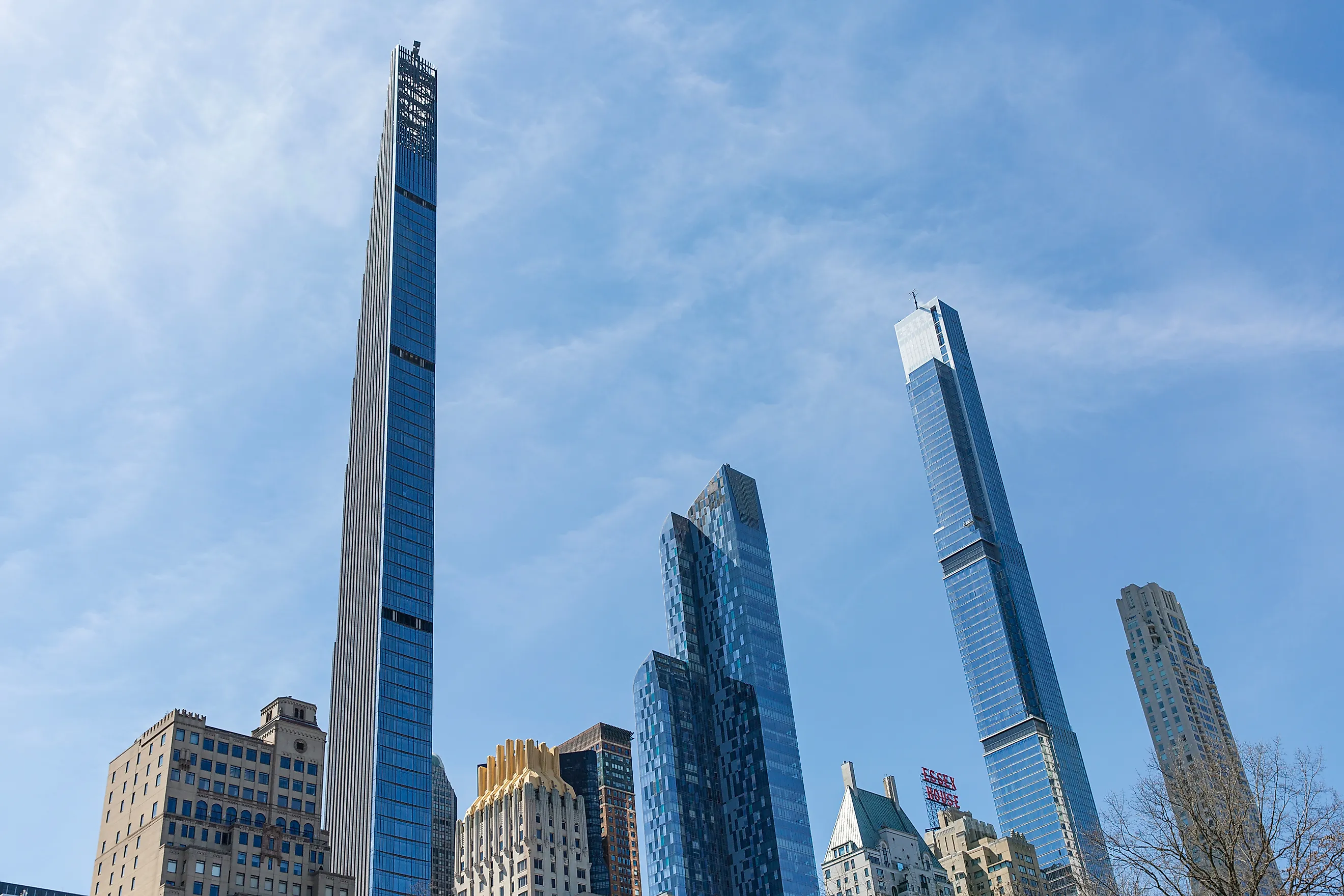
If it were not for the antennas on Willis Tower and the original 1 World Trade Center, Central Park Tower would have surpassed them in height. As it stands, Central Park Tower is 1,550 feet (472 meters) tall. An original design proposal included a spire that would have increased the building's height, but it was ultimately canceled. The spire would have added 227 feet (69 meters), bringing the total height to 1,777 feet (541.6 meters). Had the spire been added, the structure would have been a single foot taller than One World Trade Center.
Today, Central Park Tower is the tallest residential building in the world, built after 10 years of planning. The lobby features a 2,000-piece crystal chandelier, and the residences are opulent with exceptional views over Central Park, the Hudson River, and the East River.
John Hancock Center, Chicago

The John Hancock Center, at 875 North Michigan Avenue in Chicago, is a pitch-black steel skyscraper completed in 1970. Its color makes it instantly recognizable, as does its height of 100 stories. Including its two antennas, the building is 1,500 feet (457.2 meters) tall, and by roof height it ranks fourth in the city. Its external bracing forms an X, eliminating the need for interior support columns.
It took five million hours to complete the project and enough steel to produce 33,000 cars. The structure incorporates 1,250 miles of electrical wiring, enough to supply up to 30,000 people, and its caissons have been drilled into bedrock 190 feet deep. In 2014, the 94th-floor observatory deck was renamed the 360 Chicago Observation Deck, and the TILT attraction was installed. TILT is a platform constructed of glass and steel that rotates eight people at a time outward at a 30-degree angle over Michigan Avenue.
Empire State Building, New York

The Empire State Building is also known as the "World's Most Famous Building." It is the fourth-tallest building in New York City and the sixth-tallest in the country. Including its spire and antenna, this art-deco structure is 1,454 feet (443 meters) tall. The building features 103 floors and 1,860 steps. Construction started in 1930 and was completed in just 13 months.
Today, it is not only one of the most famous building on Earth, but also the most photographed. The main observatory on the 102nd floor is reached by a glass elevator from the 86th floor. There are floor-to-ceiling glass panels in the observatory offering 360-degree views. The Empire State Building hosts 2.5 million-plus visitors every year, including those who try to photograph one of the 25-plus lightning strikes that hit the building each year.
Steinway Tower, New York

111 West 57th Street, better known as the Steinway Tower, is another supertall residential structure in New York City. It is also the slimmest skyscraper on the planet. It was originally designed for a piano company and contained piano showrooms and a recital hall. Its limestone facade and interior were designated as city landmarks in 2001 and 2013. The building's total height is 1,428 feet (435 meters), and it features 91 stories and contains 46 residences.
The interior comprises limestone, steel, velvet, oak, and marble, which harks back to the Gilded Age in New York. Residents can also enjoy an 82-foot indoor swimming pool lined with miniature palms. The building stands just two minutes away from Central Park Tower and resembles a feathered shape at the top. Its height-to-width ratio is 24:1, with its original footprint being smaller than a basketball court. A tuned mass damper concealed at the top of the tower counters the wind that would otherwise sway a building this slender. The terracotta pilasters on the facade are decorative.
One Vanderbilt, New York

One Vanderbilt is also located in New York, and its SUMMIT One attraction opened to the public in 2021. It is the fifth-tallest structure in the city, at 1,401 feet (427 meters). The building features angled cuts at the base, which also reveal the Vanderbilt section of the Grand Central Terminal's cornice. The exterior and the lobby ceiling feature terracotta, while the core walls sport bronze flutes.
In addition to connecting to the terminal, the building also links to a pedestrian plaza on Vanderbilt Avenue. The SUMMIT One attraction draws thousands of people every year, with the main observation areas located between 1,020 feet (310.9 meters) and 1,063 feet (324 meters) above street level. It features two glass skyboxes that protrude from the building and a terrace that wraps around it. From the terrace, the views extend up to 80 miles (128.7 kilometers).
More Supertall Structures

Two more supertall towers clear 1,380 feet. 432 Park Avenue Condominiums forms part of Billionaires' Row, and Trump International Hotel and Tower stands in Chicago. 432 Park Avenue is a residential building in New York that is 1,396 feet (425.5 meters) tall. It contains 104 luxury residences and features 110-square-foot (10-square-meter) windows around a concrete frame.
Trump International is situated in Chicago and is 1,388 feet (423 meters) tall, including the spire. At the time of its completion, it was the tallest residential building in Chicago. It sits on the north bank of the Chicago River and features a modern steel-and-glass facade.
Two Cities Hold Almost All Of It
America’s tallest buildings are concentrated almost entirely in New York City and Chicago, with few towers elsewhere reaching the same heights. Their designs show how architects and engineers kept pushing higher through stronger structural systems, lighter materials, and increasingly complex construction. New skyscrapers may eventually surpass them, but they will rise from the same line of experimentation that turned once-impossible heights into part of the modern skyline.