The Most Famous Structures in the World
From the 4,600-year-old Great Pyramid of Giza to the Sydney Opera House completed in 1973, the structures below span almost the entire history of large-scale human construction. Each is recognizable from a single silhouette, each is identified with a specific city or country, and each has accumulated a layer of cultural meaning that goes well beyond the original purpose of its construction. The eleven covered here include royal mausoleums, religious centers, imperial palaces, an Inca mountain citadel, the seat of the American presidency, an Australian performing arts complex, and the late-19th-century industrial symbol of Paris. They are arranged below in chronological order of completion, from the Old Kingdom Egyptian pyramid age through to the late 20th century.
Great Pyramid of Giza

The Great Pyramid of Giza, also called the Pyramid of Khufu (or, in Greek sources, the Pyramid of Cheops), was built as the tomb of the fourth-dynasty Egyptian pharaoh Khufu, who reigned approximately 2589 to 2566 BC. Construction is generally dated to the period 2580-2560 BC and is estimated to have taken about 20 years using a workforce of skilled craftsmen, conscripted laborers, and farmers working in seasonal rotations. The pyramid originally stood 481 feet (147 meters) tall and held the record as the tallest human-made structure on Earth for over 3,800 years, until the central spire of Lincoln Cathedral in England was completed in 1311. The original limestone casing that gave the pyramid its smooth white outer surface has been almost entirely removed over the centuries, exposing the rougher inner masonry. It is the oldest of the Seven Wonders of the Ancient World and the only one still substantially intact.
Petra

Petra is an archaeological site in southern Jordan, carved into red sandstone cliffs in a mountain basin near the modern town of Wadi Musa. The Nabataeans, an Arab people who controlled the regional incense and spice trade, established Petra as their capital around the 4th century BC and built it into a city of perhaps 20,000 to 30,000 inhabitants at its peak. The most famous single structure at Petra is Al-Khazneh ("the Treasury"), a façade carved into the cliff face in the early 1st century AD and most likely built as the mausoleum of the Nabataean king Aretas IV, who reigned from 9 BC to 40 AD. Petra was annexed by the Roman Empire in 106 AD, declined after the Byzantine period as overland trade routes shifted, and was largely abandoned by the early Islamic period. The site was rediscovered by Swiss explorer Johann Ludwig Burckhardt in 1812, and was listed by UNESCO as a World Heritage Site in 1985.
Colosseum

The Colosseum in Rome, also known as the Flavian Amphitheatre, was begun under the emperor Vespasian in 72 AD and completed under his son Titus in 80 AD; further modifications were added by Domitian, who ruled from 81 to 96 AD. The structure was built from brick-faced concrete, volcanic tufa, and travertine limestone, with a capacity estimated at between 50,000 and 80,000 spectators across its tiered seating. It was used for gladiatorial combats, public executions, animal hunts, mock naval battles, and theatrical reenactments of mythological events. Significant portions of the outer wall collapsed in major earthquakes in 443 AD and 1349, and large quantities of the original stone were quarried by builders during the medieval and early modern periods for use in other Roman structures, including St. Peter's Basilica. The Colosseum remains the largest standing amphitheatre in the world and is one of Rome's most-visited monuments, drawing over 7 million visitors annually before the pandemic.
Forbidden City

The Forbidden City in central Beijing was the imperial palace of China from the Ming through the Qing dynasties, used continuously by 24 emperors from the Yongle Emperor of Ming (who began construction in 1406) to the abdication of the Xuantong Emperor (Puyi) at the end of the Qing dynasty in 1912. The main construction took 14 years, from 1406 to 1420, and used an estimated million workers including 100,000 skilled craftsmen. The complex covers 72 hectares (about 180 acres) and contains 980 surviving buildings arranged around courtyards and a north-south axis aligned with the Beijing meridian. The complex was renamed the Palace Museum in 1925, became a major tourist site after the founding of the People's Republic of China, and was listed by UNESCO as a World Heritage Site in 1987. The Forbidden City typically receives over 19 million visitors annually, making it among the most-visited museums in the world.
Machu Picchu

Machu Picchu sits on a mountain ridge at 7,970 feet (2,430 meters) above sea level in the Cusco region of southern Peru, about 50 miles northwest of the city of Cusco. The Inca citadel was built around 1450, most likely as a royal estate of the Inca emperor Pachacuti, and was occupied for only about a century before being abandoned around the time of the Spanish conquest of the Inca Empire in the 1530s. The Spanish never found Machu Picchu, and the site remained known only to local Quechua-speaking communities until American historian Hiram Bingham was led to the site in July 1911. Machu Picchu was declared a Peruvian historic sanctuary in 1981, listed by UNESCO as a World Heritage Site in 1983, and selected as one of the New 7 Wonders of the World in a 2007 public vote. Peru caps daily visitor numbers at around 4,500 in an effort to preserve the masonry, which uses precisely fitted stone joints with no mortar.
Saint Basil's Cathedral

Saint Basil's Cathedral, formally the Cathedral of the Intercession of the Most Holy Theotokos on the Moat, was built between 1555 and 1561 at the order of Tsar Ivan IV (Ivan the Terrible) to commemorate the capture of the Khanate of Kazan in 1552 and the Khanate of Astrakhan in 1556. The cathedral stands at the southern end of Red Square in Moscow and was the tallest building in the city until the Ivan the Great Bell Tower in the Kremlin was raised to its current height in 1600 under Boris Godunov. The structure consists of a central tower surrounded by eight smaller chapels arranged in a symmetrical eight-pointed star pattern, each topped with a distinctive onion dome. The famous polychrome paint scheme was a later addition: the cathedral was originally white with gold-leaf domes, and the bright colors were added across the 17th and 18th centuries. Saint Basil's was secularized and turned into a state museum under the Soviet government in 1928 and has been jointly administered by the State Historical Museum and the Russian Orthodox Church since 1991.
Taj Mahal

The Taj Mahal stands on the southern bank of the Yamuna River in Agra, India, and was commissioned in 1632 by the Mughal emperor Shah Jahan as a mausoleum for his third wife, Mumtaz Mahal, who died in childbirth in 1631. The mausoleum building was completed around 1648 and the surrounding complex (the mosque, guest house, and Charbagh gardens) by approximately 1653, with an estimated 20,000 craftsmen and artisans drawn from across India and Central Asia working on the project. The structure is built from white Makrana marble inlaid with semi-precious stones in floral patterns (a technique called pietra dura), and the complex covers about 17 hectares (42 acres) on three terraced platforms. Shah Jahan was deposed by his son Aurangzeb in 1658 and imprisoned in Agra Fort, where he reportedly spent his remaining years gazing at the Taj across the river; he was buried beside Mumtaz Mahal after his death in 1666. The Taj Mahal was listed as a UNESCO World Heritage Site in 1983 and draws roughly 7 to 8 million visitors each year.
White House

The White House at 1600 Pennsylvania Avenue in Washington, D.C. has served as the official residence and workplace of every U.S. president since John Adams moved in on November 1, 1800. The building was designed by Irish-born architect James Hoban in a Palladian and neoclassical style, with construction running from 1792 to 1800 and using Aquia Creek sandstone quarried in Virginia. British forces burned the building during the War of 1812 (on August 24, 1814, under the orders of Major General Robert Ross), destroying most of the interior; reconstruction by Hoban himself ran from 1815 to 1817, after which President James Monroe moved in. The first Oval Office was added during the administration of William Howard Taft in 1909; the West Wing including a relocated Oval Office was rebuilt by Franklin Roosevelt in 1934 and is the version still in use today. The building has undergone periodic structural renovation since, including a complete interior reconstruction during the Truman administration (1948-1952) that preserved the original exterior walls while replacing virtually all internal structure.
Big Ben and Elizabeth Tower

Elizabeth Tower at the north end of the Palace of Westminster in London stands 316 feet (96 meters) tall and houses the four-faced clock and the bell called Big Ben (which is technically the name of the bell rather than the tower or the clock). The tower was designed by Augustus Pugin in a Gothic Revival style and completed in May 1859; for many decades the tower was called simply the Clock Tower, and it was officially renamed Elizabeth Tower in June 2012 to mark the Diamond Jubilee of Queen Elizabeth II. The Big Ben bell weighs 13.7 tons and was the largest bell in the United Kingdom from its hanging in 1858 until being surpassed by Great Paul at St. Paul's Cathedral in 1881. The clock's four dials are 23 feet (7 meters) in diameter, and from 1859 through the early 20th century Big Ben was reputed to be the most accurate large mechanical clock in the world. The tower underwent a five-year restoration completed in November 2021, during which the entire structure was scaffolded; the project addressed structural cracks, repainted the ironwork in its original Prussian-blue color scheme, and modernized internal services.
Eiffel Tower

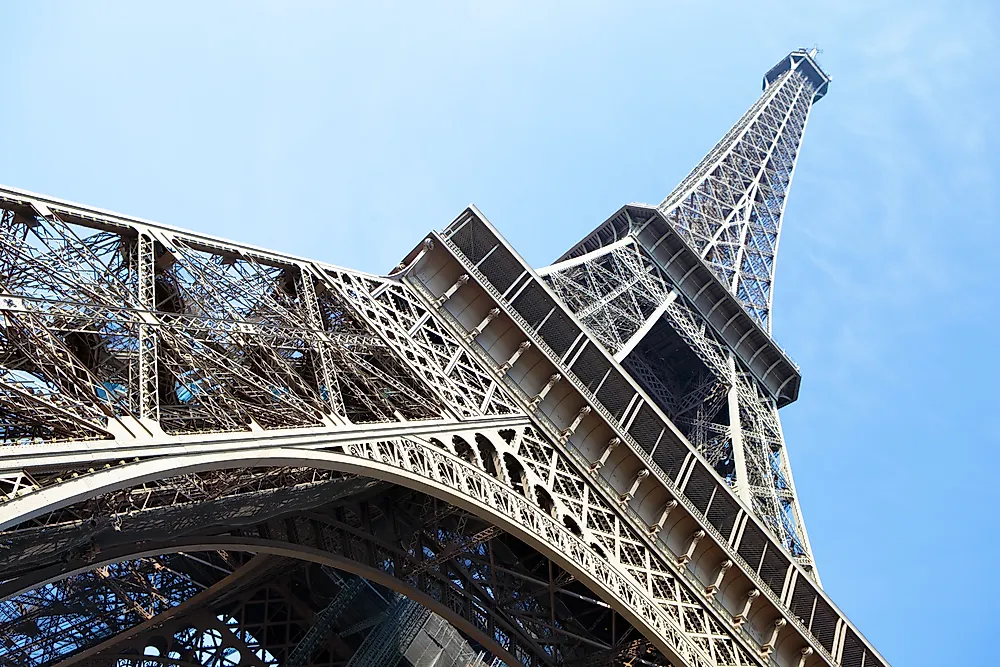
The Eiffel Tower in Paris was constructed between January 1887 and March 1889 as the entrance arch and centerpiece of the 1889 Exposition Universelle, the World's Fair marking the centennial of the French Revolution. The structure was designed by engineer Gustave Eiffel's firm; the principal designers were engineers Maurice Koechlin and Émile Nouguier with architect Stephen Sauvestre, with Eiffel himself overseeing the construction. The original tower stood about 300 meters (984 feet) tall, and with the broadcast antennas added over the 20th century, the current total height is approximately 330 meters (1,083 feet). The tower's wrought-iron lattice contains about 18,000 individual structural pieces held together by 2.5 million rivets, and it was the world's tallest human-made structure from 1889 until the Chrysler Building in New York City was completed in 1930. The Eiffel Tower draws roughly 7 million visitors per year and is the most-visited paid monument in the world.
Sydney Opera House

The Sydney Opera House at Bennelong Point in Sydney Harbour was designed by Danish architect Jørn Utzon, who won the international design competition in 1957 with what is now one of the most recognizable building silhouettes in the world. Construction by the New South Wales government began in 1958 and ran until 1973, with Utzon resigning from the project in 1966 over budget and scope disputes with the state government; the interiors were completed by Australian architects Peter Hall, Lionel Todd, and David Littlemore. Queen Elizabeth II officially opened the building on October 20, 1973, and Utzon was eventually reconciled with the project after a long estrangement and recognized with the Pritzker Architecture Prize in 2003 for his original design. The complex contains multiple performance venues and hosts more than 2,000 performances annually, drawing over 10 million visitors per year and serving as the home of Opera Australia, the Sydney Theatre Company, and the Sydney Symphony Orchestra. The building was listed by UNESCO as a World Heritage Site in 2007, one of the few 20th-century buildings to receive that designation.
What These Eleven Have In Common
The structures above span approximately 4,500 years of construction history and represent a wide range of cultures and purposes, but several patterns recur. Six of the eleven were originally built as the seat or symbol of a specific political ruler: the Great Pyramid for Khufu, the Forbidden City for Ming and Qing emperors, Machu Picchu for Pachacuti, the Taj Mahal as Shah Jahan's tribute to Mumtaz Mahal, Saint Basil's commemorating Ivan IV's conquests, and the White House as the seat of the American presidency. Two were built primarily as religious or ceremonial centers (the Colosseum for civic spectacle and Saint Basil's as a cathedral, with Petra including major tomb monuments); two more (the Eiffel Tower and the Sydney Opera House) were civic projects with no specific religious or royal patron; and the Big Ben tower is part of a parliamentary palace. Most of the structures have outlived the political systems that produced them, and several (Petra, the Forbidden City, the Great Pyramid) outlasted theirs by centuries or millennia. Nine of the eleven are now UNESCO World Heritage Sites, and the combined annual visitor count runs into tens of millions, making their preservation a continuing national priority in each of the countries that hosts them.