What Happens To Yellowstone When The Roads Close For Winter
Every November, America's first national park performs its annual disappearing act. The roads that carried more than four million summer visitors close to cars, the gateway towns exhale, and Yellowstone's 2.2 million acres drop to a visitor count measured in dozens per geyser basin. But the park never actually closes. It changes rules, changes vehicles, and changes owners: one plowed road stays open because a Montana town depends on it, the interior reopens in December to machines with tracks instead of tires, artillery guards one mountain pass, and the wolves of the Lamar Valley begin the best hunting, and the best wolf watching, of the year. Winter is not Yellowstone's off-season. It is the park with the volume turned down and the wildness turned up.
One Road Stays Open

When the November closures sweep the park, a single stretch survives: the northern road from Gardiner, Montana, through Mammoth Hot Springs and the Lamar Valley to Cooke City. Plow crews keep it open all winter for a simple reason: Cooke City's only year-round access to the outside world runs through the park, so Yellowstone operates a public lifeline road on behalf of one small town. The arrangement makes the Lamar Valley the only corner of the park's interior an ordinary car can reach in January.
Mammoth stays lit as well. The park's headquarters village remains a working, year-round community, with rangers, families, and elk wandering between the historic buildings, which makes it the strange and wonderful thing it has always been: a functioning town inside a national park, open every day of the year.
The Interior Goes Oversnow

In mid-December, the closed roads come back to life as something else entirely: groomed oversnow routes. Heated snowcoaches and strictly limited, guide-led snowmobile groups become the only motorized way into the park's heart, running daily from the gateway towns to Old Faithful and Canyon. The traffic jams of July are replaced by a few hundred people a day spread across a landscape the size of a small state.
At the end of the route, the Old Faithful Snow Lodge operates as one of the most isolated hotels in America, reachable in winter only by snowcoach, snowmobile, or skis. Guests step outside at night to watch the world's most famous geyser erupt by starlight for an audience of a dozen, a sight summer's boardwalk crowds of thousands never get.
Among The Coldest Places In The Lower 48

The interior earns its machinery. Yellowstone's high plateau sits mostly above 7,000 feet, collects well over a hundred inches of snow in an average winter, and traps cold air like a bowl: the thermometer near West Yellowstone once recorded 66 degrees below zero, among the coldest readings ever taken in the contiguous United States. Twenty below is not an event here; it is a Tuesday.
The cold rewrites the scenery. Trees near the geyser basins grow thick coats of rime from the drifting steam, turning into the white "ghost trees" of winter photography, and waterfalls like the Lower Falls of the Yellowstone build colossal ice cones at their base. The park summer visitors know is green and crowded; this one is white, silent, and sculpted.
Geysers Against The Cold

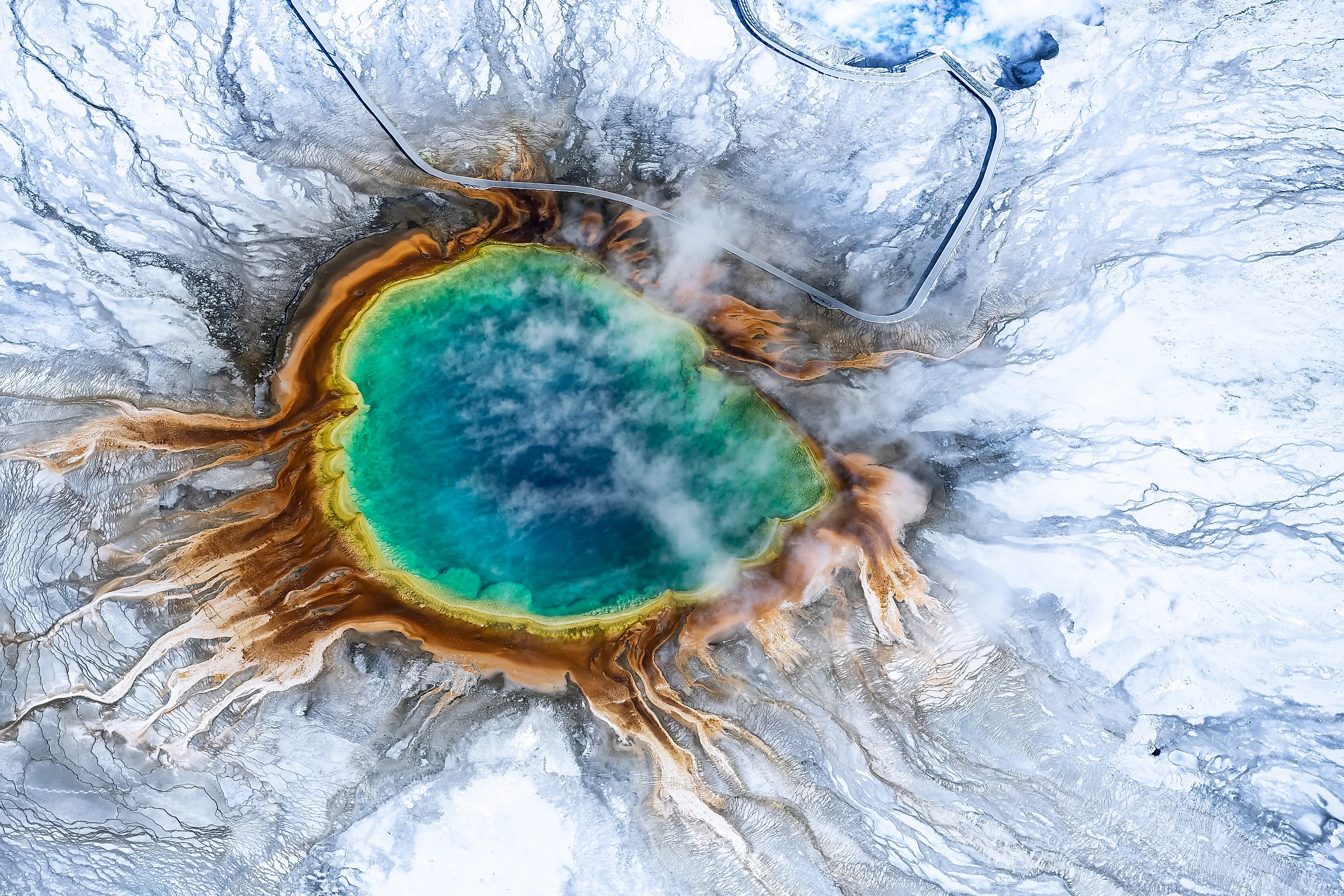
Winter is when Yellowstone's plumbing shows off. The park holds the largest concentration of geysers on Earth, and every one of them keeps its schedule regardless of the season: Old Faithful erupts into subzero air, and the collision of boiling water and arctic atmosphere builds steam columns far taller and denser than anything summer produces. The geyser basins in January look like a landscape on fire with white smoke.
The thermal areas never freeze, never sleep, and never stop steaming, which turns the basins into islands of warmth in a frozen plateau. That warmth does more than decorate the view. It keeps patches of ground snow-free and rivers flowing, and the park's biggest residents have noticed.
The Bison Take The Roads

Yellowstone's bison spend winter running a cost-benefit analysis with their foreheads: they swing their massive heads like plows to sweep snow off buried grass, burning precious calories with every stroke. So the herds gravitate to the places winter is cheapest, the geothermal flats where steam-warmed ground keeps the snow thin and the Firehole River runs open all season, and to the groomed oversnow roads, which make effortless highways for an animal that pays for every step.
That is why winter snowcoach rides routinely stop for a file of frost-bearded bison commanding the road, steam rising off their backs. Not all of them make it; late winter is the hungry season, and the winterkill feeds everything in the park with teeth, which brings the story to the Lamar.
Wolf Season In The Lamar

Winter belongs to the wolves. Deep snow slows the elk, the weak and the old reveal themselves, and the packs of the northern range do most of their serious hunting in the cold months, often in daylight, often in the open. Because the one plowed road runs straight through their best territory, the Lamar Valley in winter has become the most reliable place on the planet to watch wild wolves doing wolf things, and a devoted community of spotters lines the pullouts at dawn with scopes and radios in air that bites through every layer.
The supporting cast works the same stage: coyotes shadow the packs for leftovers, ravens and eagles claim the kills, bighorn sheep hold the windblown slopes, and river otters toboggan along the open creeks. The grizzlies alone sit winter out, denned up from roughly November to March while the park they dominate runs its coldest season without them.
Artillery On Sylvan Pass
Winter operations include one genuinely startling detail: to keep the East Entrance oversnow route open, the park service conducts avalanche control on Sylvan Pass with artillery, firing shells into loaded slopes to bring the snow down on schedule rather than on travelers. It is one of the only places in the national park system where the morning routine can include ordnance.
The bigger battle starts in March, when the oversnow season ends and the plow crews begin the weeks-long fight to reclaim hundreds of miles of buried road, carving through drifts that can stand higher than the plows themselves. The painted lines emerge in April, the gates swing open entrance by entrance, and the species of vehicle changes back.
The Park Summer Never Sees
Yellowstone in winter is the same park running a different experiment: geysers steaming against 20 below, bison budgeting calories on warm ground, wolves working the Lamar in front of a frozen audience, and one plowed road keeping a small Montana town connected to the world. The roads close to cars for five months, and in exchange the park reverts to something close to its original settings. The crowds will be back with the pavement. The wildness never left.