The Oldest Observatory Operating In America
Every Friday night, the lights go down at 8 p.m. in a small stone building on the Williams College campus in Williamstown, a college town in the northwest corner of Massachusetts. Moments later, a projector fills the ceiling with stars. That building is the Hopkins Observatory.
Completed in 1838, according to the Journal of Astronomical History and Heritage, it is the oldest observatory still standing in the United States.
The Hopkins Observatory is also still working and in use, and that's the yardstick we've applied here: the oldest building put up for astronomy that's still serving the purpose for which it was built. Here's how a professor's shopping trip to London, England, led to creating America's oldest observatory still in operation.
A Shopping Trip To London
The story of Williamstown's observatory really kicks off in 1834, when Albert Hopkins, professor of mathematics and natural philosophy (the term then used for physics) at Williams College, crossed the Atlantic with the trustees' permission to buy scientific instruments in London.
He came home with a transit instrument, a small telescope fixed on a north-south line that astronomers used to time stars crossing overhead and so set clocks and fix longitude. He also purchased a regulator clock with a mercury-compensated pendulum, a design that keeps time steady as temperatures change.
Rather than wait for funding, Hopkins put his students to work. Between 1836 and 1838, they built the observatory by hand from local stone in the middle of the campus quadrangle.

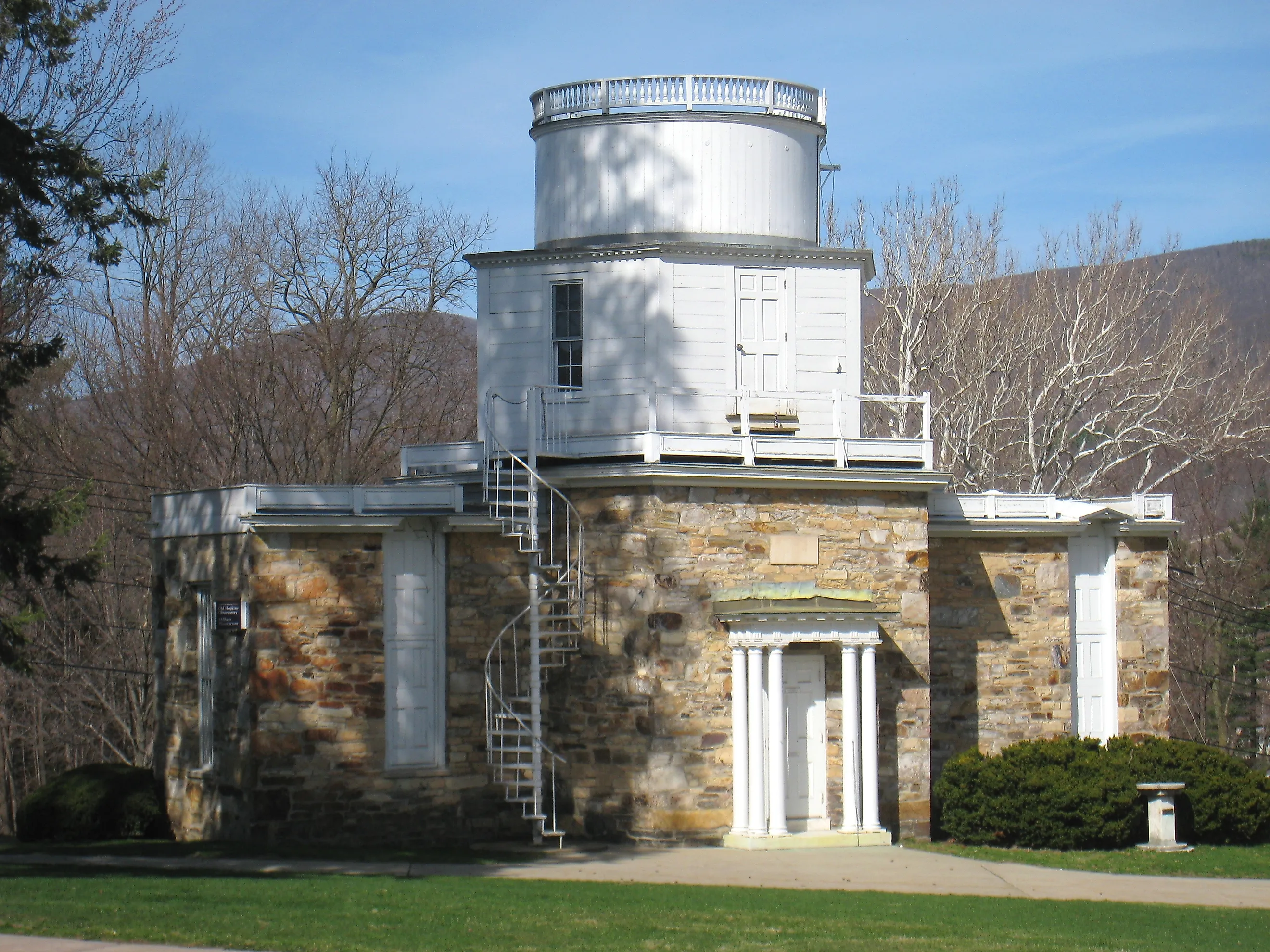
Marian Card Donnelly, an architectural historian writing in Old-Time New England, the journal of the preservation group now called Historic New England, described it as the earliest permanent observatory building in the United States: 48 feet long, divided into a central block and two wings, with a 13-foot cylindrical dome on a drum over the center and roof shutters in each wing for the transit instruments.
The first telescope placed in its dome was a Herschelian reflector, a mirror telescope of the design named for the astronomer William Herschel, with a ten foot focal length. According to Williams College, the building was the first observatory in the country built solely to serve an educational institution.
After visiting in 1865, poet Ralph Waldo Emerson commented: "Of all tools, an observatory is the most sublime."
Hopkins ran the observatory until his death in 1872 and was followed by Truman Henry Safford, a calculating prodigy who had published an almanac as a boy. From Hopkins until 2022, only five people have directed the observatory.
The Telescope That Launched Alvan Clark
That first mirror telescope lasted 14 years, and in 1852, Hopkins ordered a seven inch refractor from Alvan Clark, a portrait painter in Cambridgeport, Massachusetts, who had taught himself to grind lenses. The order led to Clark giving up his day job and setting up as a telescope maker.
The firm that grew out of it, Alvan Clark & Sons, went on to make the 26-inch refractor at the U.S. Naval Observatory in Washington, D.C., with which the Navy astronomer Asaph Hall found the two moons of Mars in 1877.
The company also made the 40-inch lens for the telescope at Yerkes Observatory in Wisconsin, which was completed in 1897 and is still the largest refracting telescope ever built for astronomical research.

The Williams telescope is the earliest Clark instrument known to survive and is still housed in the observatory's upper dome. A simple hand crank continues to turn the dome, and a narrow slit opens up for the tube.
These days, the college treats it as a museum piece rather than a research instrument, and the dome is not generally open to the public. It was restored for the observatory's 150th anniversary in 1988, and work on it resumed in 2016, after which the observatory's director reported sharp views of the Moon.
A Moving Experience
The building itself has been moved twice, though never very far. The first time, it was shifted out of the center of the quad to make room for a dormitory. It was moved again in 1961 for the same reason.
That second move to its present spot on Main Street took two and a half months and required the 254-ton stone building to be jacked onto a grid of steel beams. It was then inched 350 feet north along steel rails, pushed by jacks and later pulled by a winch.
Two years later, the round central room, which Hopkins had used for lectures beneath a ceiling painted with stars, became the Milham Planetarium, named for Willis Milham, professor of astronomy from 1902 to 1942.
The two wings of the building became the Mehlin Museum of Astronomy, after Theodore Mehlin, who ran the observatory from 1942 to 1971. The building was renovated and reopened in 1974.
Friday Nights Under The Dome
The shows held in the Milham Planetarium are free and run every Friday at 8 p.m. during Williams College's fall and spring semesters. The projector used is a Zeiss Skymaster ZKP3/B, an opto-mechanical planetarium projector (a precision star ball that throws points of light onto the dome, as opposed to a digital video system) made by the German optics company Carl Zeiss, which built the world's first planetarium projector in 1923. Williams installed it in April 2005.
Shows last 50 minutes to an hour and are written and presented by Williams students working as planetarium teaching assistants. A typical evening covers the constellations and their mythology, the phases of the Moon, and the sky as seen from the Southern Hemisphere.
The audience reclines, questions are welcome, and seats are reserved through a sign-up page on the planetarium's website due to the compact size of the room.
Before or after the show, the wings of the building are open as the Mehlin Museum of Astronomy. The original transit instrument and regulator clock that Albert Hopkins brought back from London in 1834 are mounted there, alongside the parts taken off the Alvan Clark telescope during its restoration. The college's research telescope, a 24-inch instrument, is in a rooftop observatory elsewhere on campus.
America's Oldest Observatory
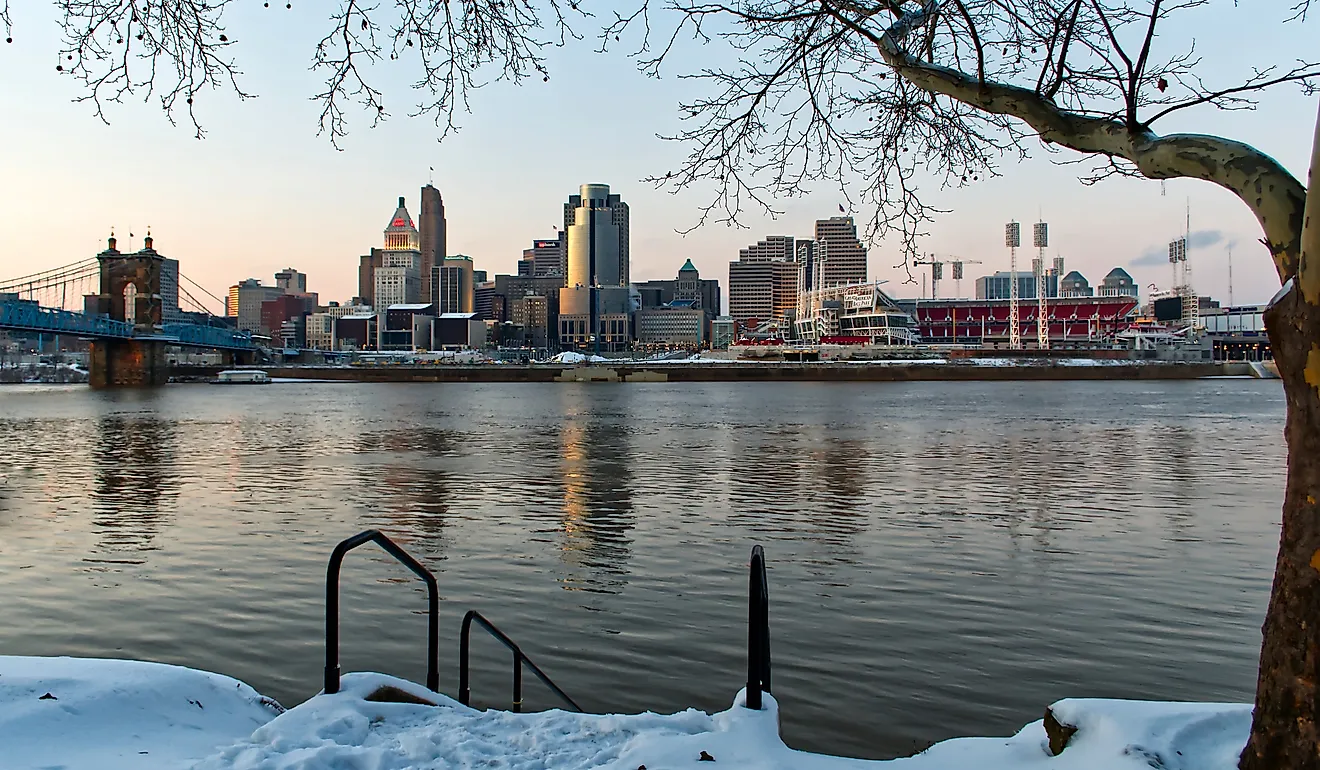
While three American observatories claim to be the country's oldest, the Hopkins Observatory claim is the strongest. The Cincinnati Observatory in Ohio, founded in 1842, has an older working telescope, an 11-inch refractor in use since 1845, but it left its original hilltop for a new building in 1873.
Georgetown University's Heyden Observatory in Washington, D.C., founded in 1841, calls itself the oldest continuously operating observatory, even though the university closed its astronomy department in 1972.
The Hopkins Observatory is the only one where the building put up for astronomy in the 1830s is still the building people walk into for astronomy today. It has been moved twice, but the Alvan Clark telescope the college bought in 1852 is still kept in working order in the dome upstairs.
That, in our book, makes it the oldest observatory still operating in the United States.