Dark Sky Parks in the United States
The Milky Way is now invisible to roughly 80 percent of Americans on a given night. Travelers who want to actually see it have a workaround in the form of certified dark sky places. DarkSky International audits and certifies sites that have committed to protecting their nighttime environment from light pollution. The United States now holds roughly 90 of these certified Dark Sky Parks plus dozens more Sanctuaries Reserves and Communities. The article below profiles flagship destinations worth planning a trip around. Each section covers what makes the location worth visiting and the best places inside it for stargazing.
Oregon Outback International Dark Sky Sanctuary
The Oregon Outback became the world's largest dark sky sanctuary in March 2024 and is the newest flagship destination in the program. The first phase covers 2.5 million acres of Lake County in southeastern Oregon. Two more planned phases would bring it to 11.4 million acres or roughly a fifth of the state. Trip planning runs through three gateway communities. Summer Lake offers hot springs and the easiest road access from the Highway 31 corridor. Plush is the jumping-off point for Hart Mountain National Antelope Refuge. Adel sits closer to the Warner Valley overlook where the Milky Way reflects across alkali lake beds on calm nights. Cell service is unreliable across most of the sanctuary so bring paper maps. Best viewing windows are summer and early fall on moonless nights. Lodging is limited to small inns and ranches in the gateway towns plus dispersed camping on BLM land. Drive times from Portland run six to eight hours.
Big Bend National Park

The National Park Service Night Sky Team has measured Big Bend's skies as the darkest in the lower 48 states which gives it a strong claim as the best stargazing trip in the country. The 801,000-acre park sits in far west Texas along the Rio Grande and earned its Gold Tier International Dark Sky Park certification in February 2012. Plan a base in the village of Terlingua or at the in-park Chisos Mountains Lodge. The Chisos Basin sits at 5,400 feet which keeps it cooler than the desert floor in summer. Best viewing spots include the Chisos Basin overlook for wide Milky Way views the Cottonwood Campground area for Rio Grande reflections and the Glenn Spring Road dispersed sites for the most isolated horizons. The surrounding Greater Big Bend International Dark Sky Reserve was certified in 2022 and pulls in McDonald Observatory near Fort Davis where regular Star Parties pair high-power telescope viewing with public astronomy programs. Closest major airports are El Paso about five hours away and Midland about three and a half.
Cherry Springs State Park

Cherry Springs is the best stargazing trip on the East Coast and the second-oldest International Dark Sky Park in the world after Natural Bridges in Utah. The 82-acre park sits in Potter County Pennsylvania at 2,300 feet on the Allegheny Plateau and is surrounded by 262,000 acres of Susquehannock State Forest. The park has two distinct visitor experiences. The Night Sky Public Viewing Area is open to all visitors with no reservations required. The Astronomy Observation Field requires advance permits and is reserved for serious observers with telescopes. Camping inside the park books up months ahead during summer star party season so reserve early. The Cherry Springs Star Party in June and the Black Forest Star Party in early fall are the biggest annual events and draw hundreds of telescopes. Nearest gateways are the small towns of Coudersport and Galeton both within 30 minutes of the park. The drive from Pittsburgh runs about four hours and the drive from New York City runs around six.
Death Valley National Park

Death Valley pairs the largest national park in the contiguous United States with sky readings that consistently rank among the country's darkest. The park covers 3.4 million acres on the California-Nevada border and earned its Gold Tier International Dark Sky Park status in 2013. Best viewing happens at Harmony Borax Works near Furnace Creek for an easy paved-road stop. Ubehebe Crater works well for night photography with the volcanic landscape as foreground. Mesquite Flat Sand Dunes give Milky Way reflections off the dune crests. Badwater Basin at 282 feet below sea level offers the lowest stargazing spot in North America. The annual Dark Sky Festival each spring brings ranger-led astronomy programs telescope sessions and night photography workshops. Plan a winter or early spring visit since summer temperatures regularly exceed 110 degrees. Lodging inside the park ranges from the historic Inn at Death Valley to budget options at Stovepipe Wells. Las Vegas sits about two hours away by car and is the most common gateway airport.
Chaco Culture National Historical Park
Chaco Culture is the rare trip that lets you stargaze from the same vantage points as the people who built solar and lunar alignments into their architecture. The park sits in northwestern New Mexico and protects more than 4,000 archaeological sites built by Ancestral Pueblo people roughly a thousand years ago. It earned Gold Tier International Dark Sky Park certification on August 19, 2013. The park runs scheduled Night Sky Program events from late April through October out of an on-site observatory dedicated in 1998. Casa Rinconada and the Sun Dagger petroglyph on Fajada Butte both track solstice and equinox alignments and are featured in ranger-led programs. Lodging is limited to the small Gallo Campground inside the park and to motels in Bloomfield or Farmington roughly two hours away. The final access road is unpaved and impassable after heavy rain so check conditions before the drive. Albuquerque is the nearest major airport at about three and a half hours.
Utah's Mighty Five

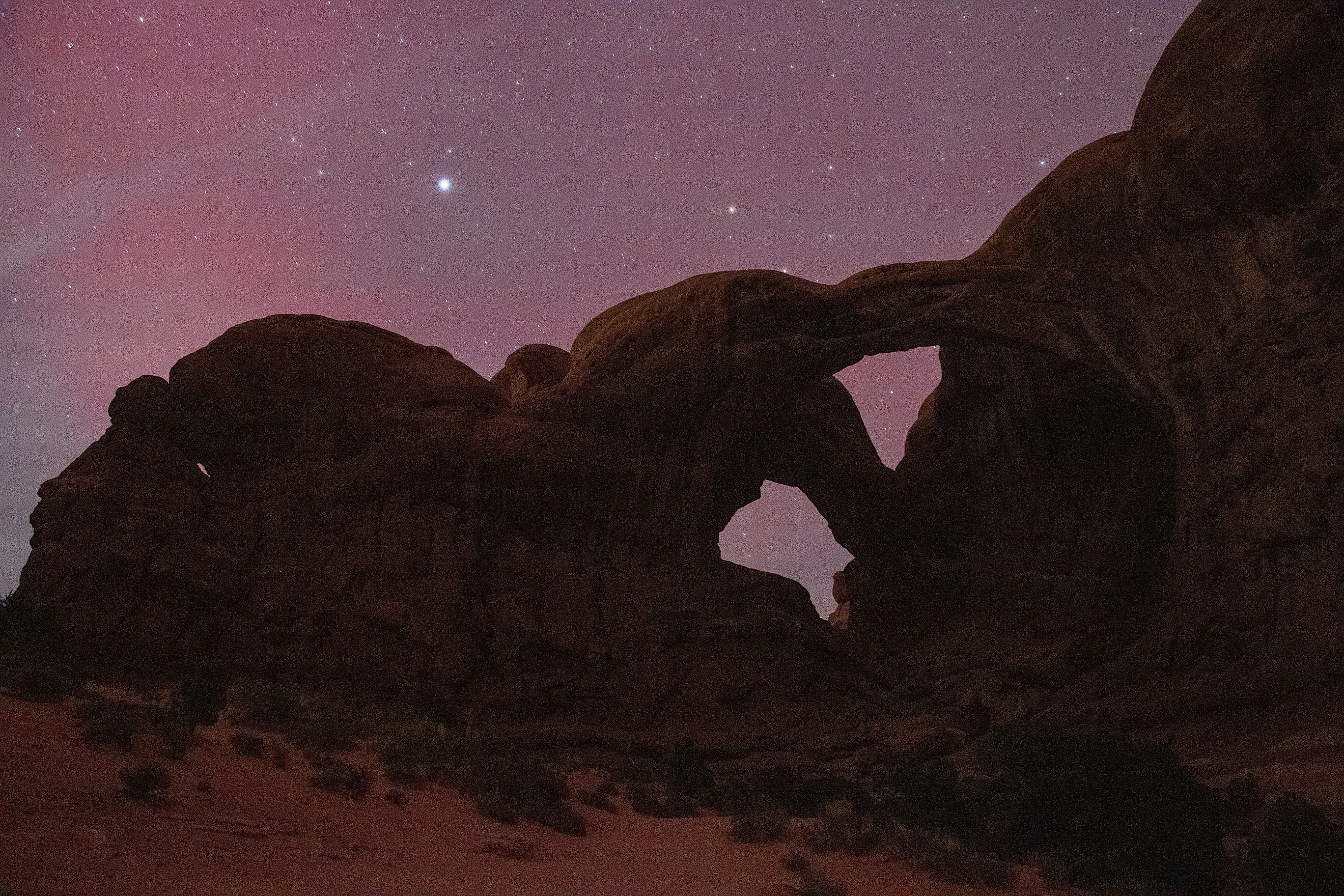
Utah is the only state where every national park holds International Dark Sky Park status which makes it the best single state for a stargazing road trip. Bryce Canyon at 8,000 to 9,000 feet has the thinnest air and arguably the clearest skies of the five. Its hoodoo formations make memorable foreground for night photography from Inspiration Point and Sunset Point. Capitol Reef gets the fewest crowds and offers extensive dispersed-camping options in surrounding BLM land. Canyonlands works best from the Needles District which is far quieter than the Island in the Sky section near Moab. Arches pairs well with a stop at Dead Horse Point State Park which is also dark-sky certified. Zion has the most ambient light bleed of the five since canyon walls block portions of the sky but Kolob Canyons in the northwest corner stays dark. Moab earned International Dark Sky Community status in 2024 and works as a central base for visiting Arches and Canyonlands. Salt Lake City and Las Vegas are the two main gateway airports.
Boundary Waters Canoe Area Wilderness and Voyageurs National Park
Northern Minnesota pairs two adjacent dark sky places into a trip that doubles as a chance to see the northern lights. The Boundary Waters Canoe Area Wilderness earned International Dark Sky Sanctuary status in September 2020 and covers 1,098,000 acres of lakes and boreal forest accessible only by canoe or kayak. Outfitters in Ely Grand Marais and Tofte rent gear and run guided trips lasting anywhere between overnight and two weeks. Voyageurs National Park west of the Boundary Waters became an International Dark Sky Park in December 2020 and is more car-accessible. The Rainy Lake Visitor Center the Ash River Visitor Center and the Kettle Falls Dam observation deck all offer panoramic stargazing without needing a paddle. Voyageurs also runs a Boreal Stargazing Week each winter. Best northern lights viewing typically runs from September through April. Lodging options cluster around International Falls Ely and Crane Lake. Duluth and Minneapolis are the most common gateway airports.
Katahdin Woods and Waters National Monument
Katahdin Woods and Waters became the first International Dark Sky Place certified anywhere in New England when DarkSky International designated it a sanctuary on May 8, 2020. The monument protects 87,500 acres of woods and waters east of Baxter State Park in northern Maine. National Park Service measurements rank the skies here among the darkest east of the Mississippi River. The Katahdin Loop Road Overlook is the easiest stargazing stop for visitors arriving by car. The Loop Road is an 18-mile gravel route accessed from the gateway town of Patten and is open seasonally from late May through October depending on weather. Stars Over Katahdin runs each fall and brings amateur astronomers and rangers together for telescope viewing and dark-sky education. Lodging is limited so book the small inns in Patten Millinocket or Sherman well ahead. Bangor is the nearest airport at about a two-hour drive.
Planning a Stargazing Trip
The Bortle Scale is the standard tool for rating night-sky darkness and is useful for travelers deciding where to go. It runs from Class 1 (the darkest possible skies on Earth) to Class 9 (inner-city light pollution). Most flagship Gold Tier International Dark Sky Parks measure Bortle 1 or 2 where the Milky Way is bright enough to cast a faint shadow and the zodiacal light is visible to the naked eye. A few practical tips apply across destinations. Plan visits around the new moon since even a quarter moon washes out faint celestial detail. Allow 30 minutes for your eyes to adjust after stepping out of any lit area. Bring a red-filter flashlight rather than a white one to preserve night vision. Summer offers the brightest views of the galactic core but winter brings longer nights and clearer dry air in desert regions. Check the park's website ahead of time for ranger-led programs star parties and special astronomical events.
Dark Sky Trips Beyond the United States
Travelers building international itineraries can find certified sites on most continents. Aoraki Mackenzie International Dark Sky Reserve in New Zealand is the largest accessible reserve in the Southern Hemisphere and pairs naturally with a South Island road trip. Pic du Midi de Bigorre in the French Pyrenees offers overnight stays in a working observatory at 9,400 feet. Iriomote-Ishigaki in Japan delivers tropical-latitude stargazing from Okinawan islands. NamibRand Nature Reserve in Namibia and Gabriela Mistral Dark Sky Sanctuary in Chile's Elqui Valley both rank as some of the darkest skies on Earth and pair with major Southern Hemisphere observatory tours. Canada's program is especially strong with Jasper National Park hosting an annual Dark Sky Festival each October. The European program includes accessible reserves in the United Kingdom Hungary and Germany.
Designated Dark Sky Places Across the United States
The table below lists International Dark Sky Places in the United States organized chronologically by year of designation. Status types follow DarkSky International's current naming. Use it as a starting point for planning a trip outside the marquee national parks. State parks and lesser-known sanctuaries often deliver equally dark skies with fewer crowds and shorter drives. The list focuses on major designations and continues to grow each year.
| Name | Location | Status | Designated |
|---|---|---|---|
| Flagstaff | Arizona | Dark Sky Community | 2001 |
| Natural Bridges National Monument | Utah | Dark Sky Park | 2007 |
| Cherry Springs State Park | Pennsylvania | Dark Sky Park | 2007 |
| Borrego Springs | California | Dark Sky Community | 2009 |
| Clayton Lake State Park | New Mexico | Dark Sky Park | 2010 |
| Geauga Observatory Park | Ohio | Dark Sky Park | 2011 |
| Headlands | Michigan | Dark Sky Park | 2011 |
| Homer Glen | Illinois | Dark Sky Community | 2011 |
| Big Bend National Park | Texas | Dark Sky Park | 2012 |
| Chaco Culture National Historical Park | New Mexico | Dark Sky Park | 2013 |
| Death Valley National Park | California / Nevada | Dark Sky Park | 2013 |
| Beverly Shores | Indiana | Dark Sky Community | 2014 |
| Copper Breaks State Park | Texas | Dark Sky Park | 2014 |
| Dripping Springs | Texas | Dark Sky Community | 2014 |
| Enchanted Rock State Natural Area | Texas | Dark Sky Park | 2014 |
| Grand Canyon-Parashant National Monument | Arizona | Dark Sky Park | 2014 |
| Hovenweep National Monument | Utah / Colorado | Dark Sky Park | 2014 |
| Mayland Earth to Sky Park | North Carolina | Dark Sky Park | 2014 |
| Oracle State Park | Arizona | Dark Sky Park | 2014 |
| Sedona | Arizona | Dark Sky Community | 2014 |
| Black Canyon of the Gunnison National Park | Colorado | Dark Sky Park | 2015 |
| Canyonlands National Park | Utah | Dark Sky Park | 2015 |
| Capitol Reef National Park | Utah | Dark Sky Park | 2015 |
| Horseshoe Bay | Texas | Dark Sky Community | 2015 |
| Pickett CCC Memorial State Park | Tennessee | Dark Sky Park | 2015 |
| Staunton River State Park | Virginia | Dark Sky Park | 2015 |
| Weber County North Fork Park | Utah | Dark Sky Park | 2015 |
| Westcliffe and Silver Cliff | Colorado | Dark Sky Community | 2015 |
| Capulin Volcano National Monument | New Mexico | Dark Sky Park | 2016 |
| Cosmic Campground | New Mexico | Dark Sky Sanctuary | 2016 |
| Dead Horse Point State Park | Utah | Dark Sky Park | 2016 |
| Flagstaff Area National Monuments | Arizona | Dark Sky Park | 2016 |
| Goblin Valley State Park | Utah | Dark Sky Park | 2016 |
| Grand Canyon National Park | Arizona | Dark Sky Park | 2016 |
| Great Basin National Park | Nevada | Dark Sky Park | 2016 |
| Kissimmee Prairie Preserve State Park | Florida | Dark Sky Park | 2016 |
| Salinas Pueblo Missions National Monument | New Mexico | Dark Sky Park | 2016 |
| Stephen C. Foster State Park | Georgia | Dark Sky Park | 2016 |
| Antelope Island State Park | Utah | Dark Sky Park | 2017 |
| Big Bend Ranch State Park | Texas | Dark Sky Park | 2017 |
| Cedar Breaks National Monument | Utah | Dark Sky Park | 2017 |
| Central Idaho | Idaho | Dark Sky Reserve | 2017 |
| Craters of the Moon National Monument | Idaho | Dark Sky Park | 2017 |
| Joshua Tree National Park | California | Dark Sky Park | 2017 |
| Kartchner Caverns State Park | Arizona | Dark Sky Park | 2017 |
| Ketchum | Idaho | Dark Sky Community | 2017 |
| Newport State Park | Wisconsin | Dark Sky Park | 2017 |
| Obed Wild and Scenic River | Tennessee | Dark Sky Park | 2017 |
| Waterton-Glacier International Peace Park | Montana / Alberta | Dark Sky Park | 2017 |
| Anza-Borrego Desert State Park | California | Dark Sky Park | 2018 |
| Camp Verde | Arizona | Dark Sky Community | 2018 |
| Fountain Hills | Arizona | Dark Sky Community | 2018 |
| Petrified Forest National Park | Arizona | Dark Sky Park | 2018 |
| Rainbow Bridge National Monument | Utah | Dark Sky Sanctuary | 2018 |
| Steinaker State Park | Utah | Dark Sky Park | 2018 |
| Torrey | Utah | Dark Sky Community | 2018 |
| Tumacácori National Historical Park | Arizona | Dark Sky Park | 2018 |
| Arches National Park | Utah | Dark Sky Park | 2019 |
| Bryce Canyon National Park | Utah | Dark Sky Park | 2019 |
| Devils River State Natural Area - Del Norte Unit | Texas | Dark Sky Sanctuary | 2019 |
| James River State Park | Virginia | Dark Sky Park | 2019 |
| Massacre Rim Wilderness Study Area | Nevada | Dark Sky Sanctuary | 2019 |
| Norwood | Colorado | Dark Sky Community | 2019 |
| Boundary Waters Canoe Area Wilderness | Minnesota | Dark Sky Sanctuary | 2020 |
| Buffalo National River | Arkansas | Dark Sky Park | 2019 |
| Katahdin Woods and Waters National Monument | Maine | Dark Sky Sanctuary | 2020 |
| Natural Bridge State Park | Virginia | Dark Sky Park | 2019 |
| Sky Meadows State Park | Virginia | Dark Sky Park | 2021 |
| Voyageurs National Park | Minnesota | Dark Sky Park | 2020 |
| Zion National Park | Utah | Dark Sky Park | 2021 |
| Greater Big Bend International Dark Sky Reserve | Texas | Dark Sky Reserve | 2022 |
| Oregon Outback (Phase 1) | Oregon | Dark Sky Sanctuary | 2024 |
| Moab | Utah | Dark Sky Community | 2024 |
| Black Mesa State Park | Oklahoma | Dark Sky Park | 2025 |
| Snow Canyon State Park | Utah | Urban Night Sky Place | 2025 |
| Chimney Rock National Monument | Colorado | Dark Sky Park | 2026 |
| Observatory Park at Turner Farm | Virginia | Urban Night Sky Place | 2026 |
| Old Snowmass | Colorado | Dark Sky Park | 2026 |