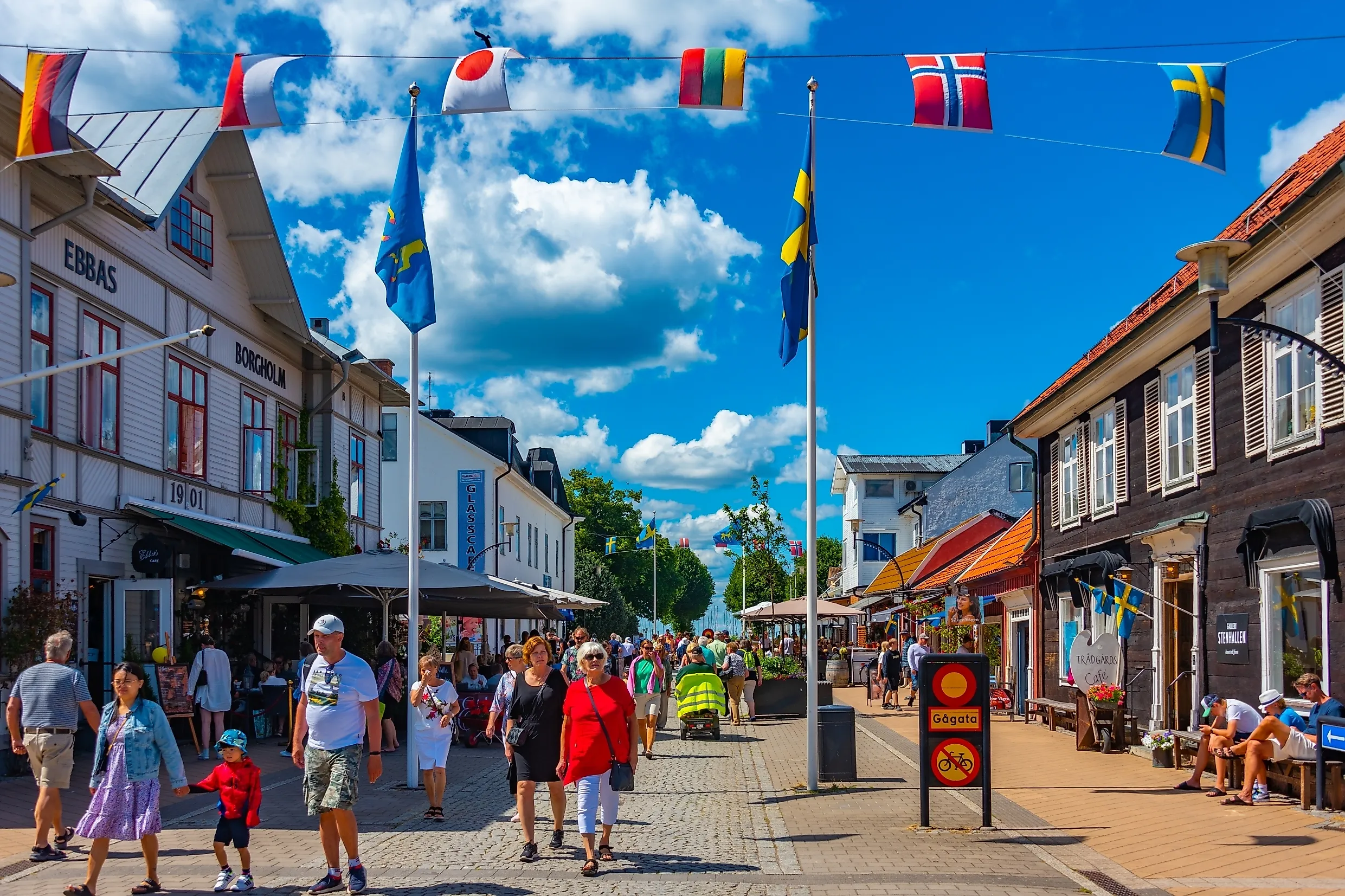
11 Most Hospitable Towns In Sweden
Sweden's small towns showcase and celebrate the traditions and history that make them unique. The eleven destinations below sit on the Bohuslän coast, the Baltic islands, the Dalarna lake country, and the mountains near the Norwegian border. None of them takes more than a day to see, though longer is better when it comes to exploring their unique streets and landmarks. Vadstena's 14th-century abbey church and a Renaissance castle are within a few minutes' walk of each other, both well worth a visit with time to spare. Rättvik counts 87 timber stables ringed around its church, built for parishioners who arrived on horseback. The UNESCO-listed landscape surrounding Borgholm is literally fit for a king and welcomes guests like royalty. For a true taste of Swedish hospitality, these towns are a must.
Marstrand

No private cars are allowed on Marstrand. The island sits off the Bohuslän coast north of Gothenburg, and the last stretch of the trip is a short chain ferry from neighboring Koön. Marstrand was Norwegian at its founding in the 13th century and did not become Swedish until the Peace of Roskilde in 1658. Carlsten Fortress, begun soon after that treaty on the island's highest point, is the landmark that dominates the wooden town below. Its most famous prisoner was Lasse-Maja, a thief who worked as the fortress cook and was pardoned in 1839 after 26 years inside. Each summer the Match Cup Sweden regatta fills the harbor with international match-racing crews and a large spectator fleet. Walking the full circuit of the island takes a few hours, passing rocky swimming spots and the lighthouse at Skallen. Marstrands Havshotell, over on Koön beside the ferry landing, stays open year-round and moors a floating sauna off its jetty.
Vadstena

Saint Birgitta founded the first monastery of the Bridgettine Order at Vadstena in the 14th century, and the town has been trading on that ever since. The Vadstena Abbey Church, built between 1384 and 1430, still sets the skyline of a town of fewer than 6,000 people on the shore of Lake Vättern. Vadstena Castle, commissioned by King Gustav Vasa in 1545, is one of the best-preserved Renaissance palaces in the country. Its four round towers sit almost in the water, which is what most visitors photograph. Each summer, the Vadstena Academy stages opera inside the castle walls. The old town between the castle and the abbey is a quiet stretch of low painted houses running down to a small harbor.
Eksjö

The fires that leveled wooden town centers across Sweden never reached Eksjö. Its 17th-century grid of painted timber houses survived intact, and only Nora and Hjo are held in comparable regard for their preserved wooden cores. Norra Storgatan runs through the middle of the old quarter and carries most of the photographers. The Eksjö Museum on the main street covers the town's history, and guided tours of the old quarter run through the summer months. Trails climb out of town in every direction into the Småland highlands, including the route to the Skurugata ravine, a narrow rock cleft a few miles northeast.
Mariefred

Gripsholm Castle stands directly on the water at Mariefred, a 16th-century brick fortress with circular towers and a moat. Gustav Vasa commissioned it, and it now houses Sweden's national portrait collection. The town itself is a small one on the southern shore of Lake Mälaren, roughly 30 miles west of Stockholm and about an hour out by train. Its cobbled main street leads down to a harbor and to the station of the Mariefred Steam Railway, a narrow-gauge heritage line running since 1895. Across from the castle, Gripsholms Värdshus received its inn privileges in 1609 and bills itself as the oldest inn in Sweden. The first innkeeper was a German named Jocim Smock, and the main building dates from the 1750s.
Borgholm

Swedish royalty has been summering at Borgholm since the 19th century, and the habit set the tone for the whole town. Borgholm Castle sits just south of the center, a vast roofless shell that hosts concerts inside its stone walls. The site was fortified as early as the 12th century, but what stands today is the Baroque palace begun for Charles X Gustav in 1654 and gutted by fire in October 1806. A short walk away, Solliden Palace was completed in 1906 as the royal family's summer residence, and its gardens open to visitors through the warmer months. The VIDA Museum and Art Gallery, about six miles south of town, holds a large collection built around the glass and paintings of Bertil Vallien and Ulrica Hydman-Vallien. Farther south again, the limestone alvar of southern Öland was added to the UNESCO World Heritage List in 2000 as an agricultural landscape worked for some five thousand years.
Norrtälje

The Roslagen Archipelago scatters thousands of islands into the Baltic, and Norrtälje is the way in. The town sits about an hour north of Stockholm, close enough to the capital to be an easy trip and far enough to keep its own character. Its old wooden center along the Norrtälje River is easy to walk, with independent shops and cafes lining the water. The Roslagen Museum covers the maritime history of the archipelago, and boat tours leave the harbor for outer islands where the summer cottages have stayed in the same families for generations. Up the coast at Grisslehamn stands the Albert Engström House, the waterside home of the Swedish artist and writer, now a museum looking out across the Åland Sea.
Åre

Winter and summer give Åre two entirely different personalities. The village sits at around 370 meters in the Åredalen valley in Jämtland, not far from the Norwegian border. Its linked ski areas make up one of the largest interconnected resorts in Scandinavia, with close to a hundred marked pistes. The Kabinbanan cable car climbs most of the way up Åreskutan, which tops out at 1,420 meters. Come summer, the same slopes turn into hiking and mountain-bike trails, and Lake Åresjön at the foot of the valley is where people swim and kayak. The village center clusters around the medieval Åre Old Church and keeps a working cafe and restaurant scene through both seasons. The train from Stockholm takes about six hours and stops in the village itself.
Falun

By the 17th century, the copper mine at Falun was the most important in the world, and it gave Sweden both a treasury and a color. The red paint on farmhouses across the country began as a byproduct of this ore. The mine is now a UNESCO World Heritage Site, with guided tours through the orange-red tunnels below and a walkway above the Stora Stöten open pit, which drops close to 100 meters. Falun is also the seat of Dalarna, the province many Swedes treat as the cultural heart of the country. Eight miles northeast in the village of Sundborn, Carl Larsson-gården preserves the home of the painter Carl Larsson and the designer Karin Larsson, with guided tours running daily. The Dalarna Museum in the center of town holds the regional collection of folk art and painted furniture.
Nora

Sweden's first standard-gauge passenger railway opened between Nora and Ervalla in 1856, and the town has been attached to trains ever since. The Nora Bergslags Veteran Järnväg, run by volunteers, still works steam through the surrounding countryside in summer. Nora itself is a grid of 18th and 19th-century wooden houses painted in soft pastels around a market square, and a summer afternoon here moves about as slowly as anywhere in the country. Lake Norasjön sits at the edge of the old town and is used for swimming and rowing through the warmer months. On the rise above the square, Nora Church is the third building on its site, a Neo-Romanesque basilica put up between 1878 and 1880 to replace a medieval predecessor.
Rättvik

A meteorite struck central Sweden about 377 million years ago and left a 32-mile ring in the bedrock. Lake Siljan occupies part of that depression, and Rättvik sits on its eastern shore. The lake is the largest in Dalarna and the main reason people come. Rättvik Church stands on a small peninsula reaching into the water, medieval in origin and rebuilt to its present shape in 1793, and 87 red-painted stable rows still ring it. Parishioners once left their horses there while they attended services. The Rättvik Gammelgård open-air museum sits a few hundred meters north of the church. Its farm buildings were hauled in during the 1920s from villages around the parish, and the oldest of them dates to the 14th century. Dalhalla, cut into a former limestone quarry outside town, stages opera and concerts through the summer in one of the more unusual outdoor venues in Europe.
Båstad

The Swedish Open has been played at Båstad since 1948, and for one week in July the tennis fills the town. The rest of the year Båstad is a quiet coastal place on Laholm Bay in northwestern Skåne, with a main street of independent shops and a harbor full of sailing boats. Behind it rise the farms and orchards of the Bjäre Peninsula, which separates Laholm Bay from Skälderviken to the south. Båstad Church, built in the 15th century, is among the oldest buildings in the area. The peninsula's coastal trails run out to the cliffs at Hovs Hallar, where the Hallandsåsen ridge meets the sea and the views take in the island of Hallands Väderö and the Kullaberg headland across the water.
What These Small Towns Do Differently
The difference between these places and Sweden's larger cities is attention rather than scale. In Nora or Eksjö, a visitor registers as a person rather than as volume, and the volunteer-run railway and the guided walk through the old quarter both depend on that. Marstrand and Båstad are the exceptions in high summer, when the sailing and tennis crowds arrive and the population multiplies for a week. Anyone choosing among them would do better to decide by season first and by place second.