The State Parks With Dinosaur Tracks
Across select state parks in the US, dinosaur tracks preserved in stone offer a direct connection to the Mesozoic Era, allowing visitors to walk in the footsteps of creatures that roamed the Earth millions of years ago. Over 500 fossilized footprints pressed into a Cretaceous-era lakebed in New Mexico, more than 350 tracks forming a section of the Dakota Group "Dinosaur Freeway," and sauropod and theropod trackways preserved side by side under a Texas riverbed are part of the accessible paleontological record within the US state park system. These sites offer verified access to dinosaur trace fossils, actual impressions left by living animals, rather than reconstructed skeletons.
Five state parks across the US protect these distinct trackways, each managed by individual state agencies rather than the National Park Service. While federal monuments like Dinosaur National Monument focus on bone beds, these state parks preserve the behavioral evidence of dinosaurs. Day-use fees and trail accessibility vary by state, and water levels and weather conditions can temporarily obscure the tracks.
Clayton Lake State Park, New Mexico

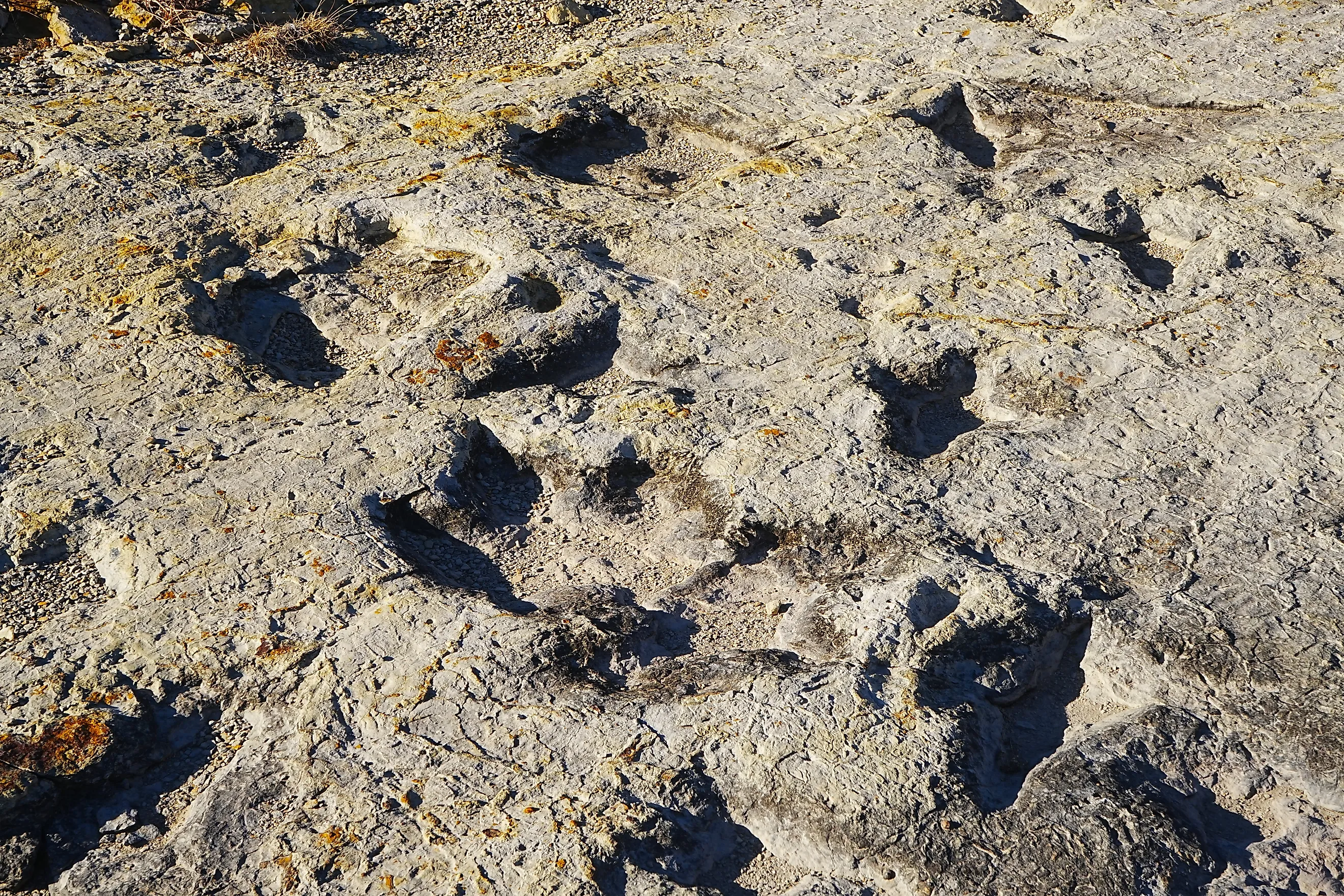
The spillway of Clayton Lake State Park exposes over 500 individual footprints from at least four different species, preserved on a single rock surface and among the larger tracksites open to the public in the United States. Dating to the Cretaceous period, approximately 100 million years ago, the tracks are preserved in the Dakota Sandstone.
The site is particularly notable for containing rare "trail drags," marks left by the tails or bellies of dinosaurs, which provide paleontologists with data on posture and movement that skeletal remains cannot offer. Managed by the New Mexico Energy, Minerals, and Natural Resources Department, the 471-acre park sits in the northeastern corner of the state. The tracks are located at the base of the dam spillway, accessible via a gentle one-mile roundtrip trail. The majority of the prints belong to ornithopods, specifically the ichnogenus Caririchnium, large herbivores that walked on two legs. Smaller theropod tracks are also present, indicating a diverse ecosystem where predators stalked prey along an ancient shoreline.
Unlike many fossil sites where access is restricted, the tracks here are openly viewable, though visitors are prohibited from walking on the fragile surface to prevent erosion. The park maintains a visitor center with interpretive displays explaining the geology and the specific species that inhabited the region. Water levels in the lake can fluctuate, but the spillway tracks remain generally visible year-round, offering a consistent window into the Cretaceous environment.
Dinosaur State Park, Connecticut

Dinosaur State Park in Rocky Hill protects one of the largest dinosaur track sites in North America, with over 750 Early Jurassic footprints preserved in place beneath the park's exhibit dome. Discovered in 1966 by a construction worker, the site dates back approximately 200 million years to when Connecticut was part of the supercontinent Pangaea, characterized by a hot and arid climate.
The tracks were made primarily by theropods, and the trackmaker is generally thought to be a large bipedal carnivore similar to Dilophosaurus. Managed by the Connecticut Department of Energy and Environmental Protection, the park features a dedicated exhibition center built directly over the main trackway. This climate-controlled facility allows visitors to view the fossils year-round, regardless of weather conditions. The center includes a geodesic dome and interactive exhibits detailing the geology of the Connecticut River Valley and the process of fossilization.
A unique feature of this park is the opportunity for visitors to create their own plaster casts of dinosaur tracks. Under ranger supervision, guests can participate in a hands-on program that replicates the scientific method of documenting trace fossils. The outdoor portion of the park includes nature trails and an arboretum, while roughly 1,500 further tracks nearby remain deliberately buried to protect them from weathering. The site serves as a critical educational resource, demonstrating that the Northeastern US was once a hub of dinosaur activity.
Dinosaur Valley State Park, Texas

The Paluxy River bed within Dinosaur Valley State Park reveals some of the most famous dinosaur tracks in the world, visible only when water levels are low. The park, managed by Texas Parks and Wildlife, protects a section of the river where sauropod and theropod tracks are preserved side-by-side in the Glen Rose Limestone, the herbivores and the carnivores together. Dating to the Early Cretaceous period, about 113 million years ago, these tracks provide rare evidence of predator-prey interactions or at least shared pathways.
The park encompasses over 1,500 acres near Glen Rose, southwest of Fort Worth. The main track sites are located in the riverbed, accessible via short hiking trails from the parking areas. When the river is flowing high, the tracks are submerged and invisible. During dry periods or droughts, hundreds of prints become exposed. The sauropod tracks are deep, circular depressions, while the theropod tracks are three-toed and sharper. Visitors are advised to check river conditions before traveling, as the visibility of the tracks is entirely dependent on water levels and recent rainfall.
Dinosaur Valley maintains a visitor center with exhibits on the local geology and the dinosaurs that roamed the region. In addition to the tracks, the park offers hiking, camping, and swimming in the river when conditions permit. The site is designated as a National Natural Landmark, recognizing its significance to paleontology.
Red Fleet State Park, Utah

The shoreline of Red Fleet Reservoir within Red Fleet State Park preserves a significant theropod trackway dating back approximately 200 million years to the Early Jurassic period. Managed by Utah State Parks, the property features a dedicated 1.5-mile trail, three miles there and back, that leads hikers across sandstone to the water's edge, where several hundred three-toed footprints are visible. These tracks, assigned to the ichnogenus Eubrontes and left by large bipedal theropods, are embedded in the rock surface and can be hard to pick out against the red sandstone, so the route is waymarked with black painted track symbols.
The park, located near Vernal in northeastern Utah, encompasses 2,170 acres of high desert landscape. The trackway is situated along the reservoir's fluctuating shoreline, meaning the number of visible prints can vary with water levels. During drought periods, more of the trackway is exposed, while high water can submerge sections of the fossil bed.
The 1.5-mile hike to the site traverses a rugged but well-marked path through juniper and sagebrush, offering views of the surrounding Uinta Mountains. The park provides interpretive signage at the trailhead and along the route, explaining the geology of the Nugget Sandstone formation and the behavior of the dinosaurs that left the prints.
John Martin Reservoir State Park, Colorado

John Martin Reservoir State Park in southeastern Colorado protects a significant but often overlooked dinosaur tracksite dating to the Cretaceous period, approximately 97 million years ago. Discovered in 2004 along the shores of the reservoir during a severe drought, the site features over 350 individual footprints including from ornithopods, a large theropod, crocodiles, and even a pterosaur, the first pterosaur evidence recorded anywhere in the Dakota Group. The tracks are preserved in the Pajarito Formation of the Dakota Group, exposed on the sandstone banks of the Arkansas River.
Managed by Colorado Parks and Wildlife, the park offers a quiet alternative to the more crowded fossil sites in the western part of the state. When the reservoir is low enough, the tracks are accessible via short walks along the shoreline. During periods of low water, extensive sections of the trackway are exposed, revealing the diverse assemblage of animals that once traversed the ancient river delta. High water can submerge the prints, making timing a critical factor for visitors.
The park maintains a visitor center with exhibits on the local geology and the fossil discoveries. Unlike sites with dedicated boardwalks or indoor protection, the John Martin tracks are viewed in their natural setting, subject to the elements and the changing water line. This raw accessibility allows visitors to see the fossils exactly as paleontologists found them, embedded in the rock of the reservoir floor.
Preserving the Trace
These five state parks demonstrate that significant paleontological features exist within the state park system, offering direct access to the history of dinosaurs. By protecting trackways in New Mexico, Connecticut, Texas, Colorado, and Utah, state agencies preserve actual impressions left by animals that lived tens of millions of years ago. The management of these sites varies, from the climate-controlled preservation in Connecticut to the river-dependent visibility in Texas and the reservoir-fluctuating shores of Utah, reflecting the diverse challenges of conserving trace fossils.
For travelers interested in paleontology, these parks provide a glimpse into the Mesozoic Era within a protected wilderness setting. Lower visitor densities compared to major federal monuments often allow for more relaxing observation of the trackways. With proper planning and awareness of site-specific conditions, such as water levels, erosion closures, or seasonal access, visitors can walk alongside the footsteps of dinosaurs within a framework defined by public access and focused educational resources.