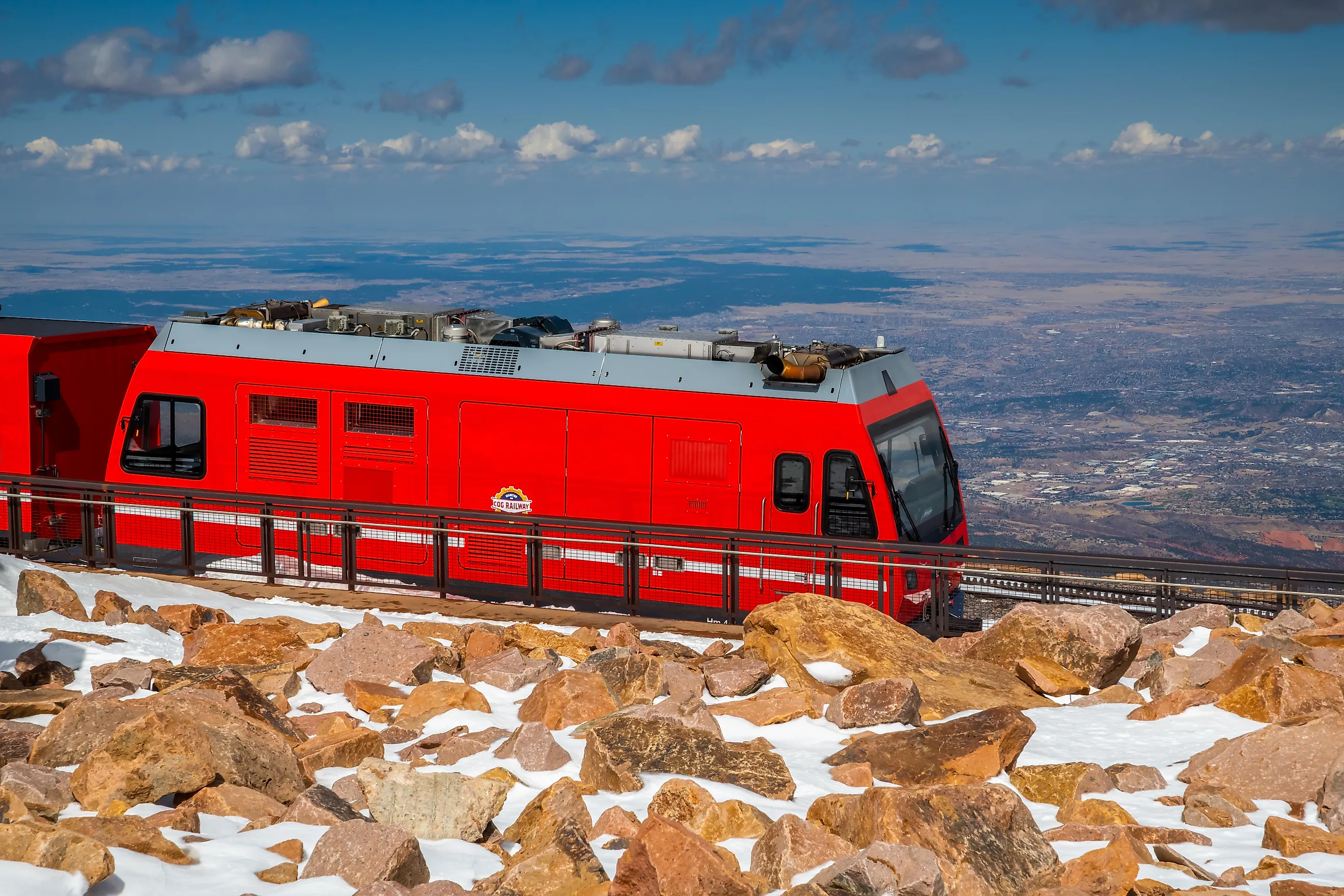
The Highest Railway In North America
The Broadmoor Manitou and Pikes Peak Cog Railway is the highest cog railroad in the world. The railway reached the 14,115-foot (4,302-meter) summit of Pikes Peak for the first time on June 30, 1891. It continues to hold the record for the highest active railway of any operational classification in the US It is also one of only two cog railways in the country.
What Makes Broadmoor Manitou and Pikes Peak the Highest Railway?

This article defines the highest railway in North America as the railway with the maximum elevation above mean sea level. This elevation is reached by an operational train track that carries passenger or freight traffic. This definition allows for rack systems, funiculars, and industrial spurs to be evaluated alongside conventional friction-based adhesion railways. However, other railways can be considered if the metric shifts. In the case of conventional adhesion railways with steel wheels running on smooth rails without cog teeth, the attention shifts to the Leadville, Colorado and Southern Railroad. This railway operates at a peak elevation of 10,800 feet (3,292 meters). If the criteria is restricted to active freight mainlines on heavy rails, Union Pacific's route through Colorado's Moffat tunnel holds the high point at 9,239 feet (2,816 meters).
Constructing the Highest Railway in the US

The history of the highest railway in North America starts with a mule ride. Zalmon Simmons, the inventor and founder of the Simmons Bedding Company, took a trip to the Pikes Peak region in the late 1880s. The goal was to check on his telegraph wire insulator invention for the wires that ran to the Army Signal Station on the summit. The only way to reach the top was via mule, which took two days. Simmons fell in love with the views, but was not crazy about the mode of transport. As such, when the owner of the hotel he stayed at mentioned what a great thing it would be to have a railway to the summit, Simmons listened intently.
The result was the founding of the Manitou and Pikes Peak Railway Company in 1889. The construction of the tracks started immediately, and the following year three locomotives were delivered from Baldwin Locomotive Works. In total, six locomotives went into service. The first passenger train headed for the Pikes Peak summit carried a Denver church choir, and they made it to the top on June 30, 1891.
In 1925, Spencer Penrose bought the railway, just more than ten years before the introduction of gasoline- and diesel-powered locomotives. A new, smaller railcar was built for summit rides, which resulted in the manufacturing of railcar No. 7. The car was gas-powered and could hold only 23 passengers. It is thought to be the first rack rail car built, and it made its first summit run on June 16, 1938. It took less than a year for the first diesel-electric cog locomotive to be delivered from the General Electric Company. Diesel meant no more water and coal. These cars, as well as Nos. 8 to 12, were part of the main railway fleet for twenty-five years.
Enter the Modern Railway Age

Colorado saw an increase in tourists starting in the 1960s, but the General Electric Company declined to manufacture more equipment for the railway to cater to the numbers. Railcars were bought from the Swiss Locomotive Works in Switzerland, with Nos. 14 and 15 put into service in 1964, followed by Nos. 16 and 17. Martin Frick, a Swiss engineer, was hired in 1965, and he worked hard for 30 years to prepare the railway for the modern age. At the same time, tourism continued to boom, and the railway operators realized they needed a train that could carry at least 200 people. This allowed Nos. 18 and 19 to be added and the first modern railcars put into service in 1976. Change came in 2018 when the Manitou and Pikes Peak Cog Railway stayed closed for renovation. It reopened in 2021, featuring new technology, Stadler trains, and a single-rail cog system. Travelers who want to experience this railway will see wildlife along the way, including elk and bighorn sheep, and at the top they will have 360-degree views of the entire Pikes Peak region. These views include the Continental Divide and the Rocky Mountains.
Other Railways With Their Own Records

The Broadmoor Manitou and Pikes Peak Cog Railway is not the only one in America with a fascinating history and a record. As mentioned, the Leadville, Colorado and Southern Railroad departs from the highest incorporated municipality in the country. Leadville, Colorado sits 10,152 feet (3,094 meters) above sea level. The train travels through the San Isabel National Forest and follows the upper Arkansas River Valley to a high point near the Climax Molybdenum Mine. The railway uses diesel-electric adhesion locomotives that do not have a rack drive, so it ranks as the highest standard-gauge adhesion railway operating in the country.
The Denver and Rio Grande Railroad was constructed in 1880 and stretched 64 miles (103 kilometers) along a narrow-gauge line across the border between Colorado and New Mexico. The track reaches the summit at Cumbres Pass at an elevation of 10,015 feet (3,053 meters). It is the highest operating narrow-gauge steam railroad and the highest mountain pass route open to rail traffic in America.
The Tennessee Pass line features a 2,557-foot (779-meter) tunnel beneath the Continental Divide in Colorado. The rail line was built by the Denver and Rio Grande in 1881 as narrow gauge and converted to standard gauge in 1890. The track elevation at the summit reaches 10,424 feet (3,177 meters). It was a heavy-rail transcontinental freight mainline for more than a century until Union Pacific parked it in 1997. The line is still not in service, making it the highest out-of-service mainline corridor on the continent.
Before the completion of the 6.2-mile Moffat tunnel in 1928, the Denver and Salt Lake Railway crossed the Continental Divide via Rollins Pass. Opened in 1904, this standard-gauge adhesion line reached a summit elevation of 11,660 feet (3,554 meters) at Corona, Colorado. The line still holds the record for the highest standard-gauge main line ever constructed in North America even though high snow-clearing costs forced the abandonment of the pass route immediately following the opening of the tunnel.
Operating in an Alpine Environment

Running a train service to the summit of Pikes Peak inevitably means dealing with harsh alpine conditions. The atmospheric pressure drops by roughly 40 percent compared to sea level. The thin air made life very difficult for early steam crews. Boiler efficiency was cut, forcing firemen to shovel large amounts of coal to keep the steam pressure up. Modern diesel engines face the same lack of oxygen, losing significant horsepower unless fitted with high-altitude turbochargers. Severe weather creates ongoing maintenance demands. Winter temperatures in the area drop well below zero, while wind speeds at the summit can exceed 100 miles per hour (161 kilometers per hour). To keep the trains moving through the ice, operators use track heaters and snowplows to clear the ice from the rack rail teeth.
America's Highest Railway
Whether you look at the Broadmoor Manitou and Pikes Peak Cog Railway as a wonder of engineering or just a great tourist experience, the achievement is unmatched. By overcoming extreme grades and extreme weather for more than 130 years, the line still sets the standard for high-elevation passenger transit in America.