Where People Are Moving To On Florida's Emerald Coast In 2026
The five counties along Florida's Emerald Coast added about 92,400 residents between April 2020 and July 2025, and most of them came from other states. Natural change was slightly negative across the region, so migration accounted for all of the net gain and more. Walton, Bay, and Santa Rosa counties posted the strongest percentage increases, while Escambia and Okaloosa grew more slowly. Much of the expansion occurred around bays, bayous, and inland building corridors where more housing could be added. Destin and Fort Walton Beach were nearly flat, although double-digit growth in Gulf Breeze and Panama City Beach shows that the movement was not exclusively away from the water.
Crestview

Crestview ranks as the largest city in Okaloosa County and the farthest inland. The city added 3,780 residents between April 2020 and July 2025, a 13.8% climb from 27,413 to 31,193 in Census Vintage 2025. For comparison, Destin, roughly 25 miles south on the Gulf, was nearly flat over the same five years.
Where the newcomers came from sets Crestview apart from much of the coast. Okaloosa County received 9,771 arriving tax returns in the latest IRS migration data, and 28.5% came from elsewhere in Florida. The named out-of-state origins include El Paso County in Colorado, Cumberland County in North Carolina, and Bexar County in Texas, all home to major military installations. Another 369 returns came from Army Post Office and Fleet Post Office ZIP codes used by service members overseas. Eglin Air Force Base spreads across the county between Crestview and the coast, placing the city at the inland end of that commute. Okaloosa County's 31,494 veterans further show the military's influence on the local population.
Niceville

Niceville sits where Boggy Bayou opens into Choctawhatchee Bay. Its population rose from 15,793 residents in 2020 to 17,948 in 2025, an increase of 2,155, or 13.6%. Fort Walton Beach, by comparison, grew only 0.8%.
Okaloosa County's in-state arrivals came mostly from nearby counties. Santa Rosa, Walton, Escambia, and Bay supplied 1,561 of the 2,781 tax-filing households arriving from within Florida, or 56.1%. That pattern fits a city tied closely to the regional military and education economy. Eglin is nearby, and Northwest Florida State College maintains its 264-acre main campus in Niceville, a large institution that does not depend on the tourist season. Fred Gannon Rocky Bayou State Park occupies the eastern shore of the bayou, while established neighborhoods spread around the water toward Valparaiso. Niceville's growth is less about beachfront construction than steady expansion around the bay and the Eglin employment corridor.
Mary Esther

Mary Esther's growth was modest but positive. The city reached 4,093 residents in 2025, up 109, or 2.7%, from its 2020 base of 3,984. Fort Walton Beach grew 0.8% during the same period.
The migration case is tied mainly to location. Hurlburt Field borders Mary Esther on the west, and Okaloosa County's inflows include 369 tax-filing households from military APO and FPO addresses, along with arrivals from counties anchored by large military installations. Those figures are countywide rather than specific to Mary Esther, but the city sits directly beside one of the region's largest employment centers. Its small footprint also limits how much growth can occur inside the municipal boundary. The most visible change is along Mary Esther Boulevard. The Santa Rosa Mall closed its interior at the end of September 2025 after partial demolition of the old Dillard's building and food court began that spring. The redevelopment vision includes a grocery store, restaurants, and additional housing.
Freeport

Freeport posted the fastest growth of the seven places here. The Walton County city rose from 6,007 residents in 2020 to 7,543 in 2025, a gain of 1,536, or 25.6%. Walton County as a whole grew 23.9% over the same period.
Freeport's growth has a clear regional source. Of the 1,646 tax-filing households that moved into Walton County from elsewhere in Florida, 860 came from Okaloosa County, or 52.2%. Another 197 came from six counties in metropolitan Atlanta. Those are county-to-county movements rather than proof that every household settled in Freeport, but the city's housing pipeline helps explain why it captures part of the growth. Freeport sits on LaGrange Bayou, and US 331 connects it directly with South Walton. Much of that building capacity is concentrated in Hammock Bay. Its community development district says the project began with 3,000 acres and approval for more than 6,000 residential units. At that scale, Freeport can absorb growth that more developed beach communities cannot.
Panama City Beach

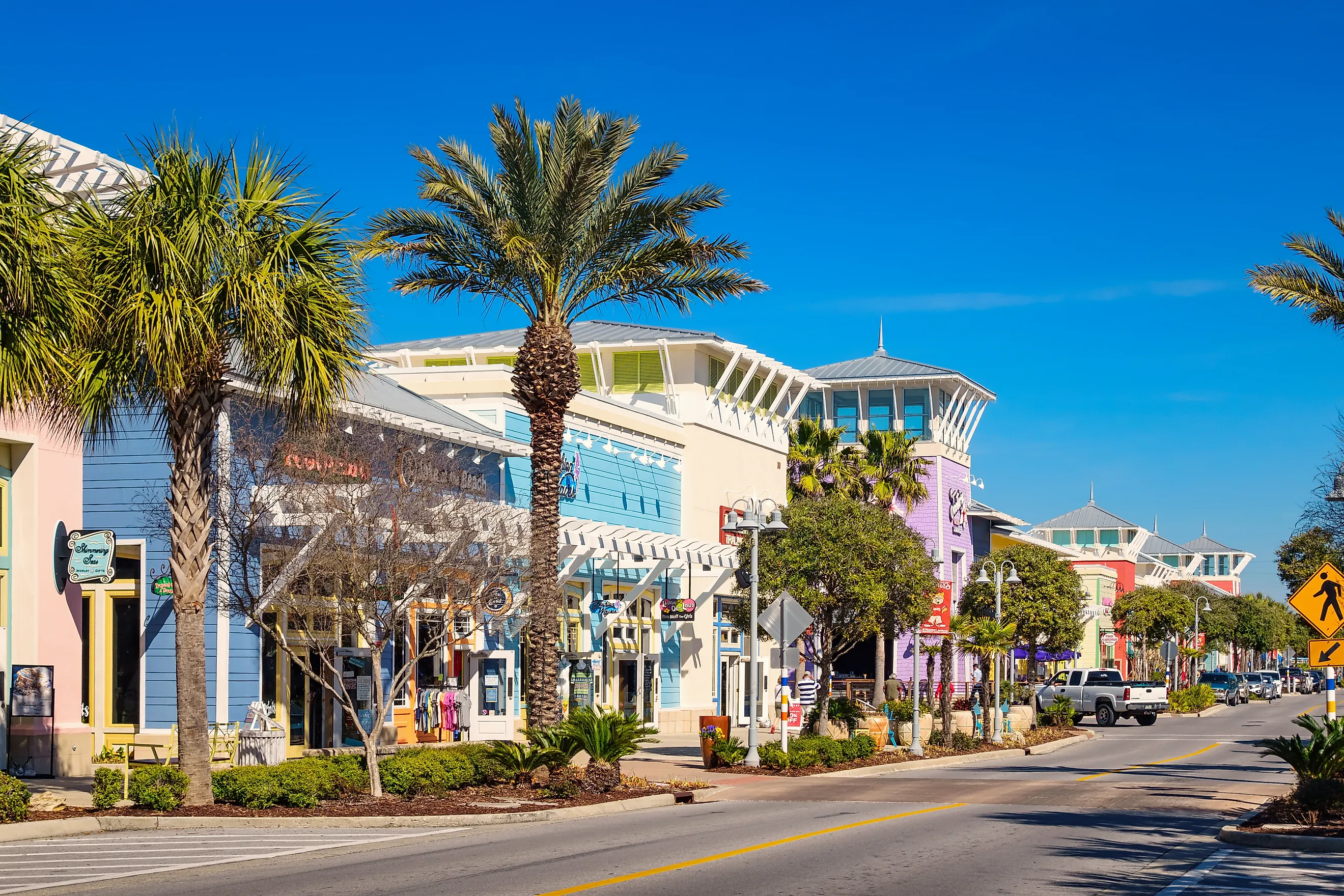
Panama City Beach is the coastal exception to the region's largely inland growth pattern. The city grew from 18,080 residents in 2020 to 20,375 in 2025, adding 2,295 people for a 12.7% increase. That is slower than Lynn Haven but still a substantial five-year gain.
Bay County's growth came almost entirely from migration. The county added 29,253 residents from its 2020 base, while deaths exceeded births by 277 and net migration added 29,335 people. Walton and Okaloosa were the two largest named in-state origin counties in the IRS data, showing movement east along the coast. Only 30.5% of Bay County's total inflow came from within Florida, however, so out-of-state migration remains the larger part of the story. Tourism supplies the city's primary economic base and supports an increasingly year-round schedule of events and sports travel. Pier Park remains the main commercial district, while St. Andrews State Park covers more than 1,200 acres at the east end and includes over 1.5 miles of beach.
Lynn Haven

Lynn Haven has grown faster than the beach since the 2020 Census base. The North Bay city reached 22,479 residents in 2025, up 3,775, or 20.2%, from 18,704. Panama City Beach grew 12.7% during the same period.
Hurricane Michael is part of the explanation, but the growth story now extends beyond recovery. The 2018 storm damaged or destroyed thousands of structures across Bay County and struck every Lynn Haven city facility. During the rebuild, residents returned to repaired homes while developers added apartments and townhomes. That created newer housing inventory on the mainland, away from the Gulf-facing resort strip. Bay County issued 2,072 building permits in 2025, showing that construction remains active. Growth among the neighboring mainland cities has been uneven: Parker increased 20.6%, Callaway 10.0%, and Springfield 5.6% between 2020 and 2025. Lynn Haven's main destination is North Bay, with established residential areas on land that could be rebuilt or filled in rather than assembled into an entirely new city.
Panama City

Panama City posted the largest numeric gain among Bay County's incorporated places. The city rose from 33,065 residents in 2020 to 37,806 in 2025. The gain of 4,741 people works out to 14.3%, a clear reversal from the population losses that followed Hurricane Michael.
The county's arrivals came from nearby Florida counties and farther away. Walton County sent 275 tax-filing households into Bay County and Okaloosa sent 233, the two largest named in-state flows. Washington, Leon, Gulf, Escambia, and Jackson counties followed. Still, only 30.5% of Bay County's total inflow came from within Florida, and another 109 returns came from APO and FPO ZIP codes. Tyndall Air Force Base is one reason the military connection remains important. The base is being rebuilt as the Department of Defense's first Installation of the Future, and its first F-35s arrived on August 1, 2023. On the west side of Panama City, St. Andrews remains a concrete neighborhood draw, with its marina, traditional street grid, and Beck Avenue business district.
Bayou Bliss
The strongest growth corridor still lies mainly one ridge back from the water, but not exclusively. Walton and Bay posted the five-county region's largest percentage gains, while Escambia and Okaloosa grew more slowly; Panama City Beach also added residents even as Destin and Fort Walton Beach were nearly flat. Within the region, households are reshuffling across county lines: Okaloosa households move into Walton, Escambia households move into Santa Rosa, and out-of-state arrivals add to both patterns. For current residents, that means continued pressure on housing supply, roads, and schools in fast-growing places such as Freeport, Crestview, and Panama City. The bayou towns are not the alternative to the beach anymore. They are the market.