11 Longest Bridges in South America
The longest bridges in South America are a strange list. The number one entry is not a road bridge at all, but the world's longest elevated metro viaduct, in Lima. The next four cross some of the continent's biggest rivers (the Guanabara Bay, the Paraná, Lake Maracaibo, the Uruguay) and were each, on opening day, the longest of their kind in their country. After that the list runs through Brazilian Paraná-crossings, an Amazon tributary bridge that only opened in 2011, and Colombia's two longest road crossings. The eleven below are ranked by total length of bridge structure, not by length of the wider road link they sit inside.
1. Lima Metro Line 1 - 21.5 miles

Lima Metro Line 1 is not a single bridge in the conventional sense. It is a 34.6-kilometer (21.5-mile) continuous elevated railway viaduct, recognized as the longest metro viaduct in the world. The line runs above ground across nine districts of Peru's capital, from Villa El Salvador in the south to Bayóvar in the northeast, serving 26 stations. Construction began in 1986, was suspended during Peru's economic crisis of the late 1980s, and only resumed two decades later. The first segment opened to passenger service in 2011-2012, and the full line to Bayóvar opened in 2014. The lead structural design was done by TYLin International, which engineered the elevated guideway and two segmental bridges over the Rímac River as part of the project. Daily ridership is now in the hundreds of thousands.
2. Rio-Niterói Bridge - 8.26 miles

The Rio-Niterói Bridge crosses Guanabara Bay in Brazil and is the longest road bridge in South America. Total length is 13.29 kilometers (8.26 miles). It was constructed between 1968 and 1974 and, on opening, was the second-longest bridge in the world; it now sits well outside the global top 50, though it remains one of the longest box-girder bridges anywhere. The central section rises to a navigation clearance of 72 meters, high enough for cargo ships entering and leaving the port of Rio de Janeiro to pass underneath. Daily traffic averages well above 100,000 vehicles. The official name is the Presidente Costa e Silva Bridge, after the Brazilian president who initiated the project in 1968.
3. Rosario-Victoria Bridge - 7.6 miles

The Rosario-Victoria connection is not a single bridge but a 12.2-kilometer (7.6-mile) chain of bridges and viaducts that crosses the Paraná River and the islands of the Paraná Delta to link the cities of Rosario in Santa Fe province and Victoria in Entre Ríos province, Argentina. The total road link, including approach embankments, runs 59.4 kilometers. The main structure is a cable-stayed bridge 4.1 kilometers long with a 350-meter central span, plus twelve smaller bridges totaling 8.2 kilometers across the islands. Construction began in 1997-1998, was repeatedly halted during the Argentine economic crisis of 2001, and the link finally opened to traffic on May 22, 2003. It was built by an international consortium led by Italian firm Impregilo.
4. General Rafael Urdaneta Bridge - 5.4 miles

The General Rafael Urdaneta Bridge crosses the Tablazo Strait at the northern outlet of Lake Maracaibo in Venezuela. Total length is 8.7 kilometers (5.4 miles). It opened on August 24, 1962, and is one of the first modern cable-stayed bridges with multiple spans, a design that became Riccardo Morandi's signature. Morandi, an Italian civil engineer, won the design competition in 1957; his proposal was the only concrete entry of the twelve submitted. The bridge has five main navigation spans of 235 meters each, supported by 92-meter towers, with 46 meters of clearance for ships entering the lake. On April 6, 1964, less than two years after opening, the oil tanker Esso Maracaibo lost steering in a power failure and struck the bridge; an 850-foot section collapsed, killing seven people. It carries only vehicles, and is named after a Venezuelan independence general born in Maracaibo.
5. Libertador General San Martín Bridge - 3.36 miles

An international bridge connecting Argentina and Uruguay. The Libertador General San Martín runs 5.4 kilometers (3.36 miles) across the Uruguay River, linking Puerto Unzué on the Argentine side to Fray Bentos on the Uruguayan side. It opened to traffic in December 1976 after a little over four years of construction at a cost of around 21 million US dollars at the time. The design is a cantilever bridge. It is named after José de San Martín, the Argentine general who led the southern campaign of the South American wars of independence. The crossing is one of three road bridges that link the two countries; the others are the Salto Grande Bridge and the General Artigas Bridge.
6. Viaducto Del Manglar - 3.3 miles

Officially the Viaducto Gran Manglar, this 5.4-kilometer (3.3-mile) viaduct runs over a mangrove lagoon and freshwater channels on the northern stretch of the Ruta del Sol highway in Colombia. It forms part of the road link between the industrial port of Barranquilla and the resort city of Cartagena. The structure was built to cross sensitive wetland terrain without disturbing the mangrove ecosystem; engineering elements include pile foundations driven into soft sediment and elevated decks above the water. It is the longest viaduct in Colombia and one of the longest in Latin America.
7. Rodoferroviária Rollemberg-Vuolo Bridge - 2.3 miles

The Rodoferroviária Rollemberg-Vuolo Bridge crosses the Paraná River between the states of Mato Grosso do Sul and São Paulo in Brazil. Total length is 3.7 kilometers (2.3 miles). The structure is a double-deck bridge: the upper deck carries road traffic, the lower deck carries railway tracks, an unusual configuration in South America. Construction began in 1991 and the bridge opened in 1998. The Portuguese name "Rodoferroviária" combines "rodovia" (highway) and "ferrovia" (railway), describing the dual function. It is named after Deputy Roberto Rollemberg and Senator Vicente Emílio Vuolo, two politicians who pushed the project through Brazil's federal funding process.
8. Ayrton Senna Bridge - 2.24 miles

The Ayrton Senna Bridge crosses the Paraná River 3.6 kilometers (2.24 miles) between Guaíra in the state of Paraná and Mundo Novo in Mato Grosso do Sul. It opened in 1998 after construction that began in 1994. The bridge is named for Ayrton Senna da Silva, the Brazilian three-time Formula One World Champion who died in a crash at the San Marino Grand Prix in 1994, the same year construction started. The bridge sits a short distance downstream of the Rollemberg-Vuolo Bridge and provides a road-only alternative crossing in the same general region.
9. Rio Negro Bridge - 2.24 miles

Officially the Journalist Phelippe Daou Bridge, the Rio Negro Bridge is 3.6 kilometers (2.24 miles) long and connects the city of Manaus with the town of Iranduba in Brazil's Amazonas state. Construction began in December 2007 and the bridge opened on October 24, 2011, after about four years of work in difficult conditions including annual floods and soft alluvial soils. Final cost was approximately R$1.1 billion. Two cable-stayed towers rise 185 meters above the water, supporting a 400-meter cable-stayed central section over the river's main navigation channel; clearance below is 55 meters, enough for Amazon cargo ferries. This is the only major bridge crossing any tributary in the Amazon basin, and a 2018 study found that its construction induced measurable deforestation in the surrounding area, a controversy that accompanied the project from the beginning.
10. Third Bridge - 2.05 miles

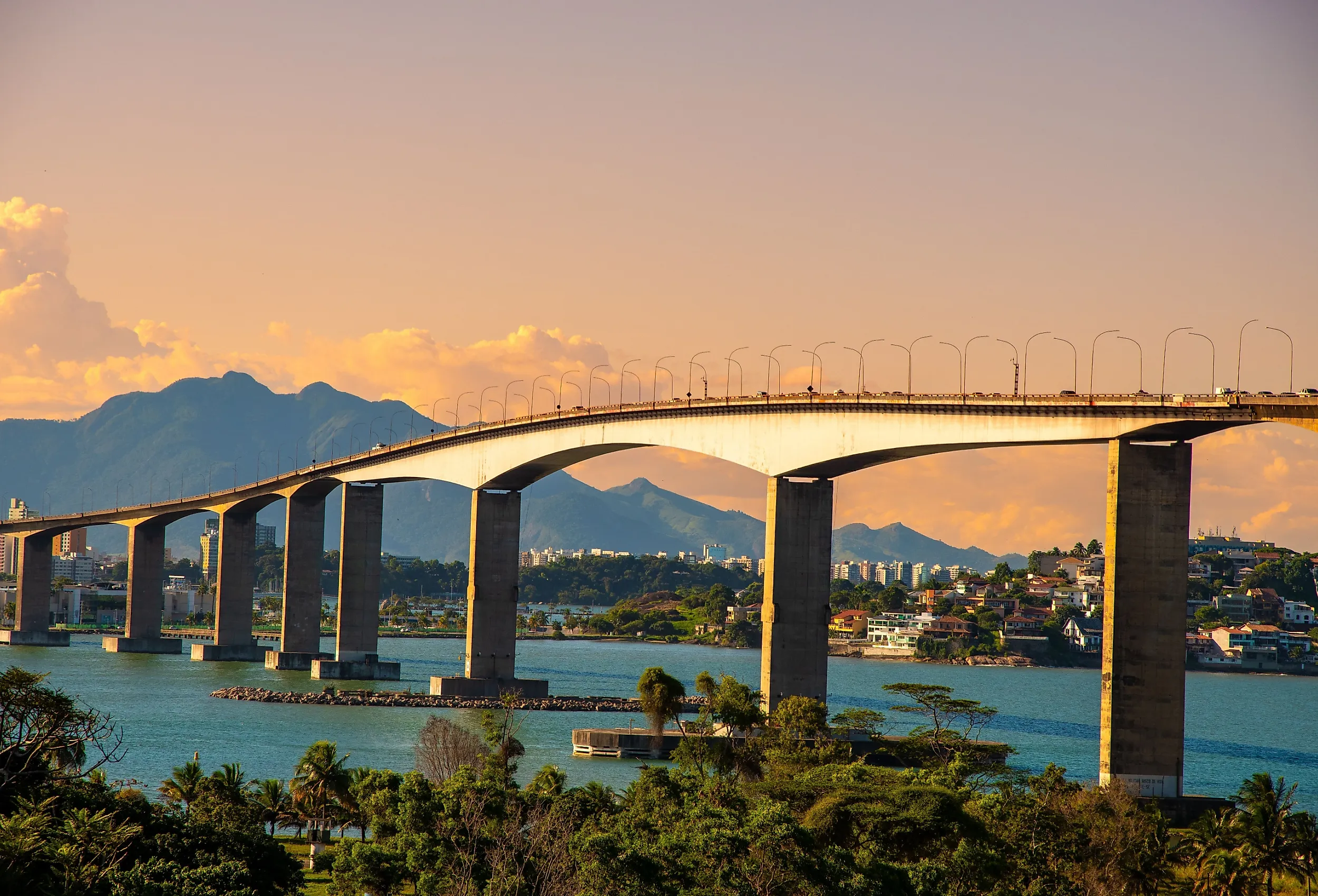
The Deputy Darcy Castelo de Mendonça Bridge, known as the Third Bridge (Terceira Ponte), connects Vila Velha and Vitória across the mouth of Vitória's Bay in Brazil's Espírito Santo state. Total length is 3.3 kilometers (2.05 miles); the deck stands 70 meters above the water at its highest point, making this the second-tallest bridge in Brazil. Construction began in 1978 and was completed eleven years later on August 23, 1989; the long timeline reflected repeated funding stoppages. The bridge originally carried four lanes of traffic. An expansion completed around 2023 added two more lanes, bringing the total to six, and a separate cycle path was added at the same time. The longest single span is 260 meters. Daily traffic is roughly 58,000 vehicles. The "Third Bridge" name is a reference to the two older bridges already connecting the two cities, the Florentino Avidos Bridge ("Five Bridges") and the Prince Bridge.
11. Pumarejo Bridge - 1.9 miles

The Pumarejo Bridge crosses the Magdalena River at Barranquilla, Colombia, linking the city with Salamanca Island Road Park and the eastern Caribbean coast. Total length is 3.2 kilometers (1.9 miles), making it the longest road bridge in Colombia by a small margin over the Pumarejo's runner-up, the Viaducto del Manglar. It opened to traffic in December 2019 after construction that began in 2012. The new structure replaced the original Laureano Gómez Bridge (built 1974) which sits alongside it and was closed rather than demolished after the replacement opened. Six road lanes carry vehicles; separate provisions are made for cyclists and pedestrians. Vertical clearance of 45 meters allows larger ocean-going ships to enter the Magdalena's port facilities at Barranquilla.
What This List Looks Like, Stepped Back
Almost half of the eleven entries are in Brazil, which reflects both the country's size and the engineering demands of its rivers; the Paraná alone carries four of the bridges on the list. Five of the structures are cable-stayed designs, three are box-girder or composite road bridges, one is a double-deck road-rail bridge, one is a viaduct over wetlands, and the entry at number one is not a bridge at all in the conventional sense but a continuous metro viaduct. The oldest on the list is the Urdaneta Bridge (1962); the newest is the Pumarejo (2019). Most of the cable-stayed bridges here were the longest of their kind in their country on opening day. The list below extends the ranking to twenty-five structures for reference.
| Rank | Bridge Name | Location | Length (miles) | Length (kilometers) |
|---|---|---|---|---|
| 1 | Lima Metro Line 1 (viaduct) | Peru | 21.5 | 34.6 |
| 2 | Rio-Niterói Bridge | Brazil | 8.26 | 13.3 |
| 3 | Rosario-Victoria Bridge | Argentina | 7.6 | 12.2 |
| 4 | General Rafael Urdaneta Bridge | Venezuela | 5.4 | 8.7 |
| 5 | Libertador General San Martín Bridge | Argentina / Uruguay | 3.36 | 5.4 |
| 6 | Viaducto Gran Manglar | Colombia | 3.3 | 5.3 |
| 7 | Rodoferroviária Rollemberg-Vuolo Bridge | Brazil | 2.3 | 3.7 |
| 8 | Ayrton Senna Bridge | Brazil | 2.24 | 3.6 |
| 9 | Rio Negro Bridge | Brazil | 2.24 | 3.6 |
| 10 | Third Bridge (Terceira Ponte) | Brazil | 2.05 | 3.3 |
| 11 | Pumarejo Bridge | Colombia | 1.9 | 3.2 |
| 12 | Second Orinoco Crossing (Orinoquia Bridge) | Venezuela | 1.9 | 3.2 |
| 13 | Eurico Gaspar Dutra Bridge | Brazil | 1.74 | 2.8 |
| 14 | Chacao Channel Bridge | Chile | 1.6 | 2.6 |
| 15 | Héroes del Chaco Bridge | Paraguay | 1.6 | 2.6 |
| 16 | Puente Maurício Joppert | Brazil | 1.5 | 2.5 |
| 17 | Avenida San Roque Gonzalez de Santa Cruz | Argentina | 1.5 | 2.5 |
| 18 | International Bridge Colón | Argentina | 1.43 | 2.3 |
| 19 | Juan Pablo II Bridge | Chile | 1.43 | 2.3 |
| 20 | Bridge Baron Mauá | Brazil | 1.3 | 2.1 |
| 21 | General Belgrano Bridge | Argentina | 1.1 | 1.7 |
| 22 | Juscelino Kubitschek Bridge | Brazil | 0.7 | 1.2 |
| 23 | Octavio Frias De Oliveira Bridge | Brazil | 0.56 | 0.9 |
| 24 | Angostura Bridge | Venezuela | 0.4 | 0.7 |
| 25 | César Gaviria Trujillo Viaduct | Colombia | 0.25 | 0.4 |