Indiana Dunes National Park's Towering Sand Ridges
Indiana Dunes is a national park at war with itself, in the best possible way. Along 15 miles of southern Lake Michigan shoreline, wind-piled sand ridges rise over the cold blue water of the Great Lake, leftovers of the last Ice Age that have somehow held on into the age of the interstate. And holding on is the theme here. Gary's smokestacks puff away to the west, the futuristic 1933 Chicago World's Fair houses squat in the Beverly Shores section, and at sunset the entire Chicago skyline glows across the water. Nowhere else does the ancient press up against the industrial quite like this, or make the case for conservation so bluntly. Let's tour the most improbable unit in the National Park Service.
Location, Geography, and History

Indiana Dunes started out in 1966 as Indiana Dunes National Lakeshore, and only earned its promotion to national park, the country's 61st, in 2019. The protected strip still runs 15 miles between Gary and Michigan City, swallowing the older Indiana Dunes State Park (established in 1926) at its midpoint. Together the two cover more than 17,000 acres, roughly 15,000 federal and 2,182 state. They look and feel identical, but they are administered separately, which means you will need a pass for each. For simplicity, this article treats the whole sandy sweep as one place.

To understand the dunes, rewind to the end of the last Ice Age, roughly 11,000 years ago, when mile-thick glaciers ground across the continent. The retreating Wisconsin glacier left behind both the five Great Lakes and staggering quantities of sand, and those relentless Midwest winds have been sculpting it into shifting ridges ever since. The biggest ridge of all, the 200-foot Hoosier Slide near Michigan City, did not survive the encounter with industry. It was carted off by the boxcar-load and melted into glass, including Ball canning jars, until it disappeared entirely by 1920. A power plant sits on its grave today.

That kind of loss lit a fire under a conservation campaign that Henry Cowles, the University of Chicago botanist often called the father of American ecology, had kicked off back in 1899. Standing with him were Dorothy Buell, an Ogden Dunes English teacher who ran the grassroots Save the Dunes Council, and, crucially, U.S. Senator Paul H. Douglas of Illinois, who fought so hard for a park in a neighboring state that he earned the nickname "the third senator from Indiana." Their work made the state park real in 1926 and the national lakeshore real in 1966. Expansion bills in 1976, 1980, 1986, and 1992 built it out to its current size, and the 2019 national-park designation was the victory lap.
Unique Natural Phenomena

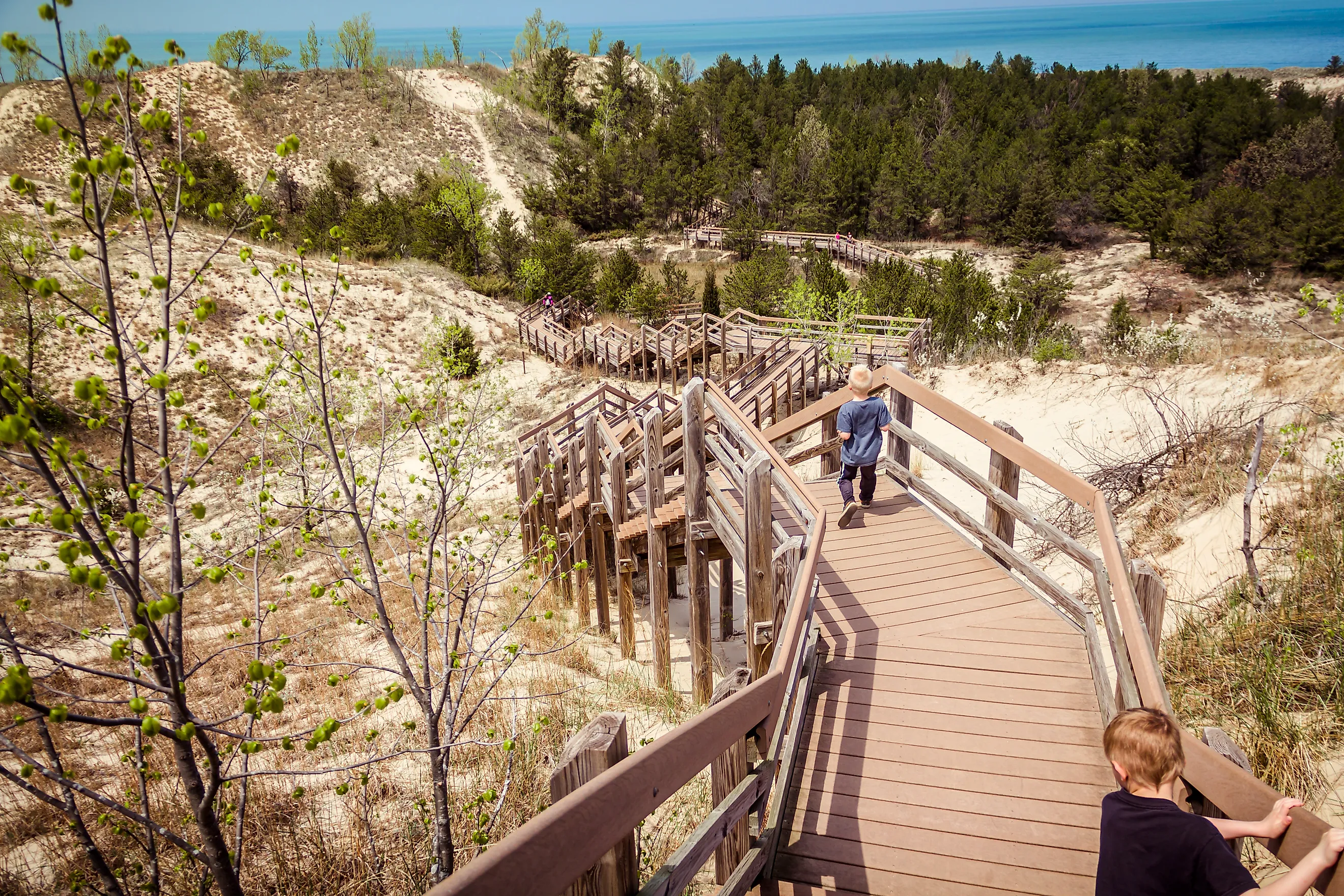
There is no mystery about this park's headline act. Four distinct dune complexes ripple inland, arranged almost like tree rings. The youngest, most restless dunes hug the shoreline as grassy ridges, and each complex behind them is older and more thickly vegetated than the last, grading into pine and oak forest, prairie, oak savanna, and boardwalk-laced wetland. The tallest ones cluster inside the state park: Mt. Jackson (176 feet), Mt. Holden (184 feet), and the reigning champion, Mt. Tom, which crests at 192 feet as the highest dune in Indiana.

The other headliner is the beach, and it is a serious one. Nearly all 15 miles of shoreline are wide, walkable, and swimmable, save for a few rip-current zones, with not a resort or arcade in sight, just sand groomed by Lake Michigan's wind and waves. It may be the most overlooked beach getaway in the country. Sure, the steel-mill stacks to the west intrude if you look that way, but there is a strange beauty in the contrast, as I went on about in the intro. Reassuringly, park staff monitor air and water quality and post updates, physical and digital, whenever conditions call for it.

Quieter, but arguably rarer, is the park's sliver of black oak savanna. This globally imperiled habitat once blanketed an estimated 50 million acres between Michigan and Nebraska. After a century of clearing, development, and fire suppression, only about 30,000 acres survive, and some of the highest-quality remnants sit right here. In the Miller Woods and Tolleston Dunes sections, where eastern hardwood forest hands off to western tallgrass prairie, 1,045 acres of this rare ecosystem are being painstakingly restored.
Top Things To Do
The dunes reward doers. Whether you want to punish your calves, chase migrating warblers, or simply eat a hot dog with a killer view, here is how to fill a day.
The 3 Dune Challenge

Link Mt. Jackson, Mt. Holden, and Mt. Tom together and you have the 3 Dune Challenge, a 1.5-mile loop that stacks up 552 vertical feet of pure sand. That number is a trap. Every step up the loose slopes slides you back half a stride, so the climb is far meaner than the distance lets on, though Mt. Tom at least rewards you with a proper wooden staircase near the end. Summit all three, snap a selfie, post it with #3DuneChallenge, and collect a free bumper sticker at the Indiana Dunes Visitor Center. You will have earned it.
Trail 9

If your legs have anything left, Trail 9 is the reward. Named by USA Today as one of the best hikes in Indiana, this 3.8-mile route threads through forest, rides the shoreline ridges, and crests two dramatic blowouts, serving up some of the finest views in the entire park. The number in the name is a hint: there are plenty of other trails to explore, and all of them stay open year-round. Come winter, you can even cross-country ski them.
Tour the Century of Progress Homes

History gets properly weird in Beverly Shores. After the 1933 Chicago World's Fair, five of its experimental "Century of Progress" homes were moved across to this little resort community, now ringed by the national park. You can study their odd angles, and in the case of the Florida Tropical house their flamingo-pink walls, from the outside any time of year. But on the last weekend of September, an annual tour opens the interiors of four of them. Tickets go on sale in early August and tend to vanish almost immediately, so set a reminder. Peering into a long-gone architect's vision of the future, dropped into a 10,000-year-old dunescape, is exactly the sort of contrast this park does best.
Snacks and Sunset at Dunes Pavilion

No beach day is complete without some cheat-day grub. The Dunes Pavilion on Porter Beach has it covered: kids can grab ice cream and hot dogs from the grab-and-go window on the patio, while the grown-ups climb to the rooftop for tacos and cocktails. Either way, the pavilion makes a natural rallying point for sunbathing, refueling, and, best of all, watching the sun slip behind the Chicago skyline across the water.
Bird Watching

Perched on the undeveloped southern tip of Lake Michigan, Indiana Dunes is a critical pit stop for migrating birds. Scan from the shoreline dunes for passing hawks and waterfowl, then head inland, where the wetlands pull in a completely different cast of characters. Serious birders should aim for the fall migration, when southbound flocks pile in, or for the Indiana Dunes Birding Festival, a four-day event held over the third weekend of May to catch the birds streaming back north.
Parting Thoughts
No other national park can frame 10,000-year-old dunes and century-old smokestacks in a single glance. Indiana Dunes puts the full, contradictory character of the Midwest on display, and then fights to keep it that way. So whether you want to kick back on a freshwater beach or grind your way up a leg-burning sand dune for a view of forest, prairie, and steel mill all at once, this stretch of Indiana shoreline delivers.