11 Main Streets Where Ohio Comes Alive
You can learn almost everything about an Ohio town by walking one street. Before there was a downtown, there was a reason for people to stop: a bend in a river, a lock on a canal, a courthouse dropped in the middle of new farmland, a waterfall that could turn a mill wheel. The main street grew up around that first reason, and generations later it is still the best place to stand and read what a town is about. The eleven below make that easy. On each one, the history, the shops, and the best walk all sit within a few blocks, and the origin story is right out in the open.
Granville

The settlers who founded Granville in 1805 came mostly from Granville, Massachusetts, and they laid out Broadway to look like the New England town they had left. That plan still holds. The street is wide and straight, the storefronts stay in a steady early-19th-century line, and the whole downtown looks like one continuous piece rather than a patchwork.
Denison University sits on the hill just above the shops, close enough that students walk down for coffee and residents walk up for concerts. A few steps off Broadway, the Robbins Hunter Museum occupies a restored Greek Revival home and displays local history inside it, and the grounds of the Bryn Du Mansion leave you room to wander at the edge of the village. It is a small downtown built for people on foot, which is exactly how its founders meant it to work.
Marietta

Everything in Marietta starts at the water. Pioneers stepped off the Ohio River here in 1788 and built the first permanent settlement in the Northwest Territory, and Front Street still traces that original riverbank. Walk it today and the levee runs alongside you, with benches facing the current and the Muskingum joining in just downstream.
The exhibits at the Campus Martius Museum lay out how those first arrivals actually lived, down to the fortified house they sheltered in. A block over stands the 1918 Lafayette Hotel, on the corner where riverboat crews once checked in. Cross the bridge and you reach Harmar Village, a second, older-feeling downtown to explore on the far bank. For a street this steeped in beginnings, Marietta stays remarkably easy and unhurried to walk.
Delaware

When Ohio lawmakers carved out Delaware County in 1807, they needed a seat, and the town grew around it. North Sandusky Street runs straight past the Italianate Delaware County Courthouse, built in 1868, and the commercial blocks line up on either side of that spine. This is central Ohio, just north of Columbus, and the old downtown stayed intact even as subdivisions filled in the countryside around it.
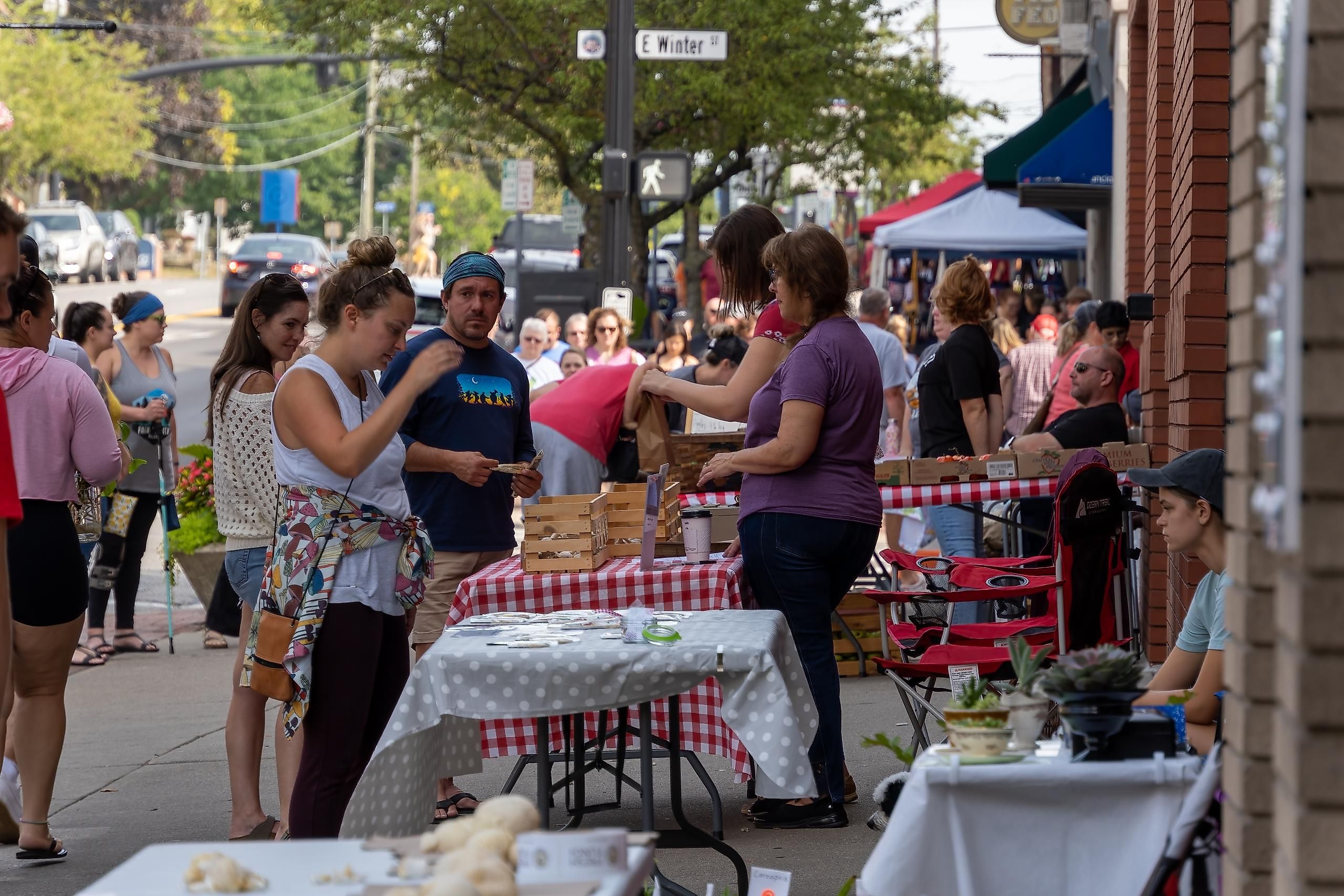
The street is worth a full afternoon. The Strand Theatre, at 28 East Winter Street, has screened films since 1916 and still lights up its original marquee. Ohio Wesleyan University, founded in 1842, sits a couple of blocks off Sandusky Street, and its students keep a steady flow into the cafes and shops. Out past the edge of town, Delaware State Park has room to boat and hike a few minutes from downtown, and on clear nights the staff at Perkins Observatory open its telescope to the public. The courthouse fixed the center of town in 1807, and everything worth doing grew up within walking distance of it.
Yellow Springs

People first came to Yellow Springs in the mid-1800s to take the waters, drawn by a mineral spring that a resort was built to sell. The resort is long gone, but the habit of showing up for something different never left. Xenia Avenue is now painted in bright colors, hung with murals, and lined with galleries and independent shops, all of it adding up to an unmistakable creative streak.
You can walk from a storefront straight into the woods here. The Glen Helen Nature Preserve begins just past downtown, its trails leading to the very spring the town was named for. Antioch College, founded in 1850, sits at the other end, and its students and faculty keep a steady flow of ideas and events moving through the village. Few main streets pack this much personality into so few blocks.
Medina

Medina followed a template that Connecticut surveyors brought west into the Western Reserve: start with a public square, then let the town grow outward from the green. Settled in 1818, it still works exactly that way. The square is the center of everything, with the Medina County Courthouse on one side and restored storefronts wrapping the rest.
There is a gazebo and planted beds to sit among in the middle of it all, and the shops are close enough that you never really leave the green behind. Just off the square, Castle Noel houses a year-round collection tied to Hollywood Christmas movies and holiday history, an oddball counterpoint to the tidy 1800s architecture around it. Because the settlers grew the town from one central point outward, the whole downtown stays within an easy stroll.
Tipp City

Tipp City owes its Main Street to a ditch full of water. The town, first called Tippecanoe, grew up in the 1840s beside the Miami and Erie Canal, and canal traffic set the shape of the whole downtown. Canal Lock No. 15 still sits within a short walk of the storefronts, a plain stone reminder of the boats that once made this a place worth stopping.
Those old commercial buildings now house antique shops and small businesses, and preservation of the Old Tippecanoe historic district has kept the 19th-century streetscape intact. When you want a change of pace, Tipp City Park spreads out just past downtown with shaded paths and open grass. It is a compact, workable main street, and its canal-town origins are still plain to see.
Chagrin Falls

The waterfall came first. Early settlers built Chagrin Falls around the drop in the Chagrin River in the 1830s because falling water could power mills, and they laid out the town to face that spot. Main Street runs right beside the falls, and the sound of the water carries down the block whether or not you can see it.
Riverside Park puts benches and short paths near the base of the falls, and footbridges stitch the two sides of downtown together. The Popcorn Shop, wedged into a skinny little building that seems to hang over the water, has been the town's most photographed corner for decades. Cafes and shops fill the surrounding blocks, so the scenery and the everyday errands sit side by side. That overlap is what makes the place stick in your memory.
Wooster

Founded in 1808 and named for Revolutionary War general David Wooster, this Wayne County seat grew the way county seats did: around a public square with the courthouse at the center. The Wayne County Courthouse still stands on that spot, ringed by historic buildings in a consistent 19th-century style. The shops and cafes run out from there along East Liberty Street.
The extras are what make a full day. Secrest Arboretum, part of the agricultural research campus on the edge of town, has landscaped gardens and seasonal color a short drive away. Through the summer, the Ohio Light Opera performs on the College of Wooster campus, one of the few companies in the country devoted to the operetta repertoire. History, a working college, and open gardens all sit within reach of the same square.
Put-in-Bay

Put-in-Bay is the one town on this list you reach by boat. This little village sits on South Bass Island in Lake Erie, about 85 miles west of Cleveland, and it grew into a busy summer resort in the late 1800s once steamers started bringing vacationers across the water. Delaware Avenue, the main strip, still runs on that resort rhythm, filling up between April and October and quieting down when the ferries thin out.
DeRivera Park sits right where the downtown meets the lake, with grass and shade a few steps from the docks. Rising above all of it is Perry's Victory and International Peace Memorial, a 352-foot Doric column, the tallest of its kind in the world, built to mark the 1813 Battle of Lake Erie. Climb to its observation deck and you can see clear to Canada. Marinas and harbor traffic keep the waterfront lively, and everything stays close enough to cover on foot.
Millersburg

Drop into the middle of Holmes County and you land in Millersburg, the county seat and the trading center for the largest Amish settlement in the world. Jackson Street runs through the heart of it, with the Holmes County Courthouse standing tall over a downtown of traditional brick storefronts. The town has been where the countryside comes to do business since the early 1800s, and that role still defines the street.
The Victorian House Museum, a 28-room mansion on the edge of downtown, is set up to show how a well-off Ohio family lived in the late 1800s. The shops and markets nearby lean toward local craft and farm goods, a direct reflection of the farmland all around. Look past the buildings in almost any direction and you see rolling fields and buggies on the shoulder. Few main streets are this plainly tied to the land that feeds them.
Cambridge

Cambridge exists because of a road. The town, first settled in 1798, grew up along the National Road, the country's first major federal highway, and Wheeling Avenue was the through route that carried wagons, mail, and money east and west. That crossroads history left a downtown of buildings from several different decades, anchored by the Second Empire Guernsey County Courthouse.
The National Museum of Cambridge Glass documents the local glassmaking trade in its displays, a nod to the factories that ran here in the early 1900s. Come December, volunteers turn Wheeling Avenue into the Dickens Victorian Village, with roughly 200 costumed figures staging scenes of 19th-century life while tens of thousands of lights play across the courthouse. A street first built to move people through is now a street people come to on purpose.
Reading a Town by Its Main Street
What connects these eleven places is not a look but a logic. In Ohio, a main street is rarely an accident. It sits where it sits because a river offered a landing, a canal offered a lock, a survey dropped a courthouse, a waterfall offered power, or a highway needed a stop, and everything else grew up around that first fact. Walk any one of them and the town's whole reason for being is right there in the storefronts and the layout.
That is what makes these downtowns worth an unhurried afternoon rather than a quick photo. You can trace 1788 in Marietta's riverbank, 1805 in Granville's imported New England grid, and the canal era in the stone of a Tipp City lock, all without moving your car. These streets are still in daily use, and walking one tells you exactly where you are.