2026's 12 Best Small Towns To Visit In Gulf Coast
On the first morning of 2026, oyster boats went back out onto Apalachicola Bay for the first time in five years. Down in Grand Isle, shrimpers still work the same pass their grandfathers did. You will find a real mix here. Some are fishing villages of a few hundred people, and a couple are small cities with art districts and museums. Here they are, running west along the coast and back again.
Apalachicola, Florida

Oysters put this Panhandle town of about 2,400 on the map, and in January 2026 they came back to it. Florida reopened Apalachicola Bay to limited wild harvest that month, ending a five-year closure meant to let the collapsed reefs recover. At its peak the bay produced most of Florida's oysters and a big share of the nation's, so the reopening is a genuine milestone for a community that has always measured itself by the catch.
The town itself is easy to take in on foot. Brick storefronts and a working marina sit within a few blocks of one another, and the Scipio Creek Boardwalk runs along the water near the docks for walking and fishing. You can catch a show at the 1912 Dixie Theatre, sort through the collection at the Apalachicola Maritime Museum, and eat your way through more raw bars than a town this size has any right to. Come in early November for the Florida Seafood Festival, when the crowds arrive for the day and the shucking contest.
Cedar Key, Florida

Dock Street is Cedar Key in one short strip: shrimp boats, oyster houses, and weathered shopfronts facing the marina, with the open Gulf just beyond. Fewer than a thousand people live out here on Florida's Nature Coast, and the town has stayed a fishing village while the rest of the state grew condos. The clam farmers who replaced much of the old net fishery still supply a big share of the country's farm-raised clams from these waters.
Cedar Key Museum State Park is set in the 1920s home of St. Clair Whitman, with exhibits on how cedar, pencil slats, and seafood once ran the local economy. A short paddle offshore, Atsena Otie Key has an old cemetery and a quiet shoreline left from the settlement that stood there before a hurricane pushed everyone to higher ground. The outer islands fall within the Cedar Keys National Wildlife Refuge, so bring binoculars for the pelicans and a camera for the sunset.
Fairhope, Alabama

A group of Iowa reformers founded Fairhope in 1894 as a single-tax colony, a place where residents leased the land in common rather than owning it outright. More than 130 years later the Fairhope Single Tax Corporation still runs on that model, and the idealism left its mark on the town of roughly 27,000 that formed here. Fairhope Avenue, the early-1900s main street, still has its brick storefronts, wide sidewalks, and an independent bookstore.
The Fairhope Municipal Pier reaches 1,448 feet into Mobile Bay and draws a crowd every evening for one of the best sunsets on the eastern shore. A rose garden sits just steps away, and the Eastern Shore Art Center a few blocks up hangs rotating exhibits from local artists. For a longer walk, boardwalks cross the salt and freshwater marsh at the Weeks Bay reserve south of town, a good bet for birdwatching.
Dauphin Island, Alabama

Three miles out in the Gulf off the mouth of Mobile Bay, Dauphin Island trades resort towers for dunes, marsh, and a small year-round population. The island sits on the Mississippi Flyway, so during spring and fall migration it fills with warblers and other songbirds making landfall after crossing open water. Birders arrive by the carload, and trails wind through the maritime forest of the Audubon Bird Sanctuary at the island's east end.
Fort Gaines stands at the eastern tip, where Confederate guns once traded fire with Farragut's fleet during the Battle of Mobile Bay. Nearby, the Dauphin Island Sea Lab runs the Estuarium, a public aquarium that walks you through the four habitats of coastal Alabama. Between the fort, the beaches, and the fishing pier, a day here goes by slowly, which is the whole idea.
Ocean Springs, Mississippi

Walter Anderson painted the marshes and islands around Ocean Springs so obsessively that he once rode out a hurricane on Horn Island to watch it. The museum named for him anchors a downtown of about 18,000 people that has leaned into that artistic streak, with galleries, independent shops, and restaurants lining Washington Avenue. Residents pack the streets each fall for the Peter Anderson Arts and Crafts Festival, one of the largest on the Gulf Coast.
Live oaks shade the streets, and the waterfront looks across to the barrier islands offshore. A Gulf Islands National Seashore visitor center and a stretch of marsh trail sit right in town, a good place to start before catching a boat out to Ship Island for the day. Between the art and the water, Ocean Springs manages to be creative and low-key at the same time.
Bay St. Louis, Mississippi

In Old Town Bay St. Louis, galleries, cafes, and century-old storefronts crowd a few walkable blocks that slope down toward the harbor. Second Saturday brings the whole district out each month for art, music, and open shops well into the evening. Hurricane Katrina flattened much of this waterfront in 2005, and the rebuilt Old Town is the clearest sign of how hard the town worked to come back.
The beach runs right along the edge of downtown, so you can browse a gallery and be standing in the sand ten minutes later. Anglers work the harbor and the bay bridge, and kayakers put in along the bayous that feed the Sound. Neighboring Waveland is a short drive down the coast if you want a quieter stretch of beach.
Pass Christian, Mississippi

Enormous live oaks arch over Scenic Drive in Pass Christian, framing the antebellum homes that survived the storms and the modern ones raised high on pilings after them. Locals call it "The Pass," a fishing and sailing town of about 6,500 that has hosted regattas since the 1800s. Shrimp and oyster boats still work out of the harbor, and the seafood markets along the water carry whatever the crews landed that morning.
The public beach runs for miles along the front, and a bike path traces the shoreline for an easy ride with the water on one side. War Memorial Park sits at the harbor with room for a picnic and a view of the boats coming and going. For photographers, the appeal is the oaks and the old houses set against the Gulf rather than a wall of high-rises in front of it.
Grand Isle, Louisiana

Grand Isle is the only inhabited barrier island in Louisiana, a seven-mile sandbar at the mouth of Barataria Bay reached by a single highway across the marsh. About a thousand people live here year-round, though the island swells toward 20,000 each summer for the Tarpon Rodeo, the oldest fishing tournament in the country. Shrimping, charter fishing, and the oilfield keep the place working the rest of the year.
Hurricane Ida tore through the island in 2021 and damaged nearly every building, and the raised, rebuilt houses on tall pilings tell that story at a glance. Grand Isle State Park sits at the eastern tip with a fishing pier and a birding trail, and migrating songbirds pour across the island every spring along the flyway. Anglers cast from the beach at sunrise while the shrimp boats head out past the pass.
Rockport, Texas

Rockport is known for birds, art, and a bay full of boats, and residents put all three back together after Hurricane Harvey came ashore here in 2017. People in this town of roughly 11,000 on Aransas Bay rebuilt the Cultural Arts District and the galleries, and the annual art festivals bring the crowds back. Rockport Beach, the first Blue Wave certified beach in Texas, curves along a protected stretch of the bay that is calm enough for kids.
The whooping cranes are the headline act. Every winter the last wild migratory flock on earth settles into the marshes at nearby Aransas National Wildlife Refuge, and boat tours out of Rockport get you close. Goose Island State Park protects the Big Tree, a coastal live oak estimated at more than a thousand years old. Between the cranes and the oak, the wildlife here is genuinely one of a kind.
Port Aransas, Texas

Port Aransas is the only town on Mustang Island, a barrier island you reach by a free ferry that runs around the clock across the ship channel. "Port A," home to about 3,000 residents, stays casual and salt-worn, with a working harbor of charter boats and seafood joints near the marina. Wide Gulf beaches let you drive right onto the sand, and deep-sea trips head out daily for kingfish and red snapper.
At the Leonabelle Turnbull Birding Center, a boardwalk crosses a freshwater wetland where alligators and roseate spoonbills are regulars, right beside the town ponds that pull the birds in. Dolphin-watching cruises leave from the harbor, often trailed by dolphins riding the wake. The University of Texas Marine Science Institute runs a visitor center in town for anyone curious about what lives in the surrounding bays.
Sarasota, Florida

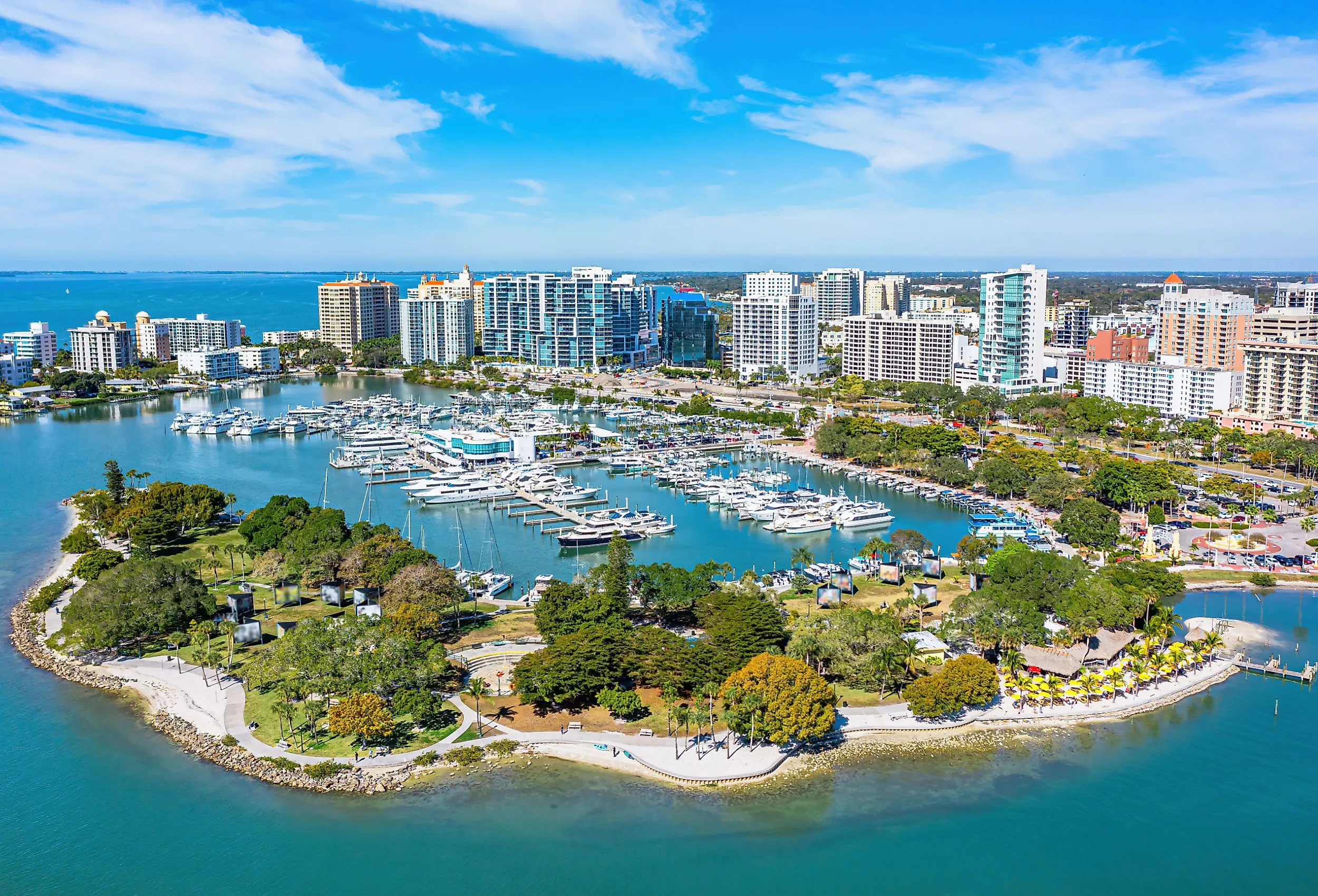
Circus money built the arts scene here. John Ringling moved his circus's winter quarters to Sarasota in 1927, and he and his wife Mable poured their fortune into a bayfront estate that they left to the state of Florida. The Ringling complex now holds an art museum, the Ca' d'Zan mansion, and a circus museum, and it remains one of the most-visited cultural sites in the Southeast. At roughly 57,000 residents, Sarasota is the largest community on this list, though it stays easy to explore on foot.
Downtown stays walkable, with Main Street, the 1926 Sarasota Opera House, and the Van Wezel hall on the bay all close together. Orchids and banyans fill Marie Selby Botanical Gardens along the waterfront a few blocks south, and joggers and anglers head out to Bayfront Park to watch the sun drop behind the marina. Drive west over the bridges and you land on Siesta Key and Lido Key, the barrier islands where the famous white sand and the swimming actually are.
Tarpon Springs, Florida

Greek sponge divers settled Tarpon Springs in the early 1900s and built the largest Greek American community in the country, and their descendants still run the docks. Sponge boats tie up along Dodecanese Boulevard, where warehouses, bakeries, and Greek restaurants stand shoulder to shoulder in a town of about 25,000. The smell of fresh baklava carries down the street, and you can watch a diver demonstrate the old hard-hat gear right at the water.
St. Nicholas Greek Orthodox Cathedral, its parish founded in 1907, still sits at the center of the community's religious and cultural life. Beyond the docks, Fred Howard Park west of downtown has a beach and a causeway popular with local anglers, and boat tours head out for the day into the Gulf. Between the food, the faith, and the sponge trade, Tarpon Springs feels like a piece of the Aegean transplanted to the Florida coast.
Twelve Ways to Meet the Water
Set these towns side by side and the pattern is clear: the Gulf Coast is at its best where people still make a living on the water. In Apalachicola the year runs on the oyster season, on Grand Isle families rebuild after every storm and fish off the beach anyway, and in Tarpon Springs the Greek community has worked the sponge trade for three generations. Birders in Rockport watch over the whooping cranes, and old circus money left Sarasota with one of the South's great arts scenes, while Cedar Key and Pass Christian have kept the fishing-village shape that bigger resorts traded away long ago. Pick any one for a weekend and you get a real place doing real things, close enough to the water that you can smell it.