8 Coolest Upstate New York Towns For A Summer Vacation In 2026
Some of the best summer days in New York are a tank of gas away. You can spend a Saturday sliding down water rides in the Adirondacks, sipping mineral water straight from the ground in Saratoga, and catching a seven-dollar matinee in a movie house older than your grandparents. There are Great Lake beaches, mountain trails, and a castle on its own island. These eight Upstate New York towns are each worth a full summer week. Peak season is July and August, so pick one and go.
Fair Haven

Fair Haven Beach State Park spreads across 1,141 acres of sand, glacial bluffs, and woodland just northeast of the village. The main beach stretches about 1,500 feet along the lake, with a 600-foot guarded swim area. Little Sodus Bay lies right behind it, calmer than the open lake when the wind picks up, and you can rent canoes and kayaks at the park for the inland Sterling Pond. At Colloca Estate Winery, 103 acres on the bay, you can take a table on the waterfront patio and drink Riesling and Pinot Noir grown on the property. In the village itself, area makers sell their work at South Shore Artisans. The menu at Brandon's Pub + Grille on Main Street includes a Friday haddock dinner and chicken riggies, the tomato-cream pasta that Utica made famous.
Old Forge

Families have been coming to Enchanted Forest Water Safari since 1956, and 2026 marks its 70th anniversary season, with a new spinning coaster named Paul Bunyan's Log Haul. It is the largest water theme park in New York, with more than 50 rides and attractions, including 33 heated water rides. Down in the village, the Strand Theatre opened as the Thomson in 1923. Matinees still cost $7, with evening seats at $8. Bring cash, because the box office does not take cards. Moses Cohen opened Old Forge Hardware in 1900, and four generations of his family have kept it going under the tagline the Adirondacks' Most General Store. Fire leveled the original in 1922, so the general store on Fulton Street today went up the year after. For lodging, book a cabin at Old Forge Camping Resort or a suite at Water's Edge Inn, both next door to the water park.
Saranac Lake

Tuberculosis made Saranac Lake. Dr. Edward Livingston Trudeau, who came to the Adirondacks sick with the disease and got better, built the Saranac Laboratory here in 1894, the first lab in the country dedicated to TB research. Historic Saranac Lake restored it and opened it as a museum in 2009, with exhibits on the science and on daily life in the cure cottages that once filled the village. The downtown Riverwalk, a brick path along the Saranac River, runs past galleries, breweries, and coffee shops through town. Pendragon Theatre, widely described as the Adirondacks' only professional company, moved into a new eleven-million-dollar building on Woodruff Street in the spring of 2026. For a place to sleep steeped in that history, Franklin Manor is an 1896 Queen Anne that did time as a cure cottage and then spent 46 years as a Carmelite monastery.
Woodstock

Woodstock has been an art town since 1902, when the Byrdcliffe colony went up on the mountainside above the village as one of the first year-round arts colonies in the country. The 1969 Woodstock Music and Art Fair borrowed the name and went somewhere else. The town denied the festival a permit, and organizers moved it to a dairy farm in Bethel, roughly 60 miles southwest. The working art scene stayed. Most of the commercial life sits in a few walkable blocks along Tinker Street, including vintage clothing and estate finds at Three Turtle Doves. The Colony opened in 1929 as a hotel and was the tallest building in town; live music now plays in its ground-floor hall most nights of the week. At the Woodstock Artists Association and Museum, founded in 1919, curators still hang exhibitions in the middle of town. A few minutes away, the chocolatiers at EJ Chocolates make handmade bonbons and confections.
Saratoga Springs

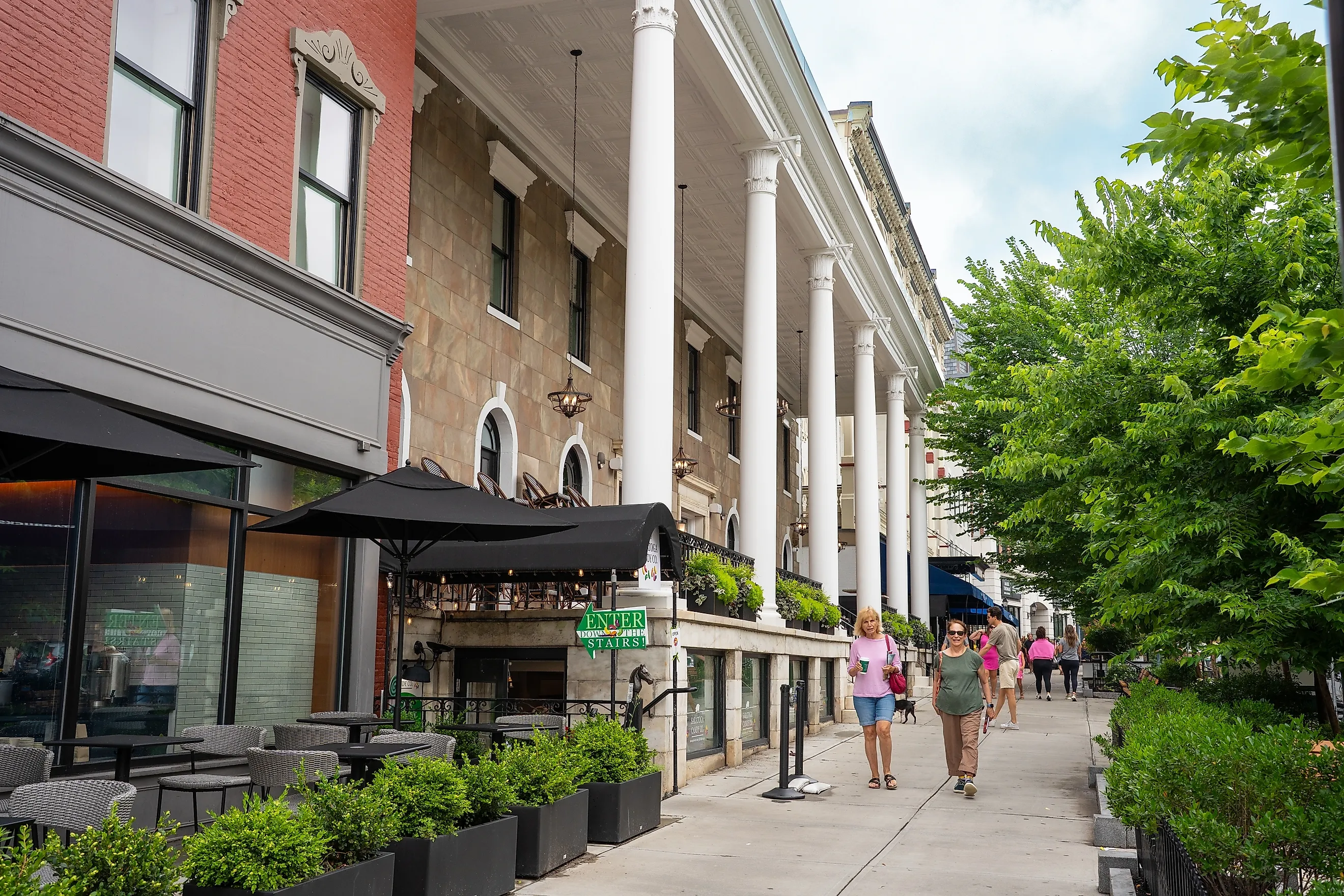
Thoroughbreds have been running at Saratoga Race Course since August 1863, which makes a seat in the grandstand one of the oldest sporting habits in the country. The 2026 meet opened over the Fourth of July weekend and closes on Labor Day, 46 racing days spread across ten weeks. Across Union Avenue, the silks, the trophies, and the horses' side of the story fill the National Museum of Racing and Hall of Fame. Congress Park downtown has four mineral springs to taste, and no two are alike. Congress Spring sits under a Greek Revival pavilion near Broadway, while Hathorn #1 bubbles up across the street at Putnam and Spring. For dinner, The Brook Tavern is on the ground floor of an 1800s carriage factory on Union Avenue, open evenings only and closed Mondays.
Alexandria Bay

Locals call it Alex Bay, or more often just A-Bay, and this village of about 900 people is the resort center of the Thousand Islands. Uncle Sam Boat Tours will take you out of the harbor, along Millionaires' Row and over to Heart Island. There, George Boldt, who owned the Waldorf Astoria, put 300 workers on a six-story castle of 120 rooms for his wife, Louise. She died suddenly in January 1904. Boldt telegraphed the island, ordered every tool down, and never returned. The shell stood open to the weather for 73 years before restoration began, and self-guided tours now run mid-May through mid-October. On shore, the Cornwall Brothers Store Museum is an 1866 stone building on the waterfront, filled with artifacts from the river communities. For a room and a meal, Bonnie Castle Resort & Marina sits on the water and has three restaurants on site.
New Paltz

Twelve Huguenot families took the New Paltz patent in 1677 and settled along the Wallkill River the following year. Their descendants' stone houses still stand along Huguenot Street, a ten-acre National Historic Landmark District. Seven of the houses survive, most dating to the early 1700s, alongside a reconstructed 1717 church and a burying ground used by the first settlers. Tickets to see the interiors come from the DuBois Fort visitor center. A few blocks away, beside the Wallkill Valley Rail Trail, independent shops and antiques dealers cluster at Water Street Market. The Denizen Theatre is there too, a 70-seat black-box playhouse that opened in 2018, with arthouse films midweek and on weekends. Next door at the market, the cooks at The Parish turn out Cajun food. For the long view over the ridge, Mohonk Mountain House has stood above Lake Mohonk since 1869.
Cold Spring

Cold Spring is here because of iron. The West Point Foundry operated just off the harbor from 1818 until about 1911, and during the Civil War its workers turned out Parrott rifles, the artillery that superintendent Robert Parrott developed and patented in 1861. Abraham Lincoln came up in 1862 to watch the guns being made. That story sits in the Putnam History Museum, set in the old Foundry School on Chestnut Street, a few minutes' walk from the bottom of Main. Main Street itself is a run of 19th-century storefronts dropping toward the Hudson, past Once Upon a Time Antiques and the former bank vault at Cold Spring Antiques Center, where around thirty dealers set up. The Hudson House River Inn has stood at the foot of the street since 1832, with outdoor tables over the water and balcony rooms upstairs.
Choosing Between Them
Water sorts half of these eight. Fair Haven has a Great Lake beach with a guarded swim area, and the St. Lawrence runs past the docks at Alexandria Bay. Old Forge stands at the head of the Fulton Chain of Lakes, and Cold Spring is a harbor village where the West Point Foundry once cast cannon for the Union Army. History sorts the other half. The story in Saranac Lake is a tuberculosis cure, Woodstock has been an art colony since 1902, and New Paltz has a street of early 1700s stone. Saratoga Springs has both, with four mineral springs in Congress Park and thoroughbreds running since 1863. In all eight, the busiest stretch falls between the Fourth of July and Labor Day, which is the window to plan around.