Ocean Acidification
- Ocean acidification refers to the lowering pH levels of the Earth's seas.
- Carbon emissions are the leading cause of acidification.
- Acidic oceans can be very harmful to marine life, leading to ecosystem collapse and wider negative effects on human life.
Ocean acidification is the long-term decline in seawater pH caused by the ocean's absorption of atmospheric carbon dioxide. Since the start of the industrial revolution around 1750, average surface ocean pH has fallen from approximately 8.2 to 8.04 (as of 2024), a roughly 40 percent increase in hydrogen ion concentration. Scientists often describe it as "the other CO2 problem" (climate change being the first), and it is one of the largest chemical changes the global ocean has undergone in tens of millions of years. Its effects on marine life are already visible across regions, from tropical coral reefs to polar food webs.
What Is Ocean Acidification?

Ocean acidification refers to the ongoing decrease in the pH of Earth's oceans driven by carbon dioxide uptake from the atmosphere. A pH measurement quantifies how acidic or basic a solution is, running from 0 (most acidic) to 14 (most basic) with pure water at neutral pH 7. The pH scale is logarithmic, which means each whole-unit decrease represents a tenfold increase in hydrogen ion concentration, and even small numerical pH changes correspond to large changes in seawater chemistry. The 0.16-unit drop in mean surface ocean pH since 1750 has produced a roughly 40 percent increase in hydrogen ion concentration.
Although the ocean as a whole remains slightly basic (pH 8 sits above neutral 7), the change is rapid by geological standards. Glacial-interglacial pH oscillations over the past million years moved between roughly 8.3 (during glacial maxima such as 20,000 years ago) and 8.2 (during warm interglacial periods like the late Holocene), a range of only about 0.1 units. The industrial-era change has already exceeded that natural range, and it is occurring within centuries rather than millennia. IPCC projections under a high-emissions pathway suggest a further pH decline of 0.3 to 0.4 units by 2100, which would push ocean chemistry beyond anything seen in at least the past two million years.
The Chemistry: How CO2 Becomes Acid

Atmospheric carbon dioxide dissolves in seawater and undergoes a series of equilibrium reactions. Dissolved CO2 first combines with water to form carbonic acid (H2CO3), which then dissociates in two stages. The first stage releases a hydrogen ion (H+) and produces a bicarbonate ion (HCO3-), and the second stage releases another hydrogen ion to produce a carbonate ion (CO3 2-). The hydrogen ions released in both stages are what reduce seawater pH and define the acidification process. The full reaction sequence runs CO2 + H2O to H2CO3 to H+ plus HCO3- to 2H+ plus CO3 2-.
Equally important is a secondary effect: excess hydrogen ions in solution bind with carbonate ions already present in seawater, converting them to bicarbonate and reducing the total carbonate concentration available. Marine calcifying organisms (corals, molluscs, crustaceans, sea urchins, and many planktonic species) build their shells and skeletons by combining carbonate ions with calcium ions to form calcium carbonate (CaCO3) in two principal mineral forms, aragonite and calcite. As carbonate concentrations fall, these organisms struggle to form structurally sound shells, and existing CaCO3 structures can begin to dissolve when the aragonite saturation state (denoted omega-arag) falls below 1. In several Southern Ocean and subarctic regions, omega-arag has already approached or crossed this threshold seasonally.
The Scale of Change Since the Industrial Revolution

The atmospheric CO2 concentration in 2024 was approximately 422 parts per million by volume, against a pre-industrial baseline of around 280 ppm. That is a 51 percent increase, with half of the rise occurring since the mid-1980s. The ocean has absorbed approximately 25 to 30 percent of all anthropogenic CO2 emissions since the start of the industrial era, equivalent to roughly 600 billion tonnes of CO2 according to current global carbon budget estimates. Without this oceanic uptake, atmospheric CO2 levels would be approximately 55 to 77 ppm higher than they actually are today.
The result for ocean chemistry is well documented. The longest continuous time series of ocean pH measurements, the ALOHA station offshore Hawaii operating since the late 1980s, shows mean surface pH declining by approximately 0.0019 units per year. Global modelled estimates from the Copernicus Marine Environment Monitoring Service show mean surface pH falling from 8.11 in 1985 to 8.04 in 2024, an 18 percent rise in acidity over four decades. NOAA projections under a high-emissions pathway (the IPCC RCP8.5 scenario) suggest the ocean's buffering capacity, its ability to absorb additional CO2 without further pH decline, could fall by as much as 34 percent between 2000 and 2100.

The driver of the rise in atmospheric CO2 is well established. Fossil fuel combustion (oil, coal, and natural gas) accounts for the majority of anthropogenic CO2 emissions, with cement production and land-use change (primarily deforestation) contributing most of the remainder. Forests function as natural carbon sinks by storing carbon in biomass and soils, and the loss of tropical forests since 1850 has both released stored carbon directly and reduced the global capacity to remove CO2 from the atmosphere going forward. The ocean has effectively functioned as the largest remaining sink for the resulting excess.
Why Polar and Cold-Water Seas Acidify Fastest
Carbon dioxide is more soluble in cold water than in warm water, so polar and subpolar oceans take up disproportionate amounts of atmospheric CO2 relative to their surface area. Cold seas also naturally hold less dissolved calcium carbonate, so they reach the aragonite undersaturation threshold faster than warmer waters. The Arctic Ocean, the Southern Ocean, and the subarctic North Pacific are therefore among the first regions where ocean acidification has produced clearly biologically significant chemistry changes.
The World Meteorological Organization's State of the Global Climate 2024 report identified the Indian Ocean, the Southern Ocean, the eastern equatorial Pacific, the northern tropical Pacific, and portions of the Atlantic as the regions showing the most intense recent rates of acidification. The Southern Ocean is now widely considered the bellwether region: it absorbs roughly 40 percent of all ocean CO2 uptake despite covering about 13 percent of global ocean surface area, and several recent surveys have measured seasonal omega-arag values below 1 in surface waters around Antarctica.
Effects on Shell-Building Marine Life
The most vulnerable organisms are those that build their structures from aragonite, the more soluble of the two main calcium carbonate forms. These include pteropods (small free-swimming sea snails often called sea butterflies, which form the base of polar and subarctic food webs), most reef-building corals, and many bivalves at certain life stages. Calcite-builders, including most foraminifera, coccolithophores, and adult oysters, are somewhat more resilient but face the same long-term pressure as carbonate ion concentrations decline.

The pteropod is the most extensively studied case. Experimental work and field surveys in the Southern Ocean and subarctic Pacific have documented widespread thinning, pitting, and dissolution of pteropod shells in surface waters where omega-arag is approaching or below 1. Because pteropods are a primary food source for juvenile salmon, herring, and several whale species, a collapse of pteropod populations could cascade up entire food chains. For larger calcifiers the most affected life stage is typically the larva: larval oysters and mussels build aragonite shells and are highly sensitive to small changes in carbonate chemistry, and laboratory mortality rates of 50 to 80 percent have been reported under projected end-of-century pH conditions. Adult crab and lobster studies show reduced shell thickness, slower growth, and increased moulting difficulties in higher-CO2 seawater.
Effects on Coral Reefs
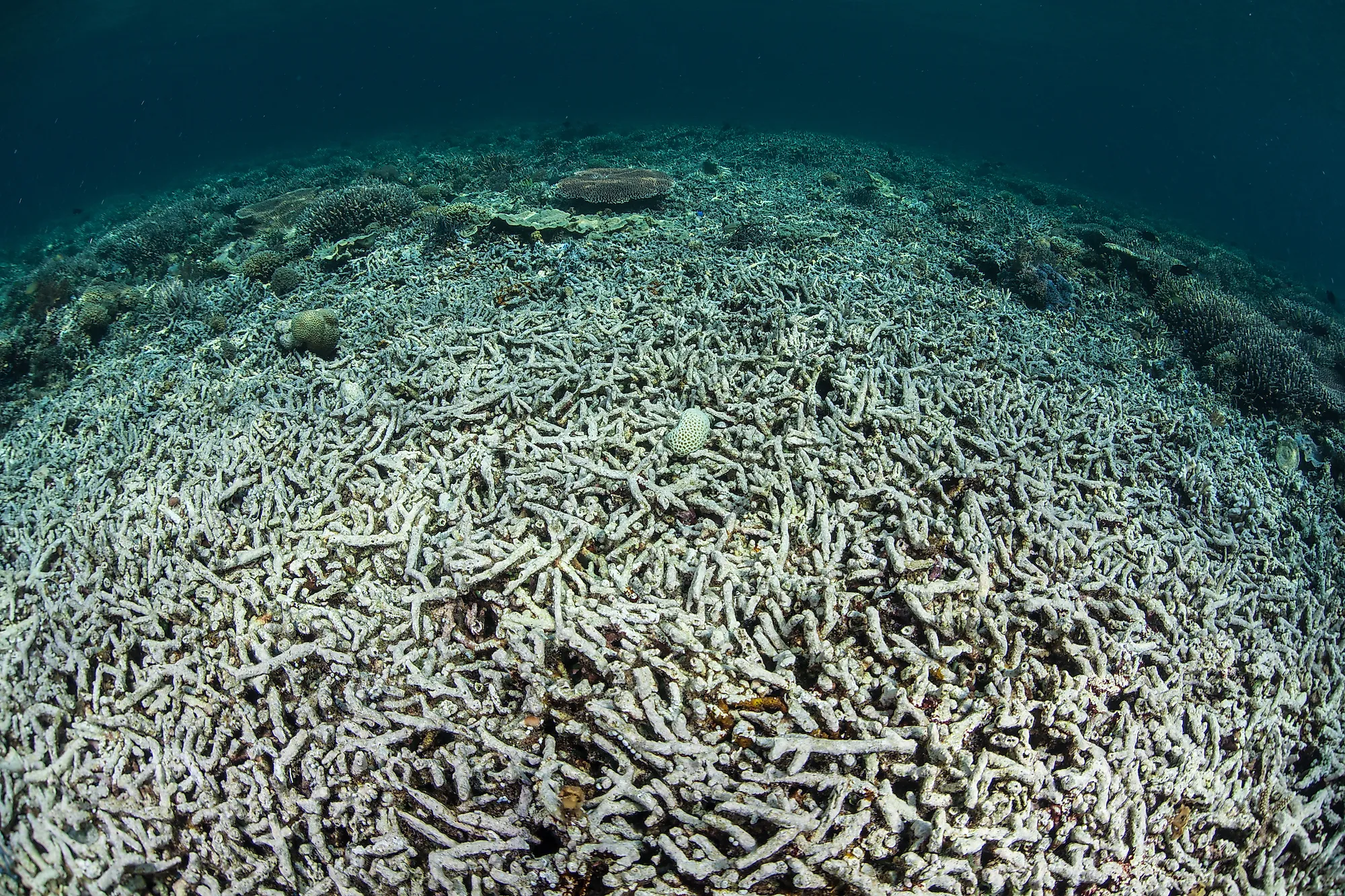
Tropical coral reefs face the compound pressure of acidification and ocean warming. Reef-building corals construct aragonite skeletons, and as carbonate concentrations decline, both calcification rates and skeletal density decrease. Independent of acidification, the warming oceans drive coral bleaching events when corals expel their symbiotic zooxanthellae algae under heat stress. Combined, these two stressors have driven repeated mass mortality events on reefs worldwide.
The Great Barrier Reef has experienced six mass bleaching events since 1998 (in 1998, 2002, 2016, 2017, 2020, and 2022), with the 2016 and 2017 events killing approximately 50 percent of the reef's shallow-water coral cover. The Caribbean has lost an estimated 80 percent of its hard coral cover since the late 1970s to a combination of bleaching, disease, acidification, and local stressors. Modelling published in the IPCC Special Report on the Ocean and Cryosphere (2019) projects that 70 to 90 percent of tropical coral reefs will be lost at 1.5 degrees Celsius of global warming above pre-industrial levels, and 99 percent at 2 degrees Celsius.
Effects on Fisheries and Coastal Economies
The most economically documented case of ocean acidification damage in any major fishery is the Pacific Northwest oyster crisis of the mid-2000s. Starting in 2005, hatcheries along the Oregon and Washington coast began reporting mass mortality of larval Pacific oysters (Crassostrea gigas) at certain times of the year, with mortality rates above 80 percent at some facilities. By 2008 and 2009 researchers had traced the cause to seasonal upwelling of older, deeper, naturally more CO2-rich water onto the coastal shelf, with anthropogenic acidification pushing the chemistry past the threshold larval oysters could tolerate. Whiskey Creek Shellfish Hatchery on Netarts Bay, Oregon, which supplies about 75 percent of Pacific oyster seed to the US industry, has since adapted by chemically buffering its intake water, a workaround that does not scale to the open ocean.
The Bering Sea snow crab (Chionoecetes opilio) fishery, one of the most valuable shellfish fisheries in US waters, collapsed approximately 90 percent between 2018 and 2022. The peer-reviewed cause has been primarily linked to marine heatwave conditions, but ocean acidification is widely cited as a contributing chronic stressor on crab life stages. NOAA closed the snow crab fishery for the 2022 to 2023 season for the first time in its history, costing the Alaska economy several hundred million dollars.
Geological Context: The PETM Comparison
The closest geological analogue to current ocean acidification is the Paleocene-Eocene Thermal Maximum (PETM), which occurred approximately 56 million years ago. During this event, a release of roughly 4,500 to 5,500 gigatonnes of carbon to the atmosphere over several thousand years drove a global temperature rise of 5 to 8 degrees Celsius and significant ocean chemistry changes that triggered widespread extinction among benthic foraminifera and other calcifying marine organisms. Sediment records show seafloor calcium carbonate dissolution at deep-sea sites worldwide during the event, with the carbonate compensation depth (the depth at which CaCO3 dissolves faster than it precipitates) shoaling by hundreds to thousands of metres.
The critical difference between the PETM and the present is rate. The PETM carbon release occurred over a few thousand years; current anthropogenic carbon emissions are unfolding over a few centuries, roughly an order of magnitude faster. Because the ocean's buffering chemistry operates on timescales of thousands to tens of thousands of years, modern ocean ecosystems have considerably less time to adjust than their PETM-era counterparts did. The fossil record of the PETM remains the best available preview of where prolonged anthropogenic emissions would lead, and it shows ecosystem-scale change rather than gradual adaptation.
Outlook and Mitigation

The pace of ocean acidification follows the pace of atmospheric CO2 emissions. The 2015 Paris Agreement targets of limiting warming to well below 2 degrees Celsius (and ideally 1.5 degrees Celsius) above pre-industrial levels would correspondingly limit further pH decline to approximately 0.06 to 0.07 units below the 2020 baseline. Achieving those targets requires cutting global net CO2 emissions to roughly zero by mid-century, alongside scaling natural and engineered carbon removal.
Adaptation options for marine ecosystems are limited. Protecting and restoring natural carbon sinks (forests, mangroves, kelp beds, and seagrass meadows) modestly slows the rate of atmospheric CO2 increase. Reducing other stressors on vulnerable ecosystems (pollution, overfishing, coastal habitat destruction) can improve their resilience to acidification but cannot reverse it. Experimental approaches to direct ocean alkalinity enhancement, which involves adding alkaline minerals or industrial alkalinity to seawater to neutralise dissolved CO2, are under active research but face significant scaling, ecological-impact, and economic constraints. The unavoidable conclusion of the current science is that emissions reduction remains the only effective lever at the scale of the whole ocean.