Why Alaska Has More Park Land Than Every Other State Combined
One state holds so much National Park Service acreage that if every other state's parks, monuments, and preserves were added together, Alaska's total would still top them all. According to the National Park Service, roughly 60% of the land the agency manages nationwide sits within Alaska's borders. The bragging rights come down to a single 1980 law. That law redrew the map of American conservation almost overnight. They also come down to a handful of Alaskan park units so large that the rest of the country's national parks look small by comparison.
The Numbers Behind the Claim

The National Park Service's most recent land resources acreage report puts the entire National Park System at close to 85 million gross acres, spread across more than 400 units in all 50 states. Of that total, Alaska's units alone account for more than 54 million acres. The figure is derived by adding up every park, preserve, and monument NPS administers in the state. California, the next-largest state by NPS acreage, holds just over 8.2 million acres by comparison. Alaska's total isn't just the biggest slice, and it dwarfs the sum of everywhere else the agency operates.

That imbalance traces back to the Alaska National Interest Lands Conservation Act (ANILCA), signed into law in December 1980. ANILCA protected more than 100 million acres of federal land in Alaska across several agencies, and the National Park Service's own share of that grew by roughly 43 million acres, nearly doubling the size of the entire National Park System in a single stroke. Before ANILCA, Alaska had a handful of park units, and afterward it had Wrangell-St. Elias, Gates of the Arctic, Kobuk Valley, and several other parks and preserves that remain the largest protected landscapes in the American park system to this day.
One State, Eight National Parks, and Some Record Holders

It's worth separating two things that often get blurred together in casual conversation. There are 63 official National Parks in the United States, but there are more than 400 total units the National Park Service oversees, including monuments, preserves, historical parks, and recreation areas. Alaska's contribution to the official 63 is disproportionate. Eight of the country's national parks (Denali, Gates of the Arctic, Glacier Bay, Katmai, Kenai Fjords, Kobuk Valley, Lake Clark, and Wrangell-St. Elias) sit inside the state, and several of them are also the largest national parks anywhere in the country.

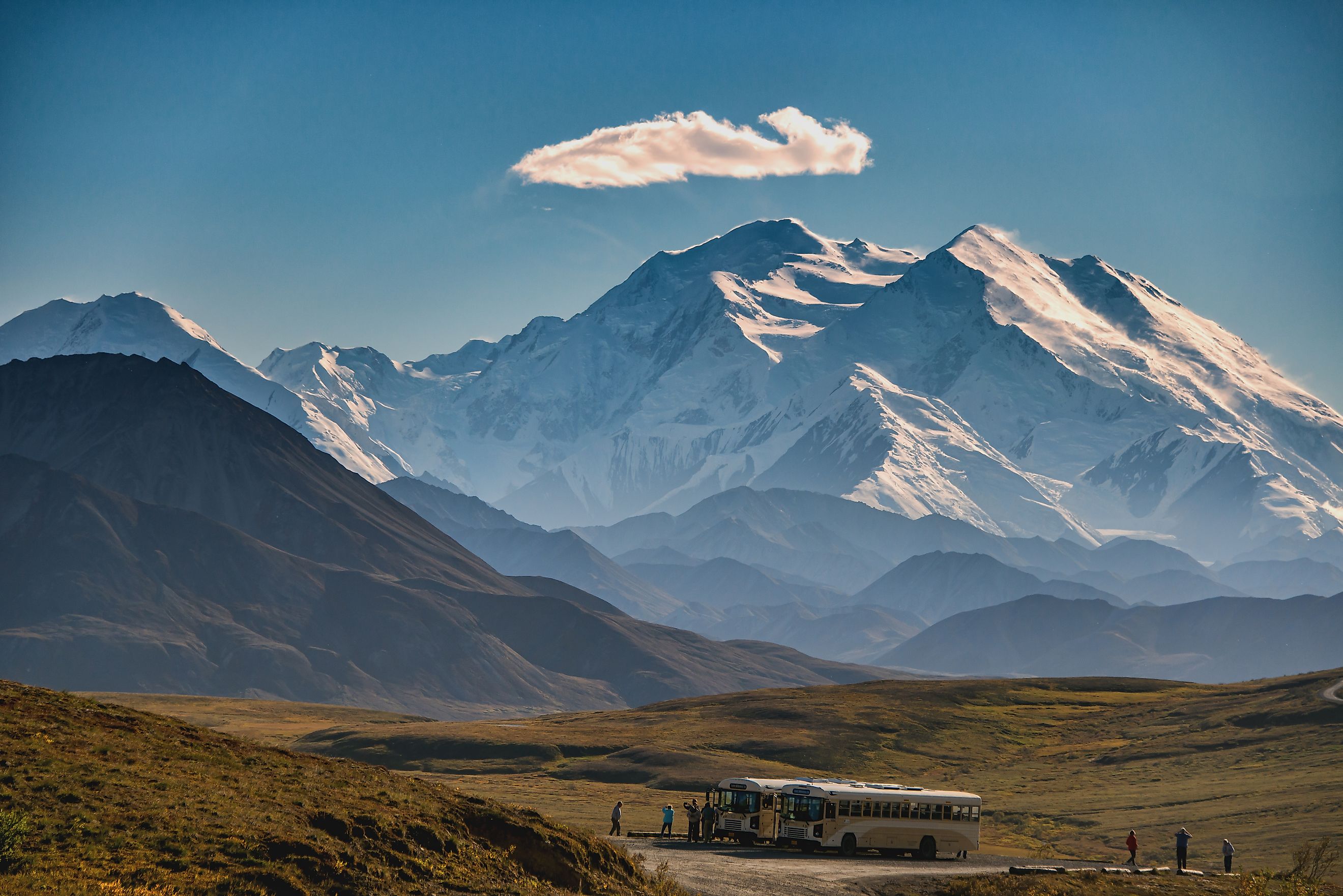
Wrangell-St. Elias National Park and Preserve is the biggest of all, covering approximately 13.2 million acres of glaciers, volcanic peaks, and braided river valleys in south-central Alaska. The National Park Service describes its combined footprint as roughly the size of Yellowstone, Yosemite, and Switzerland put together. Gates of the Arctic National Park and Preserve, entirely north of the Arctic Circle and reachable only by small plane or on foot, covers around 8.4 million acres and contains no roads, trails, or campgrounds of any kind. Denali National Park and Preserve, home to North America's tallest peak, spans roughly 6 million acres, and Katmai National Park and Preserve, famous for the brown bears that fish at Brooks Falls, adds another 4 million acres to Alaska's total.
Size in Alaska cuts both ways when it comes to visitors. Great Smoky Mountains National Park in Tennessee and North Carolina remains the most visited national park in the country, drawing roughly 11.5 million recreation visits in 2025 alone. Kobuk Valley National Park, by contrast, was the least visited national park in the entire system that same year, logging fewer than 7,800 visits, down sharply from 17,233 the year before. There are no roads into Kobuk Valley, and reaching its Arctic sand dunes and caribou migration routes generally requires a good plan and a bush plane. Gates of the Arctic was second-to-last with 14,923 visits in 2025. In other words, two of the largest parks in the country are also two of the emptiest.
Land Beyond the National Parks

Alaska's acreage advantage doesn't stop at its eight national parks. Some of the state's biggest NPS-managed landscapes carry other designations entirely, which is part of why the "national park" label and the broader "park land" figure diverge so sharply in Alaska. Noatak National Preserve, a roadless expanse of tundra and mountains in the northwest of the state, covers more than 6.5 million acres on its own, more land than Denali National Park and Preserve holds, even though Noatak has never carried the National Park title at all. Bering Land Bridge National Preserve, another Arctic unit with no paved access, adds close to 2.7 million more acres. Neither shows up on a list of the 63 National Parks, but both add substantially to Alaska's total and help explain why the state's overall park acreage climbs so far past its already-impressive count of national parks.
The contrast with the rest of the system is easiest to see at the small end. Gateway Arch National Park in St. Louis, Missouri, is the smallest national park in the country at just 91 acres, built around the 630-foot monument on the city's riverfront. Wrangell-St. Elias alone is roughly 145,000 times larger. Both carry the same National Park designation, yet only one of them could swallow entire states in the Lower 48 and still have room left over.
A Landscape Too Big to Compare
Alaska's park acreage isn't really a story about any single park, even one as vast as Wrangell-St. Elias. It's a story about scale that resists the usual comparisons. This is a state where a single national preserve outsizes every national park in the Lower 48, where the least-visited park in the country is also one of its largest, and where one 1980 law reshaped the entire National Park System by doubling it in a single year. The numbers will keep shifting as new visitation data comes in each spring, but the underlying arithmetic isn't likely to change. Alaska's park land was already bigger than everywhere else in the country combined, and nothing on the map is positioned to close that gap.