The Newest National Park In The United States
If you ever travel U.S. Route 19 in West Virginia's New River Gorge area late in October, don't be surprised to see people jumping off the highway's tallest bridge. It's all part of an annual event at the New River Gorge National Park and Preserve that sees hundreds of thrill seekers descend upon America's newest national park for supervised BASE jumping and rappelling. That soaring steel arch is the centerpiece of the whole gorge, but it is only the beginning of what awaits here. Below it runs 53 miles of the New River, prized for world-class whitewater, rim-top hikes, and sandstone cliffs beloved by climbers. And it's all just part of the fun at America's newest national park.
Bridging the Gorge Gap

When the New River Gorge Bridge opened to traffic in October 1977, it cut a 40-minute drive around the canyon to less than a minute. Measuring 3,030 feet end to end, its main arch spans 1,700 feet, and the deck stands 876 feet above the New River, which makes it the highest bridge east of the Mississippi River and the third highest in the country.
It was also the world's longest single-span steel arch bridge, a title it held for 26 years until the Lupu Bridge opened in Shanghai, China, in 2003. It is, however, the longest bridge of its type in the Western Hemisphere.
America's 63rd National Park

This beautiful corner of southern West Virginia was already protected as the New River Gorge National River. A designation signed by President Jimmy Carter in 1978, it covered 53 miles of free-flowing water between Bluestone Dam and Hawks Nest Lake. A century before that, it was lined with coal camps, coke ovens, and rail sidings, all a far cry from what you see today.
The New River Gorge National Park and Preserve Designation Act took effect in December 2020. The park and preserve designation is certainly unique and was the result of a compromise between local hunters and opponents to the sport. The result satisfied everyone, with the hunt-free 7,021-acre national park set within a much larger 65,165-acre national preserve where hunting is permitted.
It was a compromise that worked, and the New River Gorge became both the country's 63rd national park and its 20th national preserve on the same day. Since the change, visitor numbers have increased, with more than 1.8 million travelers now stopping in. There's no entrance fee, and four visitor centers cover the length of the gorge. Of these, Canyon Rim near Lansing and Sandstone at the southern end are open year-round, while the centers at Thurmond and Grandview are seasonal.
Celebrating Bridge Day

The park's much-anticipated Bridge Day takes place on the third Saturday of October and sees the bridge close to vehicles as pedestrians and jumpers take over. In addition to an estimated 100,000 walkers in 2025, 315 BASE jumpers made 752 jumps from the deck, along with 16 tandem jumps. Meanwhile, rappel teams descend fixed ropes from the catwalk underneath, and a high line carries riders 700 feet down to Fayette Station Road. Paid shuttles run from two lots in Fayetteville, and the Canyon Rim Visitor Center parking lot is closed for the day.
The rest of the year, there are two other ways to get close to this marvel of engineering. Bridge Walk, the only operator licensed to guide tours on the structure, takes visitors the full 3,030 feet along a 24-inch-wide walkway that runs 25 feet below the traffic roaring overhead. The adventure lasts two to three hours, and yes, you're clipped to a continuous safety cable the whole time.
The other option is to take Fayette Station Road down to the river. This eight-mile, one-way route drops from Canyon Rim to the floor of the gorge through a set of hairpin turns, then passes directly under the arch. From here, it crosses the Tunney Hunsaker Bridge at river level, then climbs out the far side. This breathtaking diversion will take 45 minutes to complete but is well worth it.
Tackling the New River

Somewhat unusual for a major American river, the New River flows north, and at an estimated 300 million years of age is among the oldest rivers in North America. Fifty-three of its 360 miles pass through New River Gorge National Park, its southern stretch broad and comparatively gentle, with long pools and gentler rapids.
The seven-mile stretch from Cunard to Fayette Station in the Lower Gorge is a completely different kettle of fish. As the canyon narrows, it increases water flow volume, intensifying the whitewater and rapids and creating conditions best suited to experienced rafters.
Regardless of skill level, the commercial rafting season runs April through October, and outfitters in Fayetteville, Lansing, and Oak Hill can set you up with an experience suited to your skill level. ACE Adventure Resort and River Expeditions both operate out of Oak Hill, Adventures on the Gorge is at Lansing near the bridge, and Cantrell Ultimate Rafting works from Fayetteville. Half-day Lower New trips typically run three to four hours on the water.
Anglers are also in for a treat when fishing on the New River. Working the calmer upstream pools and the water below Sandstone Falls will reward you with smallmouth bass and catfish. Be sure to have a valid West Virginia fishing license when casting a line anywhere in the park.
Rim Hikes and Climbs

Over 100 miles of biking and hiking trails crisscross the park. One of the most popular, the 2.4-mile Endless Wall Trail heads from the Fern Creek Trailhead, crossing Fern Creek on a footbridge before zigzagging along the top of the cliff line. There's 427 feet of climbing and 545 feet of descent involved, so most people only go as far as Diamond Point, an exposed sandstone outcrop with a clear view up the canyon, and turn back. This still makes for a two-mile out-and-back hike, but without the climb.
The gorge is also extremely popular with climbers. The sandstone here is 98 percent quartz, making it considerably harder than most sedimentary rock. And there's plenty of choice from the more than 1,400 established routes inside the park's boundary. Most routes are graded 5.9 and harder, with rises reaching between 30 and 120 feet.
Thurmond and Nuttallburg

Named after a surveyor working for the Chesapeake and Ohio Railway, at its height in the 1920s, more coal tonnage moved through Thurmond than through Cincinnati. The National Park Service now owns most of what remains, and the entire town is listed on the National Register of Historic Places as a historic district.
The depot, built in 1904, was restored in 1995 as a seasonal visitor center and railroad museum. It's still a flag stop on Amtrak's Cardinal, which runs three times a week between Chicago and New York (it halts here only by reservation). The 500-ton capacity concrete coaling tower, built in 1922, still impresses.
Downstream, Nuttallburg is named after an English mine operator who previously worked coal in western Pennsylvania. The town was known for its smokeless coal, a low-volatile bituminous grade that burned with almost no visible smoke. Henry Ford leased the mines in 1920 through his Fordson Coal Company, paying for a new tipple and the steel conveyor that still runs down the hillside. Of the town's 80 original coke ovens, 40 remain.
The Nuttall family transferred the site to the Park Service in 1998, and the resulting historic district covers 90 acres of mine plant, conveyor, tipple, ovens, and house terraces, with interpretive panels along a signed walking route. Getting there is part of the experience, as the road down Keeneys Creek narrows to a single lane and isn't meant for large vehicles.
Grandview and Sandstone Falls

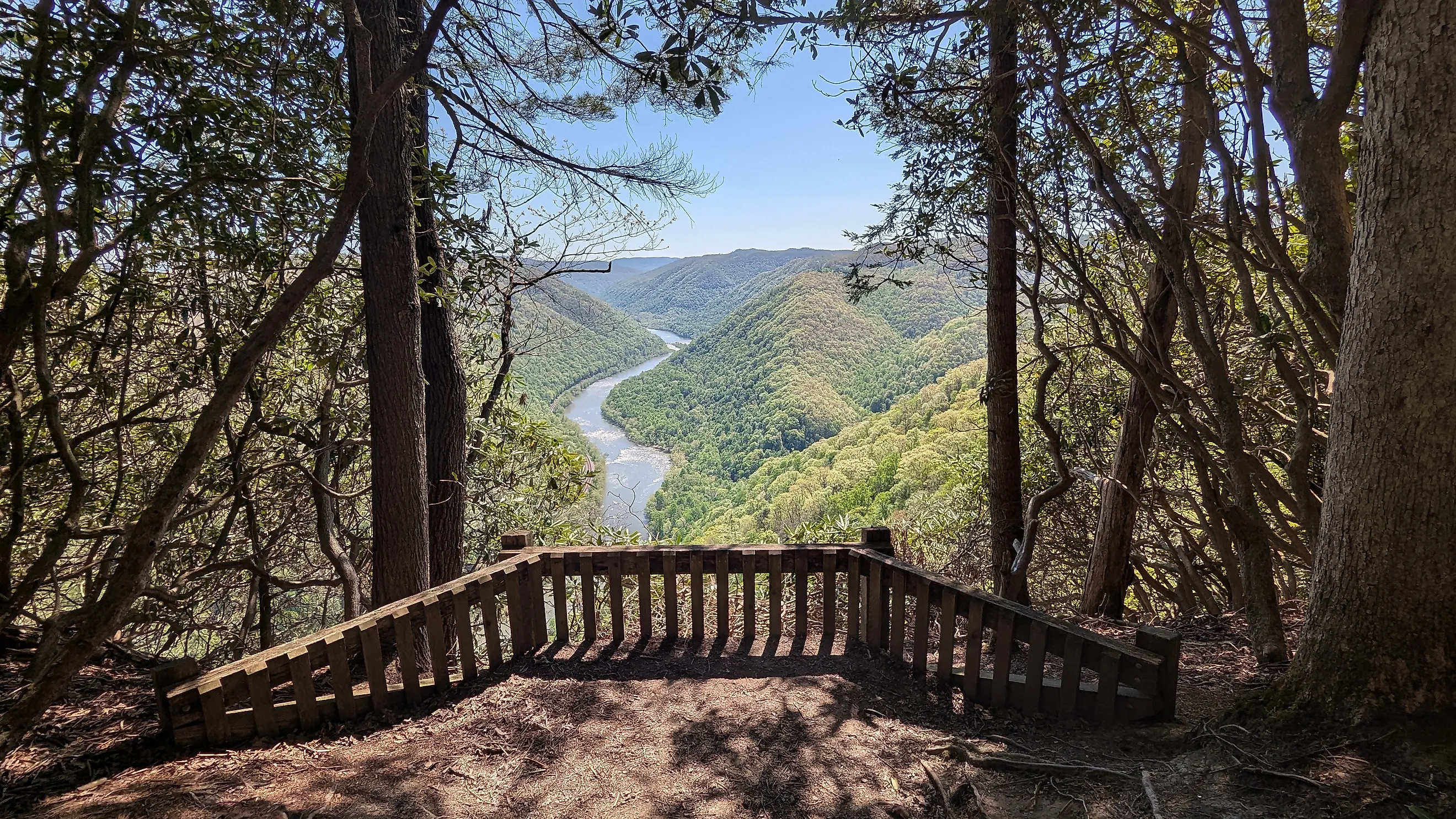
Grandview is where you'll find some of the best views of the gorge. Its Main Overlook is located 1,400 feet above the river and takes in seven miles of the river as it loops around a horseshoe bend, the widest and deepest section of the gorge. On the far bank, you can pick out Quinnimont where the first coal was shipped out in 1873. Coal trains still work the line.
The Grandview Rim Trail winds for 1.6 miles between overlooks, and 130 steps get you up to Turkey Spur Overlook. The 1,200-seat Cliffside Amphitheater from the 1960s hosts Theatre West Virginia productions from June through August.
Situated at the park's southern end, Sandstone Falls is the New River's largest waterfall. Although 1,500 feet wide, its drop is only 10 to 25 feet, split across islands into a broad set of ledges rather than a single wall of water. A quarter-mile accessible boardwalk crosses two bridges to the islands below the falls.
America's Newest National Park
Given the fact it's 53 miles long and incredibly scenic, you'll want to spend at least a full day exploring New River Gorge National Park. Better still, shoot for a two-day visit, starting at the Fayetteville end. Include Long Point, Fayette Station Road, and a rafting trip on the Lower New if the water is behaving. Day two will cover the remainder of the park, including Grandview's overlooks and Sandstone Falls, with a stop at Thurmond or Nuttallburg in between. However long you take, America's newest national park won't disappoint.