The National Parks With No Cell Service At All
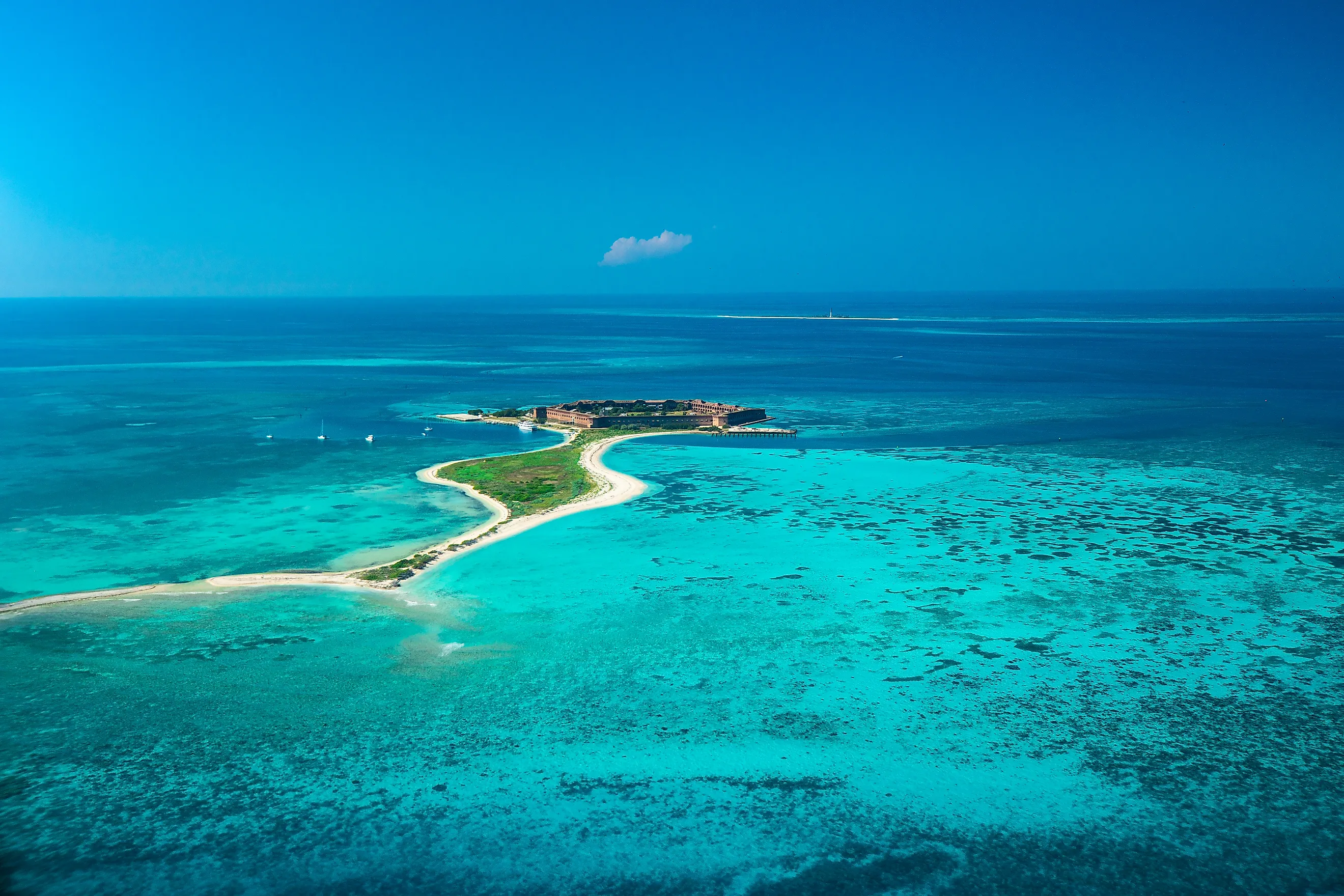
Across the vast expanses of land the National Park Service covers, visitors can find almost endless places in nature that seem to isolate them from civilization. There are a few parks, however, that truly isolate visitors from civilization, including from cell service. In the Gates of the Arctic, visitors can wander at will through 8.4 million acres of pristine Alaskan wilderness. In Congaree National Park, in South Carolina, you can see some of the tallest trees in the Eastern US and thousands of fireflies congregating in the spring. In Dry Tortugas west of Key West, you can snorkel around ship wrecks and coral reefs and explore one of the nation's largest 19th century forts.
But in none of these parks will you find any cell service.
Gates of the Arctic National Park and Preserve (Alaska)

The Gates of the Arctic is a vast and rugged arctic landscape with no modern roads or trails. It offers instead the increasingly rare opportunity to wander at will through 8.4 million acres of stunning land in its natural state. You will find wild rivers, scenic lakes, caribou trails, almost endless summer days, and winter nights with the aurora borealis in the sky. The NPS website advises visitors that, "There are no established services within the park boundaries and only limited means of communication work effectively to contact anyone for assistance. Cell phones don't work here. Visitors to the park should be PROFICIENT in outdoor survival skills, and be prepared to care for their own life and their partner(s) if an emergency arises."
Kobuk Valley National Park (Alaska)

Located entirely above the Arctic Circle, Kobuk Valley National Park is the least visited park in the entire national park system. It is an extremely popular location, however, for caribou, whose tracks visitors will see crisscrossing the shifting sand dunes among the tundra and trees. Like at the Gates of the Arctic National Park, there are no roads, but instead, visitors are welcome to explore the 1,750,716 acres of remote backcountry. It is an ideal place for watching wildlife in untouched nature, and also provides endless opportunities for landscape photography. What this park does not provide, however, is any cell towers, or cell service. The NPS website advises that, "the conditions are extreme, even in the summer, and can change on a dime; the park is home to potentially dangerous animals like bears and moose; and most importantly, if you do get in trouble, you're miles away from the nearest help... Many of us depend on our cell phones, but they will not work in the park. Satellite phones will work for short emergency calls. Take along several phone numbers to report emergencies. Call friends/family who have your itinerary, your pilot, or park rangers (907) 318-2230. Rescue could be delayed by days. The best plan is to be self-sufficient in this remote, wild landscape."
Isle Royale National Park (Michigan)

One of the relatively few national parks in the sprawling American Midwest, Isle Royale National Park sits on a remote and isolated island in Lake Superior. It is only accessible by water, whether by ferry, seaplane, or private watercraft, and visitors do well to remember that weather will critically influence their ability to voyage to and from the island. This park is most popular among backpackers, who will find several trails across the island, the longest stretching some 40 miles. It is also popular among campers, and there is no overnight camping fee for parties of six or fewer at any of the 36 camping sites. The lush green beauty of Isle Royale is well worth even a day trip, but the NPS site strongly advises that the weather in the middle of Lake Superior is extremely unpredictable and visitors absolutely must keep safety first in their minds. Even day trippers should be prepared to spend the night if a crossing back to the mainland becomes impossible. In terms of cell phone use, the NPS site says, "Basic emergency services are available on the island, but contacting rangers for assistance can be difficult. Most private boaters on Lake Superior have radios and may be able to contact park rangers in an emergency. Cell phone service is unreliable; do not depend on it. Emergency response and evacuation take time, requiring you to rely on your own skills and equipment."
Katmai National Park and Preserve (Alaska)

Katmai National Park and Preserve was originally made into national land in order to preserve the "living laboratory" that exists in the aftermath of the Novarupta-Katmai volcanic eruption in 1912. This eruption was the largest of the 20th century in the world, exploding violently for 60 hours, blasting ash as high as 20 miles in the sky, and sending quick-moving pyroclastic flows down into the Ukak River Valley below, filling it as deep as 700 feet. The river in the valley flashed into steam like smoke, and that is why today, it's known as the "Valley of Ten Thousand Smokes." This valley is one of the most popular and fascinating reasons to visit Katmai, to see the violence, beauty, and mystery that lies in the wake of a major volcanic eruption. This park is also famous as an important habitat for salmon and thousands of brown bears. Brooks Camp is perhaps the most famous destination in the park because this is where visitors can observe brown bears in nature at the mouth of the Brooks River and the shore of Naknek Lake. So, while there are truly unique phenomenon to experience here, there is also the potential for real danger and the park website advises there are few park services at all, with the nearest services in the town of King Salmon, Alaska. "There is no wifi or cell phone service available in most of Katmai National Park and Preserve. Visitors will likely only be able to communicate via satellite phone, should they choose to bring one."
Congaree National Park (South Carolina)

Inside the swampy wilderness of Congaree National Park in South Carolina, visitors will find two things that can be found almost nowhere else, some of the tallest trees in the Eastern United States, and fireflies that blink in unison. The Congaree and Wateree Rivers sweep through the floodplain here carrying nutrients and sediments that nourish the trees, such as bald cypress, loblolly pine, and water tupelo, and help them soar to record heights. The fireflies congregate here in the spring, in early to mid May, by the thousands, and while most fireflies blink their lights whenever they choose, they keep time with each other. This happens in only a few places on earth. Visitors flock here, especially in the spring for the fireflies among such soaring scenery, but visitors should also be advised that cell service here drops off completely as soon as you walk through the boardwalk entrance. The NPS site advises that, "cell service can be unreliable in the park, so you may have to find a place where there is reception, or send someone with a cell phone to make the call." If you get lost in this park, stay in one place, and this will help rescuers find you as quickly as possible.
Lake Clark National Park and Preserve (Alaska)

Lake Clark National Park, like other remote parks in Alaska, offers visitors a chance to become part of the wilderness, and the wilderness here includes steaming volcanos, salmon runs, many bears, craggy mountains, and shimmering lakes. There are 4 million acres to explore here, and Lake Clark itself is perhaps the favorite place for visitors to explore by kayak, where they are suspended in the vast and reflective beauty of the sky and mountains and tundra meeting their view from both above and below. Other popular activities include fishing, hunting, wild river rafting, bear viewing, and of course hiking out of Port Alsworth, which is home to the park's field headquarters and only established hiking trail system. When exploring any areas outside of Port Alsworth, the NPS site advises that, "adventures in this remote and isolated area demand self-sufficiency. Preparation can make the difference between the adventure of a lifetime and tragedy. Remember, help may be days away... There is no cell phone service in the park, and amenities are few and far between. Consider carrying a satellite phone or satellite based text messaging device with you."
Dry Tortugas National Park (Florida)

Dry Tortugas National Park can be found in the open waters west of Key West, and is accessible only by boat or sea plane. This park is known for being the home of Fort Jefferson, a 19th century fortification, colorful coral reefs, old ship wrecks, and magnificent aquatic and bird life. This is an ideal place for swimming, snorkeling, paddling, fishing, hiking, and even camping on one of the seven small islands of the park. While there is endless opportunity for fun in the sun here, the NPS website reminds visitors to, "be safe - it's a long way to the hospital." And further advises that, "visiting such an isolated place means that you need to be prepared, not only for rough seas, but for primitive conditions. There are no services available in the Dry Tortugas."
Self Sufficiency Is Required Where There's No Cell Service
Beyond this list of national parks with no cell service, there are many more national parks have weak, limited, or unreliable cell service. Among these are North Cascades National Park, Crater Lake National Park, Great Basin National Park, and Big Bend National Park. Also of note is Wrangell-St. Elias National Park and Preserve, which is America's largest national park, and due to its massive valleys and peaks, will often have unreliable service. Visitors to any of these parks should be strongly advised to remember that they absolutely cannot rely on cell phones for assistance, and should only plan on adventuring into them if they are prepared to live self sufficiently in the wild.