9 Most Walkable Town Centers In Sweden
Sweden is known for its rugged forests, rocky islands, and colorful wooden houses, but some of its most rewarding experiences are found simply by walking from one town-center attraction to the next. In these smaller Swedish towns, historic town squares lead to medieval churches, waterfront promenades give way to cafés and shops, and centuries-old neighborhoods remain compact enough to explore without a car. From UNESCO-listed Visby's medieval walled center on the island of Gotland to the lakeside wooden streets of Sigtuna on Lake Mälaren and Hjo on the cobalt colored Lake Vättern, these nine destinations make it easy to turn sightseeing into a leisurely stroll. So lace up a comfortable pair of shoes and follow the streets, waterfronts, and old lanes that connect each town's standout sights as you explore Sweden's most walkable town centers.
Visby, Gotland

Visby's medieval center is the kind of place where walking is part of the attraction. Inside the famous ring wall, cobblestone lanes wind past church ruins, colorful houses, small squares, and gardens, while the island locale ensures that the Baltic Sea is never far away. The compact center is officially recommended for exploring on foot, and a short tourist-tested route covers several of the town's major sights.
Start at Almedalen, the leafy park beside the waterfront, then enter the old town through Lilla Strandporten and walk toward Stora Torget, the central square surrounded by restaurants and historic buildings. From there, continue uphill to Sankta Maria Cathedral, the surviving medieval church that anchors the old town. A climb toward historic Klinten adds a panoramic view over the rooftops and Baltic Sea.
From Klinten, head toward the rose adorned Fiskargränd Street, one of Visby's most photographed alleys, then continue toward the waterfront and the enchanting Botanical Garden. The official tourist office's roughly 1.5-kilometer quick route connects Almedalen, Stora Torget, the cathedral, Klinten, Fiskargränd, and the city wall, while a longer circuit around the 3.4-kilometer ring wall takes roughly 45 to 60 minutes.
For an even longer walk, follow the wall or its surrounding paths back toward your starting point. With medieval ruins, gardens, viewpoints, restaurants, and waterfront scenery packed into the same compact area, Visby is particularly well suited to travelers who prefer sightseeing on foot.
Ystad, Skåne

Ystad's center combines pastel-colored half-timbered buildings, cobblestone streets, medieval churches, museums, cafés, and small shops in a remarkably compact area. The official Ystad tourism site specifically recommends walking as the best way to experience central Ystad, with many attractions connected by pedestrian-friendly streets and alleys.
Begin at St. Knuts Square, where you can visit the Ystad Visitor Center and Ystad Art Museum before heading into the older blocks. From the square, walk toward Sankta Maria Church, whose red brick tower is a familiar landmark among the town's colorful buildings. Continue through the surrounding cobblestone lanes toward Greyfriars Monastery, a 13th-century Franciscan complex with gardens and a rose-filled courtyard.
After exploring the monastery, turn back toward the center along the narrow streets around Lilla Västergatan, one of Ystad's most photographed streets. Its historic houses, flowers, and church tower make the walk itself part of the experience.
Film enthusiasts can extend the walk toward Ystad Studios Visitor Center, where interactive exhibits explore productions filmed in the town. The visitor center is farther from the medieval core than the other stops, but the official tourism site describes it as a short walk from central areas. If you prefer to stay entirely within the oldest part of town, simply linger around the squares, shops, cafés, churches, and monastery gardens.
Ystad works especially well for a slow walking day because there is little need to choose between sightseeing and wandering since the streets themselves are part of the attraction.
Sigtuna, Uppland

Sigtuna's appeal is concentrated along a remarkably old street plan. Founded around AD 980, the town retains much of the layout of Stora Gatan, its historic main street, making it particularly easy to explore at walking pace. The street is also recognized as Sweden's oldest preserved street, while the surrounding center contains churches, ruins, museums, shops, and cafés, such as Café Valvet.
Begin at Sigtuna Museum, which provides useful context for the town and its many archaeological remains. From there, walk along Stora Gatan toward Stora Torget, the main square and home to Sweden's smallest town hall, dating to 1744. The route is lined with historic wooden buildings, cafés, and small shops, so there is plenty to see between the major landmarks.
Continue south toward St. Mary's Church, a 13th-century brick church that remains one of Sigtuna's most important landmarks. Nearby are the ruins of several medieval churches, including St. Olof's Church Ruin, which can be incorporated into the same walking circuit.
After exploring the ruins, return toward Stora Gatan for a fika at Tant Bruns Kaffestuga, housed in a historic wooden building and described by Visit Sweden as one of Sweden's oldest cafés. For an additional stroll, continue toward the waterfront and Sigtuna Marina, where a lakeside boardwalk provides a change of scenery from the old streets.
Sigtuna is especially satisfying for walkers who like their sightseeing layered. A single route can combine Viking-era remnants, medieval churches, historic wooden architecture, cafés, shopping, and Lake Mälaren views.
Eksjö, Småland

Eksjö is one of Sweden's standout walking towns because so much of its historic center has survived intact. More than 50 protected historic buildings fill the town center, with narrow streets, courtyards, shops, cafés, and small public spaces creating a neighborhood that is easy to explore without rushing.
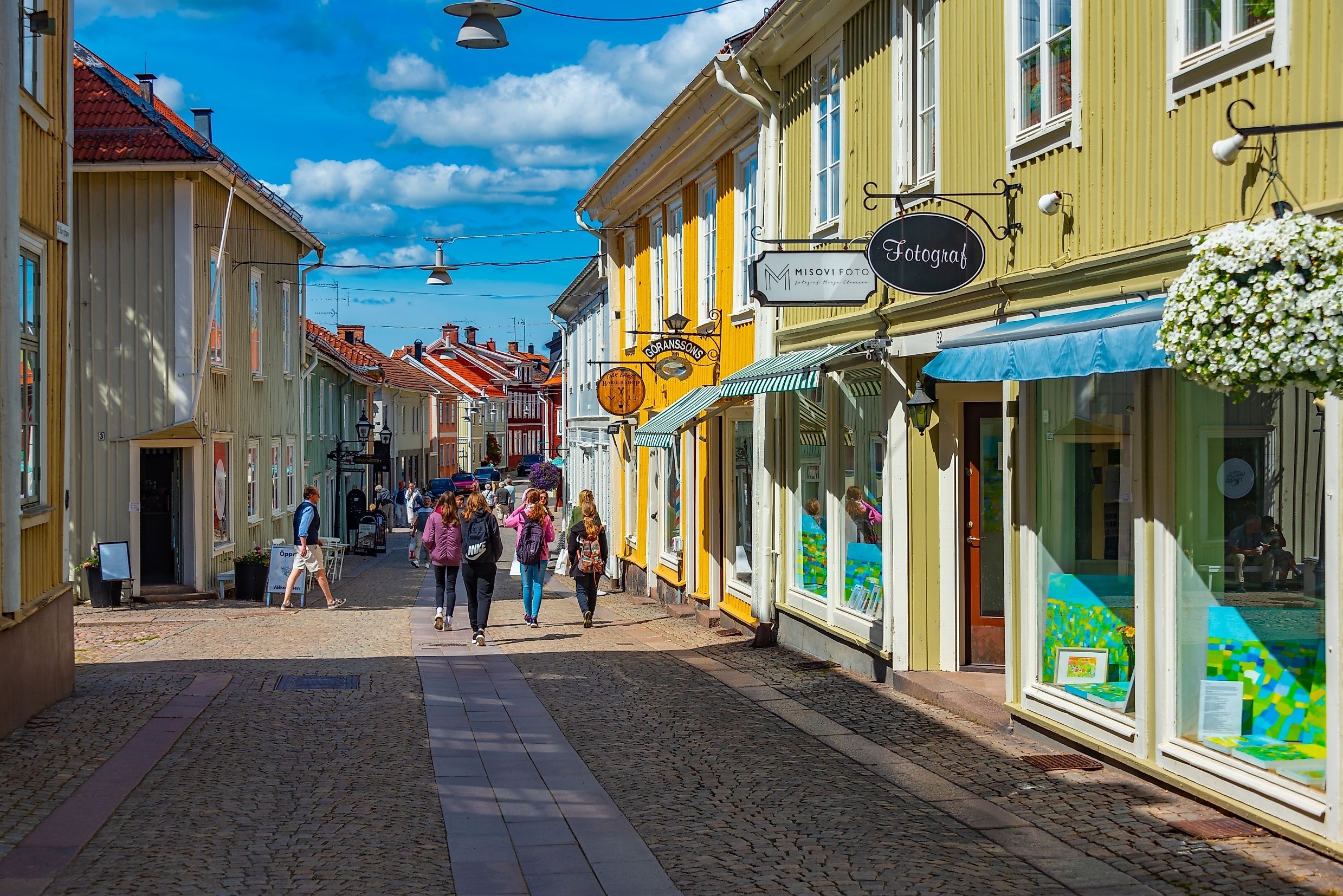
Start at Eksjö Museum, located in the heart of the old town. The museum's exhibitions cover local history, art, and military heritage, while its courtyard provides a pleasant place to pause and enjoy the scenery. From there, walk into Gamla Stan with its beautifully preserved colorful wooden buildings, following the narrow streets along this delightfully historic old town.
Continue toward Krusagården, a historic courtyard in the center of the wooden town. The 17th-century property now serves as a local gathering place and hosts activities such as concerts, flea markets, and seasonal waffle service. From Krusagården, continue along the old streets toward Eksjö Church and the central town-square area, where the historic architecture continues around the surrounding blocks.
The entire old-town district is compact enough to explore simply by wandering, and Visit Småland offers guided and self-guided walking tours specifically designed around Eksjö's wooden architecture. Shops, cafés, and restaurants such as the eatery Putte Kock also occupy the center, giving visitors plenty of reasons to slow down between landmarks.
Rather than treating Eksjö as a list of isolated attractions, think of the old town as one large walking experience. The buildings, courtyards, streets, and small businesses are what make the route worthwhile.
Nora, Västmanland

Nora is another of Sweden's celebrated wooden towns, and its cobblestone center makes for a particularly pleasant walking circuit. Historic buildings, independent shops, cafés, a lakefront promenade, and a revitalized industrial quarter are all within easy reach of the main square.
Begin at Nora Torget, the town's central square, and walk through the surrounding streets to see the preserved wooden architecture. From the square, head toward Göthlinska Gården, a beautifully preserved 19th-century merchant's home that provides a glimpse into upper-middle-class life in historic Nora.
Next, walk toward Kvarteret Bryggeriet, a short trek from the square. The former industrial area has been given new life as a creative quarter filled with craft studios, independent businesses, food and drink, exhibitions, and small shops. It is an especially useful stop for travelers who want something beyond traditional historical sightseeing.
From Kvarteret Bryggeriet, continue toward Norasjön Lake and the Å-promenaden waterfront path. This route offers a quieter contrast to the old-town streets and brings you close to the scenic lake. On your way back toward the center, stop by NoraGlass for their famous ice cream at the square before browsing the independent shops housed in the historic buildings.
Nora's attractions feel naturally connected rather than scattered, making it possible to spend several hours moving between architecture, local businesses, culture, and waterfront scenery entirely on foot.
Hjo, Västra Götaland

Hjo brings together three things that make a Swedish town especially enjoyable to explore on foot. These are preserved wooden architecture, a central square, and a waterfront park. More than 9,000 people live in the wider municipality, and its historic center retains much of its medieval street pattern.
Start at Stora Torget, Hjo's main square and a designated pedestrian-priority area. From the square, wander south through the historic wooden streets, where colorful façades, traditional courtyards, and small-scale buildings make even the stretches between attractions worth exploring.
Continue toward Hjo Church, located in the central part of town, then make your way toward Hjo Town Park. Established as a spa park in the 19th century, the park contains mature greenery and preserved spa-era villas. Paths make it easy to stroll through the grounds before continuing downhill toward Lake Vättern.
Finish at Hjo Harbour, where restaurants, cafés, boats, and views across the lake provide a natural endpoint. The harbor is centrally located, and Hjo's tourism organization specifically provides self-guided walking maps for the wooden town and Hjo River area.
For a longer stroll, follow the paths around the mouth of the Hjo River before returning to the harbor. The combination of colorful wooden houses, greenery, lake views, and small-town businesses makes Hjo a particularly varied walking destination.
Vadstena, Östergötland

Vadstena's compact center packs several centuries of Swedish architecture into a relatively small area. Cobblestone streets, preserved wooden houses, a Renaissance castle, monastery buildings, shops, cafés, and Lake Vättern are all close enough to connect in a single walking outing.
Begin at Rådhustorget, the central square, then follow Storgatan through the old town. The street is lined with historic buildings and small independent businesses and forms one of the town's main pedestrian corridors.
From the square, walk toward Vadstena Abbey and Monastery Church, where the medieval monastery complex occupies a major part of the historic center. The Abbey Museum adds another stop for visitors interested in the layers of religious and cultural history represented here.
From the monastery district, continue toward Vadstena Castle, one of Sweden's best-preserved Renaissance castles. The route takes you through the old center and toward the harbor, where the castle stands beside Lake Vättern. After visiting the castle, walk through Harbor Park and along the tranquil waterfront before returning toward the center.
The town's official tourism information describes Storgatan and Rådhustorget as important links between the castle-and-harbor area and monastery district. That makes Vadstena particularly convenient for visitors who want to build an itinerary around a straightforward walking loop rather than repeatedly retracing their steps.
Mariefred, Södermanland

Mariefred is small enough to explore at a relaxed pace, yet it offers an unusually rich mix of historic streets, waterfront scenery, cultural attractions, and one enormous landmark in Gripsholm Castle. The preserved town center sits beside Lake Mälaren, with the castle rising near the water at the edge of town.
Start in Mariefred's town center, where small shops like Jerners Rum, restaurants, cafés, and historic buildings cluster around the streets leading toward the waterfront. From there, walk toward Callanderska Gården, a historic manor house now operating as a heritage museum. Its garden provides a welcoming pause before continuing toward the lake.
Follow the waterfront toward Gripsholm Castle, whose red-brick Renaissance architecture makes it impossible to miss. The castle contains historic rooms and Sweden's National Portrait Collection and is the centerpiece of Mariefred's sightseeing circuit.
After visiting the castle, continue through Hjorthagen, the adjacent nature reserve, where paths wind through verdant woodland and open areas populated by deer. Return toward the center via the waterfront for another look at the town's cafés and shops.
Mariefred's appeal comes from the way its attractions connect. You can begin with a quiet café-lined street, walk through a historic garden, reach a lakeside castle, and then finish among trees and waterfront paths without needing a car between stops.
Trosa, Södermanland

Trosa is built around the Trosaån River, and that waterway gives the town one of its most natural walking routes. Pastel-colored wooden buildings, small shops, cafés, restaurants, bridges, and a harbor all sit within a compact central area, and the official tourism organization even provides a self-guided walking tour that takes about an hour.
Start at Trosa Square, where the river passes beneath the historic Market Bridge and small businesses line the surrounding streets. From the square, follow Västra Långgatan and its neighboring lanes, including the narrow streets named after traditional crafts. Along the way, stop at Garvaregården, the town museum housed in a historic setting.
Continue along the river toward Trosa Town Church, a distinctive Baroque-style church dating to the early 18th century. Then turn back toward the water and follow the riverside walk toward Trosa Harbour. The route is lined with historic buildings and provides a quieter alternative to the commercial streets.
At the harbor, take a break among the boats and waterfront businesses such as popular seafood eatery Fina Fisken, before returning toward the square along the river. The official tourism site describes the central walking route as roughly an hour and notes that it passes shops, cafés, restaurants, and scenic views.
Trosa is therefore less about checking off individual monuments and more about experiencing how the river, historic buildings, businesses, and harbor fit together. For an easygoing walking day, that cohesion is precisely the point.
Take A Leisurely Stroll Through These Swedish Town Centers
The best walkable Swedish town centers do not require visitors to choose between history, scenery, food, and local life. In Visby, medieval lanes lead to a cathedral, gardens, ruins, and the Baltic waterfront, Ystad connects half-timbered streets with museums and a historic monastery, and Sigtuna turns its ancient main street into a route through Sweden's early history. Meanwhile, Eksjö, Nora, and Hjo show just how much character Sweden's preserved wooden towns can pack into a compact area. Vadstena adds castles and monastery buildings, Mariefred pairs its compact center with a lakeside royal castle, and Trosa lets the river guide the entire outing. For travelers who would rather leave the car parked and experience a destination one street, historic square, waterfront promenade, and café at a time, these nine towns make a strong case for slowing down and exploring beautiful Sweden on foot.