The National Parks Where Wolves Have Returned
Wolves have returned to seven North American national parks or national park reserves, but not through one shared recovery story. Yellowstone received 41 relocated wolves between 1995 and 1997. Grand Teton, Glacier, Banff, and Pacific Rim were recolonized by animals moving through connected wilderness. Isle Royale required an emergency population rescue after inbreeding reduced its wolves to only two.
These differences matter because a wolf crossing a park boundary is not the same as a restored population. A successful return requires breeding packs, sufficient prey, genetic diversity, and safe movement beyond park borders. Wolves can reshape food webs by affecting elk, deer, and moose. Their ecological influence also depends on climate, hunting, other predators, and habitat conditions. Their recovery is therefore both a conservation success and an ongoing management challenge.
Yellowstone National Park

Gray wolves still occupied Yellowstone National Park when it was established in 1872. Early park managers, however, treated large predators as threats to livestock and desirable game. At least 136 wolves were killed inside the park between 1914 and 1926. The last known Yellowstone wolf pack was killed in 1926, although occasional lone wolves were reported afterward.

An intensive survey during the 1970s found no evidence of a breeding population. Restoration planning accelerated after the gray wolf received federal protection under the Endangered Species Act. Fourteen Canadian wolves entered acclimation pens in Yellowstone during January 1995. Seventeen more arrived in 1996, followed by ten wolves from northwestern Montana in 1997. The program released 41 wolves in total.
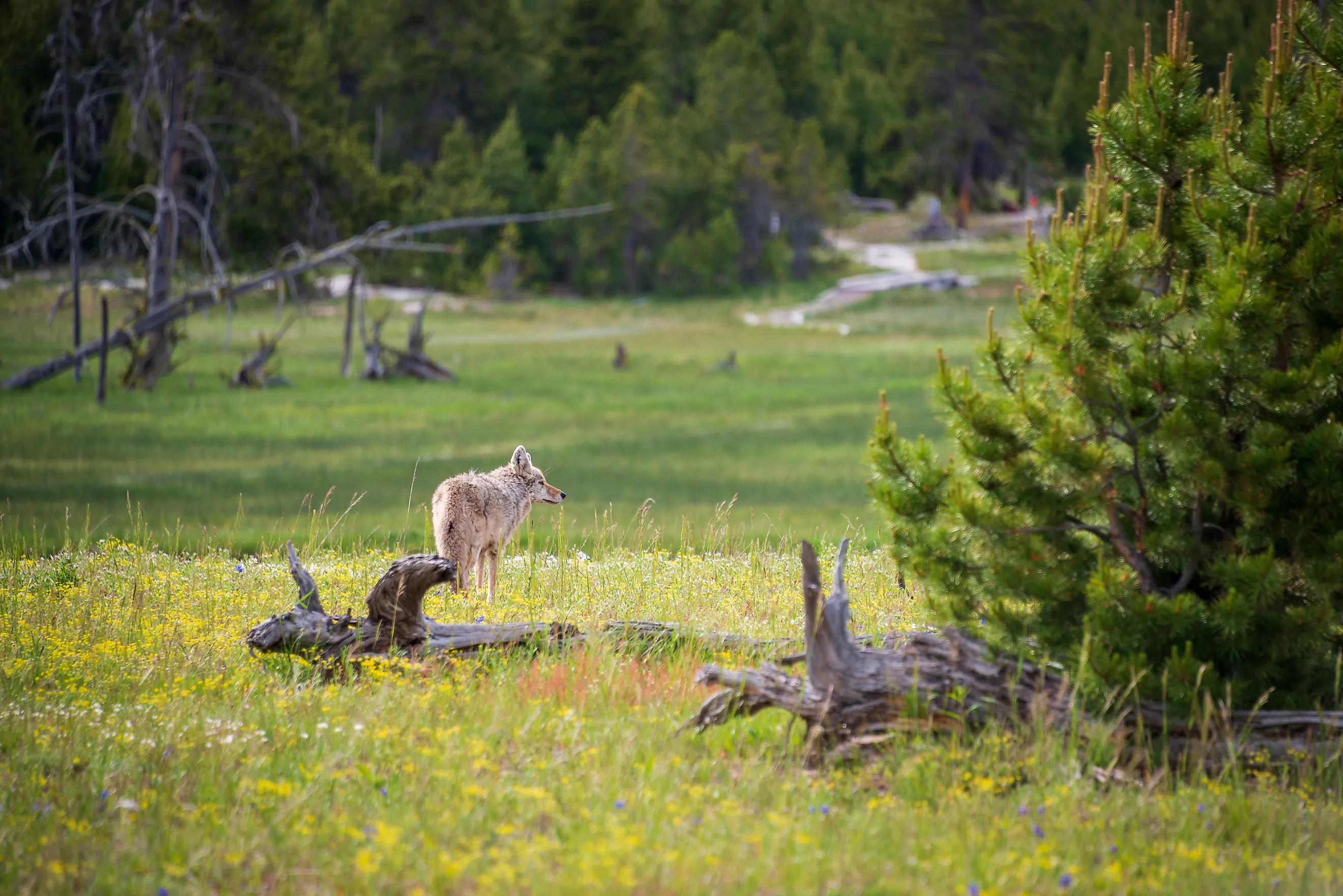
By January 2025, at least 108 wolves in nine packs lived primarily within Yellowstone. The population has generally fluctuated between 83 and 123 since 2009. Wolves now occupy most of the park, although the northern range remains the most reliable place to observe them. Researchers use GPS collars, radio telemetry, remote cameras, genetic samples, and direct observations to monitor packs.
Wolf restoration changed Yellowstone's predator-prey system, but the ecological results are more complicated than the familiar claim that wolves alone transformed the landscape. Wolves contributed to lower elk numbers and altered elk behavior. Other predators, hunting outside the park, winter severity, drought, stream hydrology, and changing prey distribution also affected vegetation. Scientists continue to debate the strength and extent of the resulting trophic cascades.
Grand Teton National Park

Wolves returned to Grand Teton without being released there. Animals from the restored Yellowstone population dispersed south through the Greater Yellowstone Ecosystem and entered Jackson Hole. In 1999, a pack denned inside Grand Teton and produced pups. It was the first documented wolf litter in the park in more than 70 years.

Wolves have continued to live and reproduce in Grand Teton and the neighboring John D. Rockefeller, Jr. Memorial Parkway. At the end of 2024, at least 46 wolves belonged to six packs whose home ranges included the park. The Two Ocean pack denned inside Grand Teton that year. Elk form the majority of their recorded prey, although the wolves also hunt moose and occasionally deer or bison.
Glacier National Park

Glacier National Park contained several of the last surviving wolf packs in the contiguous United States when the park was established in 1910. Protection did not follow immediately. Early park employees used guns, traps, and poison to eliminate wolves, and the species had disappeared from Glacier by 1936.

The park remained without a breeding population for about 50 years. During the 1980s, wolves belonging to the Magic Pack crossed south from Canada. They established a den in the North Fork area and produced five pups, marking the natural return of a breeding population. Unlike Yellowstone, Glacier did not need a formal release program. Its position beside the Canadian border and connection to large wilderness areas allowed wolves to recolonize the park themselves.
Isle Royale National Park

Isle Royale represents a population rescue rather than a conventional reintroduction. Wolves probably reached the Lake Superior island by crossing an ice bridge from Canada during the winter of 1948. They established a population that became central to the park's long-running study of wolves, moose, and predator-prey relationships.

Isolation eventually created serious problems. Disease, fluctuating prey numbers, and genetic inbreeding reduced the population from 50 wolves in 1980 to only two between 2016 and 2018. Warmer winters also made ice bridges less frequent, reducing the chances that mainland wolves could reach the island and introduce new genetic material naturally.
The National Park Service relocated 19 wolves to Isle Royale between autumn 2018 and autumn 2019. The animals came from Minnesota, Michigan, and Ontario. Researchers subsequently documented denning, pack formation, and the birth of pups. The project restored genetic diversity and prevented the park's wolf population from disappearing, although continued isolation remains a long-term concern.
Banff National Park

Government predator-control programs systematically reduced wolves across the Canadian Rockies. Wolves were extirpated from Banff National Park during the late 1940s and remained absent for several decades. They returned naturally during the mid-1980s as animals moved into the park from surrounding landscapes.

Several packs now use Banff, including wolves that travel through the lower Bow Valley near roads, railway lines, campgrounds, and the Banff townsite. Parks Canada estimates that Banff and the surrounding area support roughly 60 to 70 wolves, although pack numbers and territories change over time. Wildlife corridors and seasonal closures around denning areas help wolves cross busy sections of the valley while avoiding people.
Jasper National Park

Jasper is the least straightforward example because wolves were heavily suppressed rather than conclusively absent for one continuous period. Predator-control programs kept their numbers extremely low during the early twentieth century. The programs were intended partly to protect elk that had been introduced to Jasper from Yellowstone in 1920.

Predator control ended abruptly in 1959. Wolves then increased as they fed on Jasper's abundant elk, deer, and moose. Packs expanded into additional valleys and higher-elevation caribou habitat. Their recovery restored an important predator to the park, but it also created difficult conservation tradeoffs because Jasper's small woodland caribou herds are vulnerable to wolf predation.
Wolf density has since fallen as elk numbers declined. Parks Canada estimated an average of 1.6 wolves per 1,000 km2 between 2017 and 2024, approximately half the density recorded during the previous eight years. Resident packs nevertheless continue to occupy and reproduce within the park.
Pacific Rim National Park Reserve

Wolves disappeared from the west coast of Vancouver Island during the 1960s. They began recolonizing the region naturally in the 1990s, including the beaches, rainforests, and coastal watersheds protected by Pacific Rim National Park Reserve. Pacific Rim is formally a national park reserve because Indigenous land claims in the region remain subject to negotiation.

The greater Pacific Rim area now supports an active population of coastal wolves. Families use territories covering hundreds of square kilometres, so their ranges extend beyond the reserve into First Nations lands, communities, forests, beaches, and neighboring watersheds. Parks Canada reports that the population using the Long Beach Unit is increasing.
The return has also produced new management challenges. Some wolves have become accustomed to people or learned to associate human areas with food and domestic dogs. Parks Canada works with Nuu-chah-nulth First Nations to monitor the population, protect cultural relationships with wolves, manage attractants, and reduce conflicts in heavily visited coastal areas.
What Wolf Recovery Shows
These seven parks do not represent a single conservation method. Yellowstone involved deliberate releases. Grand Teton, Glacier, Banff, and Pacific Rim were recolonized by wolves moving through connected landscapes. Isle Royale required genetic and demographic rescue, while Jasper's population recovered after predator control ended.
The distinctions matter. A lone wolf crossing a park boundary does not establish a restored population. Rocky Mountain National Park, for example, has recorded reintroduced Colorado wolves moving through the park, but it does not yet have a documented resident pack. Long-term recovery requires breeding, sufficient prey, connected habitat, genetic diversity, and protection across territories that often extend far beyond national park boundaries.