The Oldest Hot Springs Resorts Still Operating In America
A handful of American hot springs resorts were open to paying bathers before the Revolution, and several more were in business before the Civil War. At the oldest of them, the soak has changed far less than the buildings around it. Bathers in Bath County, Virginia, still float in a pool whose stone basin was laid in 1761. A Montana resort that began as a prospector's saloon and bathhouse in the 1860s now bans alcohol on the property. Over the past two centuries, fires, a hurricane, a Navy takeover during World War II, and years-long closures have hit these resorts, and each time the baths were reopened on the same springs.
Warm Springs Pools, Virginia

Bathers at Warm Springs float on foam noodles in 98-degree water inside an octagonal wooden bathhouse, and they are asked not to talk. The stone basin beneath them dates to 1761, the Gentlemen's Bathhouse was raised over it in the 1820s, and spring water pours through at roughly 1.7 million gallons a day. A 50-minute soak is $35, or $40 on weekends and holidays, by reservation only. Morning sessions require swimsuits and include family time in the 22-sided Ladies' Bathhouse from the 1870s, while late-afternoon sessions are for adults only, separated by gender, with swimsuits optional.
County officials ordered the bathhouses shut in 2017 because they were close to collapse, and the pools were reopened in December 2022 after a $4 million restoration. Thomas Jefferson soaked in this water after arriving on August 8, 1818, praising the "delicious bath" and working up to three quarter-hour soaks a day, until he developed what he called "a large swelling on my seat" and went home with his health "entirely prostrated by the use of the waters."
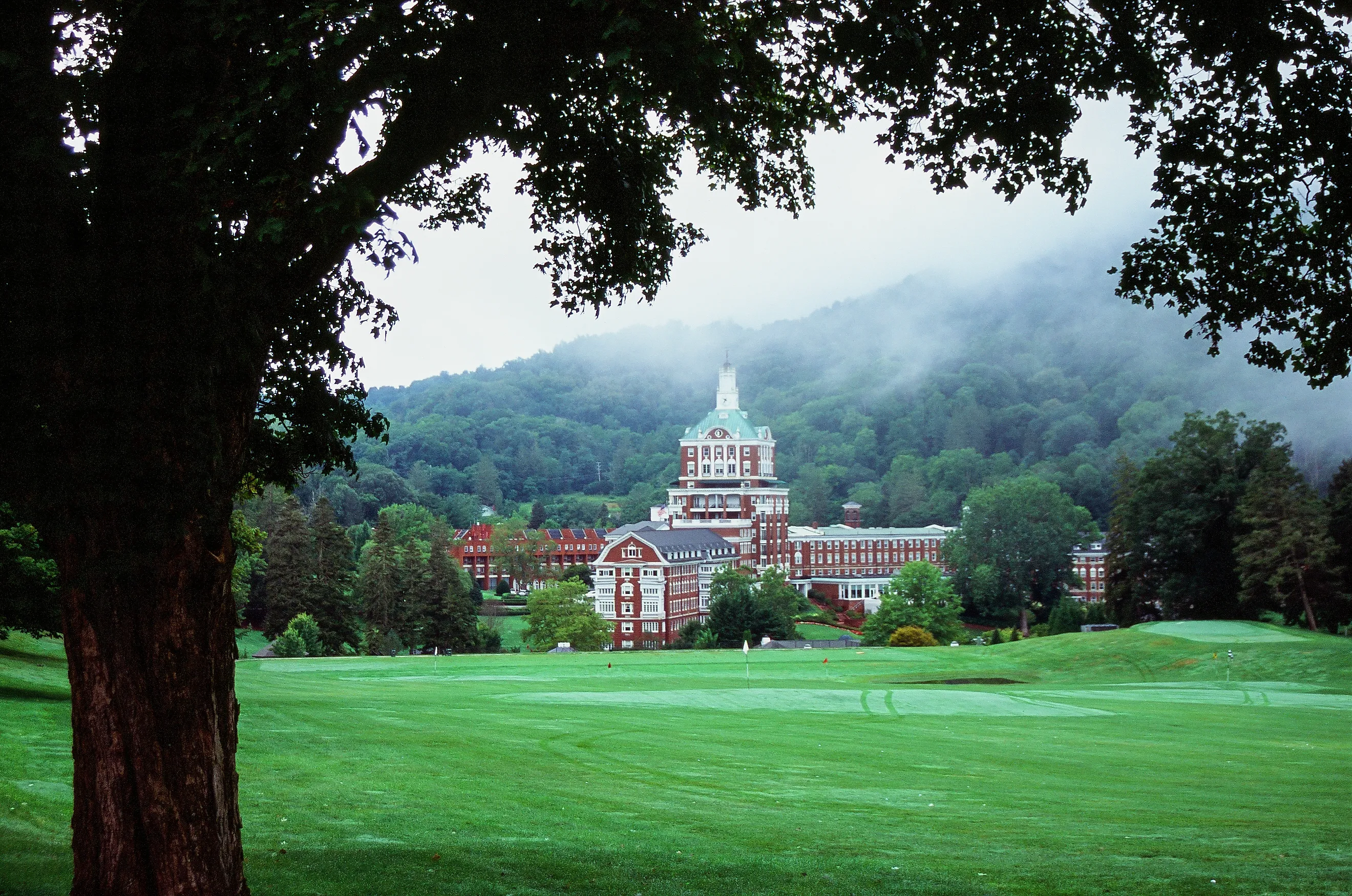
The Omni Homestead, Virginia

Fire swept through the Homestead in 1901, and the 1892 Spa was spared while most of the main building had to be rebuilt, with its tower finished in 1929. The Octagon Pool is fed by two hot springs, and in the adults-only Serenity Garden, a spring-fed pool is set beside a naturally pressurized deluge shower. The resort dates to 1766, when an 18-room wooden hotel went up on land Thomas Bullitt had acquired two years earlier, and its Old Course has the oldest first tee in continuous use in the country, in play since 1892, according to Omni. Summer days can include the two 100-foot slides at Allegheny Springs or a naturalist-led hike past the waterfalls of Cascades Gorge, and in winter, guests ski on nine trails.
Berkeley Springs State Park, West Virginia

Filling a jug or wading in the spring water at Berkeley Springs costs nothing, and the water comes out of the ground at 74.3 degrees at any time of year, so the soaks in the park's bathhouses are heated.
The heated version is in the Roman Bath House, built in 1815, where private walk-in tubs are filled with 750 gallons of spring water at 102 degrees and up to six adults can share one. A half hour is $32 for the first adult and $22 for each additional person, with 10 percent off for seniors and military, and reservations are recommended. Upstairs is a free museum open March through December, and massages paired with a 15-minute bath are booked at the yellow-brick Main Bath House from 1929.
George Washington wrote in his diary on March 18, 1748, that he had "called to see Ye Fam'd Warm Springs," and the springs have been public property since 1776, the year the town was incorporated as Bath. The outdoor stone pool known as George Washington's Bathtub is a 1930s replica honoring his visits.
Hot Springs Resort and Spa, North Carolina

Hurricane Helene flooded Hot Springs on September 27, 2024, wiping out three-quarters of the resort's mineral baths and two-thirds of its lodging, and the owners received no insurance or government money to rebuild. The baths were reopened in spring 2025 with four surviving tubs and four newly built ones, and by early 2026, seven of the original 27 guest rooms were back in service.
The site has been rebuilt before. Settlers found the springs in 1778, and the 350-room Warm Springs Hotel was standing here by the 1830s and burned in 1884. Its replacement, the Mountain Park Hotel, was turned into an internment camp during World War I for about 2,700 German merchant sailors, who built a Bavarian-style village with a working carousel.
Today's soaks take place in private outdoor tubs along Spring Creek, booked by the hour, with towels brought from home. A standard tub for two is $50, or $60 after 6 p.m., and the signature cabanas, which add a private mineral shower and a fire bowl, run $100 to $130. The Appalachian Trail is routed along Bridge Street, through the middle of town.
Bathhouse Row, Hot Springs, Arkansas

Baths have been given at the Buckstaff Bathhouse every year since 1912, making it the only bathhouse on the Row in continuous operation for more than a century. Starting January 1, 2027, it will be operated by a new concessioner, Historic Baths LLC, with no interruption in service expected, according to the National Park Service. Men bathe on the first floor and women on the second, with same-sex attendants, and baths are walk-in only.
In the traditional bath, based on a ritual from the 1800s, bathers spend 15 to 20 minutes in a whirlpool tub capped at 102 degrees, then up to five minutes in a steam cabinet that can reach 145, followed by a sitz tub and hot packs with a cold towel on the head, and an optional 20-minute massage at the end. The full sequence takes an hour and a half to two hours. The spring water itself averages 143 degrees across 47 springs, in an area that was set aside as a federal reservation in 1832.
Thermal water is free at the jug fountains, including one just outside the park at Hill Wheatley Plaza. Farther along the Row, a soak in the four thermal pools at the 1922 Quapaw Baths and Spa, known for its mosaic-tiled dome, is $25 plus tax, and the Fordyce Bathhouse is now the park's visitor center and museum.
Vichy Springs Resort, California
Cottages that founder William Day built in the 1850s are still in use at Vichy Springs, a resort founded in 1854 and listed as a California Historical Landmark, where the plaque describes it as one of the state's oldest continuously operating mineral springs. Jack London and Robert Louis Stevenson are said to have stayed here. In the concrete "champagne baths" that William Doolan added while he ran the resort between 1866 and 1896, naturally carbonated water fills the tubs at about 90 degrees, well below the tubs on Bathhouse Row, so many soakers finish in the hot pool. The owner says it is the only mineral water in the county that can be drunk.
Day passes are $45 for up to two hours or $110 for the full day, between 9 a.m. and 5 p.m., booked by phone or email, and they include the Olympic pool in season. Beyond the pools, hikers reach 40-foot Chemisal Falls after 30 to 40 minutes along Little Grizzly Creek on the 700-acre property.
Indian Springs Calistoga, California

For a mud bath at Indian Springs, an attendant packs warm mud, made from volcanic ash and water from the property's own geysers, over the whole body below the neck. After the mud come a shower, a soak in mineral water, an infrared sauna, and a rest wrapped in flannel, and an attendant then walks guests out to the Buddha Pond, with the full treatment lasting 60 minutes and priced at $170. Sam Brannan opened the original spa, mud baths, and pool here in the early 1860s, and locals trace the town's name to his reportedly tipsy promise of a "Calistoga of Sarafornia." Water from the four geysers on the property comes up at about 230 degrees, and the Olympic-size pool built in the 1910s is kept between 92 and 102. Mineral buildup clogs the pipes so quickly that they are replaced every five to eight months, and the cut pieces are sold as souvenirs.
Indian Hot Springs, Colorado

For $35 on weekdays or $40 on weekends, adults at Indian Hot Springs can sit in walk-in tubs inside cave passages that were dug into the rock in the early 1900s, in water averaging 108 to 113 degrees. The caves are separated by gender, kept as a quiet zone, and limited to ages 18 and up, and swimsuits are optional on weekdays but required on Saturdays and Sundays.
Idaho Springs had paying bathers by 1863, a few years after gold was found nearby, and the stone and frame center building of the lodge dates to 1869. A swimming pool under a dome planted with banana trees is kept at 96 to 102 degrees and costs $30 on weekdays, and private baths and a mud room called Club Mud are also available.
Boulder Hot Springs, Montana

Bathing at Boulder Hot Springs began in the 1860s at a saloon and bathhouse that prospector James Riley built beside the springs. A Victorian hotel addition followed in 1890 and 1891, and between 1910 and 1913 the hotel was remodeled in the Spanish Mission style still visible today. It was closed in 1989 and reopened in 1991 under new owners.
Spring water flows continuously through the indoor plunges, replacing all of it every four hours, and the plunges stay between 103 and 106 degrees, while the outdoor pool is cooler at 96 to 100. A cold pool below 70 degrees is on the women's side only, natural mineral steam rooms are on both sides, and a day pass is $12 on weekdays or $14 on weekends, between 10 a.m. and 8 p.m. The hotel that started as a saloon is now run as a bed-and-breakfast and retreat center where alcohol, drugs, and smoking are banned.
Ojo Caliente Mineral Springs Resort, New Mexico

Hikers climb a little over a mile from the resort to Posi Pueblo, a Tewa village occupied between the late 1300s and the early 1500s, where pottery sherds and sunken room blocks are still visible and a brochure from the front desk is keyed to numbered signs along the trail. Back down at the pools, most are named for their minerals, including the Iron and Lithia pools, the Soda Pool, where silence is required, and the recently reopened Arsenic Pool. In season, bathers in the mud pool coat themselves in clay and let it dry in the desert sun. Most pools are kept between 98 and 105 degrees, and day soaks are $45 Monday through Thursday or $65 Friday through Sunday.
Paying bathers have soaked here since the 1860s, and the historic district includes a 1910s hotel and a 1924 adobe round barn. A fire in 2020 destroyed the old bathhouse, and the rebuilt one, reopened in 2022 for overnight and spa guests, has a lounge wall made of salvaged stones, some still scorched.
Glenwood Hot Springs Resort, Colorado

The Grand Pool at Glenwood Hot Springs is 405 feet long and 100 feet wide, filled by a spring that flows about 3.5 million gallons a day at 122 degrees, and kept at 90 to 93 degrees. It was opened to the public on July 4, 1888, and is billed as the world's largest outdoor mineral hot springs pool. Its longest closure came during World War II, between 1943 and 1946, when the resort was used by the Navy as a convalescent hospital. The red sandstone bathhouse from 1890 was reopened in 2025 as the 16-room Hotel 1888.
A day pass is $42 to $60 for adults and is good for re-entry until closing. A morning soak in the 104-degree Therapy Pool can be paired with the 0.7-mile round-trip walk to Linwood Cemetery, where Doc Holliday, who died in town in November 1887, is buried in a spot no one can pinpoint. In the separately run Yampah Vapor Caves nearby, guests sit on marble benches in underground rock chambers averaging 110 to 113 degrees for 10 to 12 minutes at a time, cooling off between rounds.
Evenings at the Yampah Mineral Baths, opened in 2024 and included with the pass, are reserved for adults. Five pools there range between 95 and 104 degrees, and between soaks, bathers can drop into a cold plunge kept at 52 to 60 degrees.
Evans Plunge Mineral Springs, South Dakota

Evans Plunge was built over 13 springs, and about 5,000 gallons a minute come up through the river-stone floor of the pool. The water stays at 87 degrees all year and is replaced entirely every 90 minutes, and it is chlorine-free, so swimmers can open their eyes underwater. Fred Evans built the plunge in 1890, and it is the oldest attraction in the Black Hills.
The building also has four waterslides, swing rings, two hot tubs, a sauna, and a steam room. Admission is $19 for ages 16 and up and $14 for ages 3 to 15, and the plunge is closed on Tuesdays. In the same town, the bones of 61 mammoths can be seen where they were found at the Mammoth Site, in a sinkhole dated by a 2026 study to between 160,000 and 232,000 years ago.
The oldest thing at any of these resorts is the water. The thermal water at the jug fountains in Hot Springs, Arkansas, fell as rain more than 4,000 years ago, according to the National Park Service. Bathers on Bathhouse Row took more than a million baths in 1946, and in the decades that followed, the Row's bathhouses were closed one by one, with only the Buckstaff staying open the whole time. Eight of those bathhouses still stand, and soaks are still sold at two of them, the Buckstaff and the Quapaw. On January 1, the Buckstaff passes to its first new operator in 114 years, with baths expected to continue through the change. Filling a jug at the park's fountains still costs nothing.