The Highest Mountain You Can Reach Without Climbing Gear
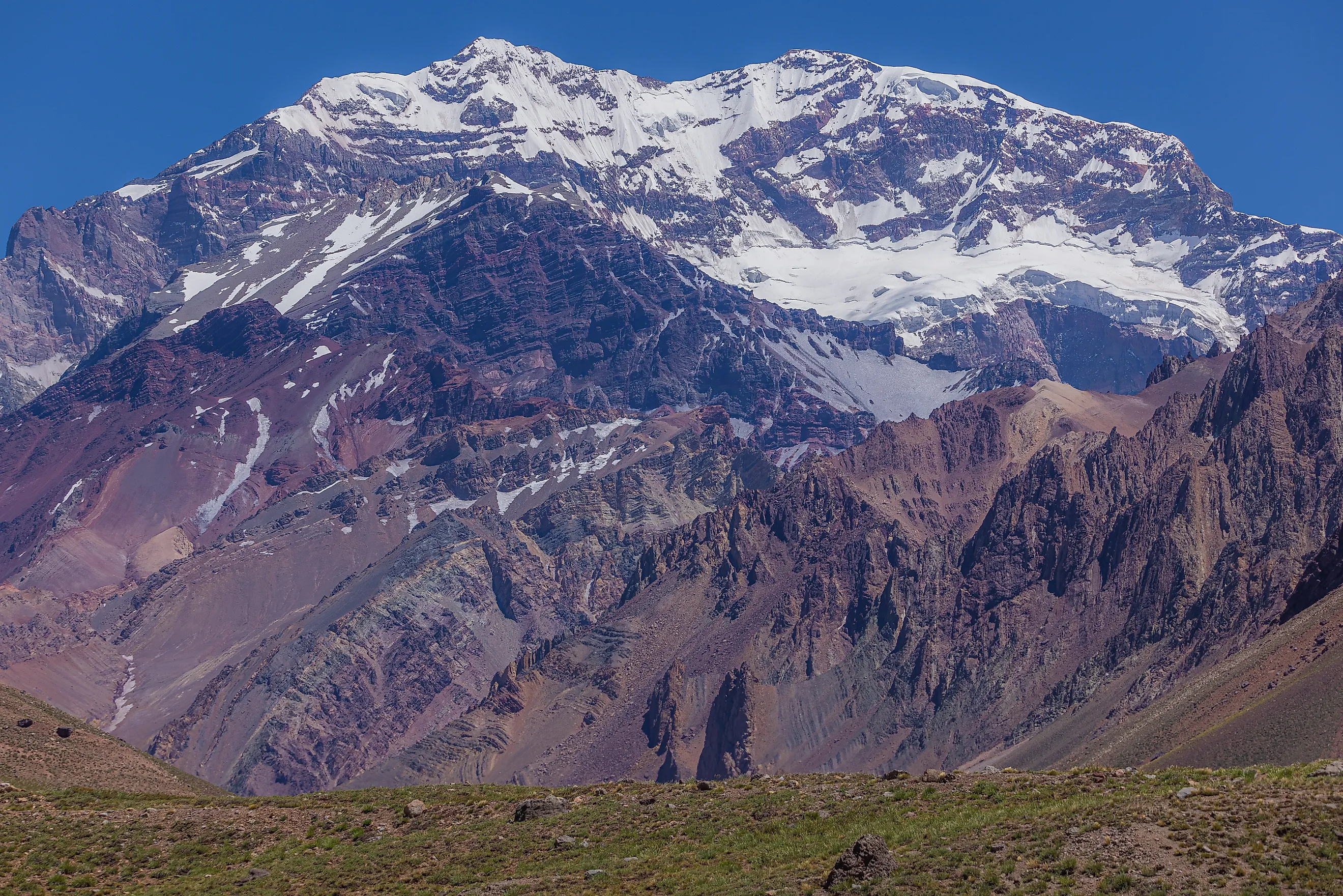
At 6,961 meters (22,838 feet), Aconcagua is taller than every peak in North America, Europe, Australia, and Antarctica, yet its standard route asks for no rope, no ice axe, and no crampons. Climbers reach the summit by walking, at times on all fours over loose scree, rather than by climbing in the technical sense. That combination, extreme altitude paired with a route that demands stamina instead of rock or ice skills, is why mountaineers commonly call Aconcagua's Normal Route the highest non-technical ascent on Earth. Roughly two out of three people who attempt it still turn back. The mountain punishes with thin air and violent wind, not with cliffs.
Where Aconcagua Sits
Aconcagua rises in Argentina's Mendoza Province, in the Principal Cordillera of the Andes, about 112 kilometers (70 miles) northwest of the city of Mendoza and roughly 15 kilometers (9 miles) from the Chilean border. It is the highest point in the Western and Southern Hemispheres and the tallest mountain on Earth outside Asia, ranking second in topographic prominence worldwide, behind only Mount Everest. The mountain has two summits connected by a narrow ridge called the Cresta del Guanaco, with the taller north summit at 6,961 meters and a south summit roughly 30 meters lower. Argentina's own geographic institute lists the height at 6,959 meters (22,831 feet), while a 2001 GPS survey put it slightly higher, around 6,962 meters (22,840 feet); most climbing outfitters and reference sources still cite the traditional 6,961-meter figure.
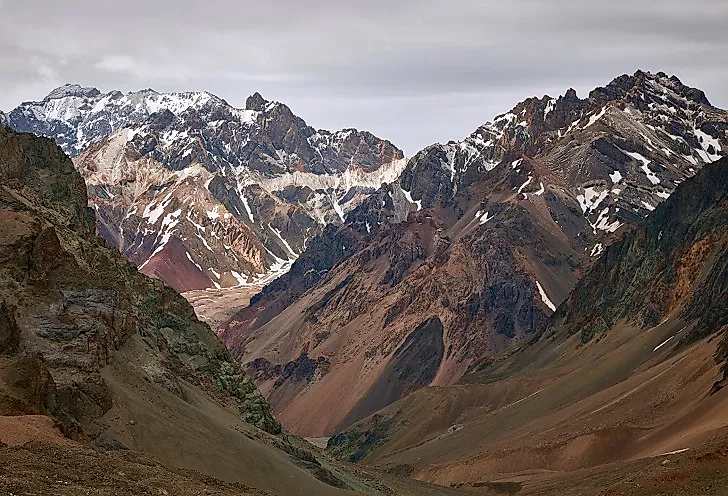
Aconcagua began as an active stratovolcano, built up as the Nazca Plate slid beneath the South American Plate. Volcanic activity stopped roughly 8 to 10 million years ago, and the mountain has been dormant ever since. Its slopes are made mostly of lava, breccia, and pyroclastic rock, while the surrounding valleys hold colorful sedimentary deposits of limestone and turbidite that give the approach hike its striking reddish and ochre coloring.
First Ascent and a Deadly Reputation

Swiss guide Matthias Zurbriggen reached the north summit on January 14, 1897, as part of a British expedition led by Edward FitzGerald, after German geologist Paul Güssfeldt's earlier attempt in 1883 failed to reach the top. Zurbriggen made the final push alone, via what is now called the Normal Route, along the northwest ridge.
More than 100 people have died on Aconcagua since climbing records began, and the mountain averages about three deaths a year, mostly from altitude sickness, high-altitude cerebral or pulmonary edema, falls, and exposure. Argentine climbers Federico Campanini and Elena Senin were among five people who died on the mountain in 2009, one of its deadliest recorded seasons. Rangers at Aconcagua Provincial Park, the protected area that surrounds the mountain, have reported that roughly 40 percent of climbers arrive with little to no acclimatization training, a major factor in the death toll.
Climbing It: Routes, Season, and Rules

The Normal Route, also known as the northwest ridge route, starts near Puente del Inca and follows the Horcones Valley to Plaza de Mulas, the main base camp at 4,260 meters (13,976 feet). From there, climbers move up through a series of high camps, commonly Camp Canada around 5,000 meters, Nido de Cóndores at roughly 5,400 meters, and a final high camp near 5,950 to 6,000 meters, before a long summit push that typically takes 8 to 12 hours. Most expeditions budget 13 to 20 days total to allow for acclimatization, and only about 30 to 40 percent of climbers who attempt the mountain reach the top.
The park designates an official ascent season each year, generally running through the Southern Hemisphere summer, though the exact dates are set season by season. For the 2026 to 2027 season, the authorized window opened on November 1, 2026, and closed on March 31, 2027. Most summit attempts concentrate between mid-December and late January, when winds are calmer and temperatures less extreme, since the upper mountain grows far more dangerous once winter storms arrive.

Unlike Africa's Kilimanjaro, Argentina does not require climbers to hire a guide. Park permits are sold in tiers based on whether a climber uses authorized local service providers, and the pricing runs counterintuitive. The "assisted" permit, for those who hire authorized operators, actually costs less than the "unassisted" permit for climbers going without them. During the 2025 to 2026 season, an unassisted foreign climber paid roughly USD 1,640 for a summit permit via the Horcones entrance, while assisted climbers paid closer to USD 1,170, with separate, lower-priced trekking permits available for those only visiting Plaza de Mulas without attempting the summit.
Climbers who want the challenge of technical terrain instead of a long walk can take the Polish Glacier route. First climbed by a Polish expedition in 1934, it crosses genuine glacier ice and calls for crampons, an ice axe, and rope work, unlike the Normal Route.
A Sacred Mountain Before It Was a Summit

Long before European mountaineers arrived, the Inca regarded Aconcagua as sacred. Archaeologists have found a preserved Inca child mummy high on the mountain's slopes, evidence of capacocha, a ritual sacrifice practice. The name itself likely comes from Andean languages, possibly Quechua for "Sentinel of Stone" or Aymara for "White Ravine," though linguists still debate the exact origin.
What Draws Climbers Back
Aconcagua's appeal is precisely that gap between its size and its demands. It lets trekkers with strong lungs and stubborn legs stand higher than any mountaineer on six of the world's seven continents, without learning to swing an ice axe or trust a rope. That accessibility is also what fills the mountain with climbers who underestimate it, which is the real reason Aconcagua's death toll rivals mountains with far more technical reputations.