6 Most Beautiful Gothic Churches In Kentucky
Kentucky has a complex history, and much of its heritage is reflected in the architecture lining the commercial districts of its small towns. The state is known for many things, including bourbon, bluegrass music, and the Appalachian Mountains. From the historic district of Old Louisville to the capital, Frankfort, there are many stunning Gothic churches and basilicas, with their trademark facades, arches, and vast, open spaces that reflect the periods in which they were built.
Gothic architecture was prominent from the 12th to the 16th centuries, and there are various forms and later versions, including Collegiate Gothic and Carpenter Gothic. The styles are characterized by intricate stonework, stained glass, and flying buttresses, which create soaring, light-filled effects. It is one of the best design styles for places of worship, creating a sacred atmosphere with vertical spaces filled with meditation and hymns rising skyward. These are six of the most beautiful Gothic churches in Kentucky, each featuring distinctive styles that make them landmarks throughout the state.
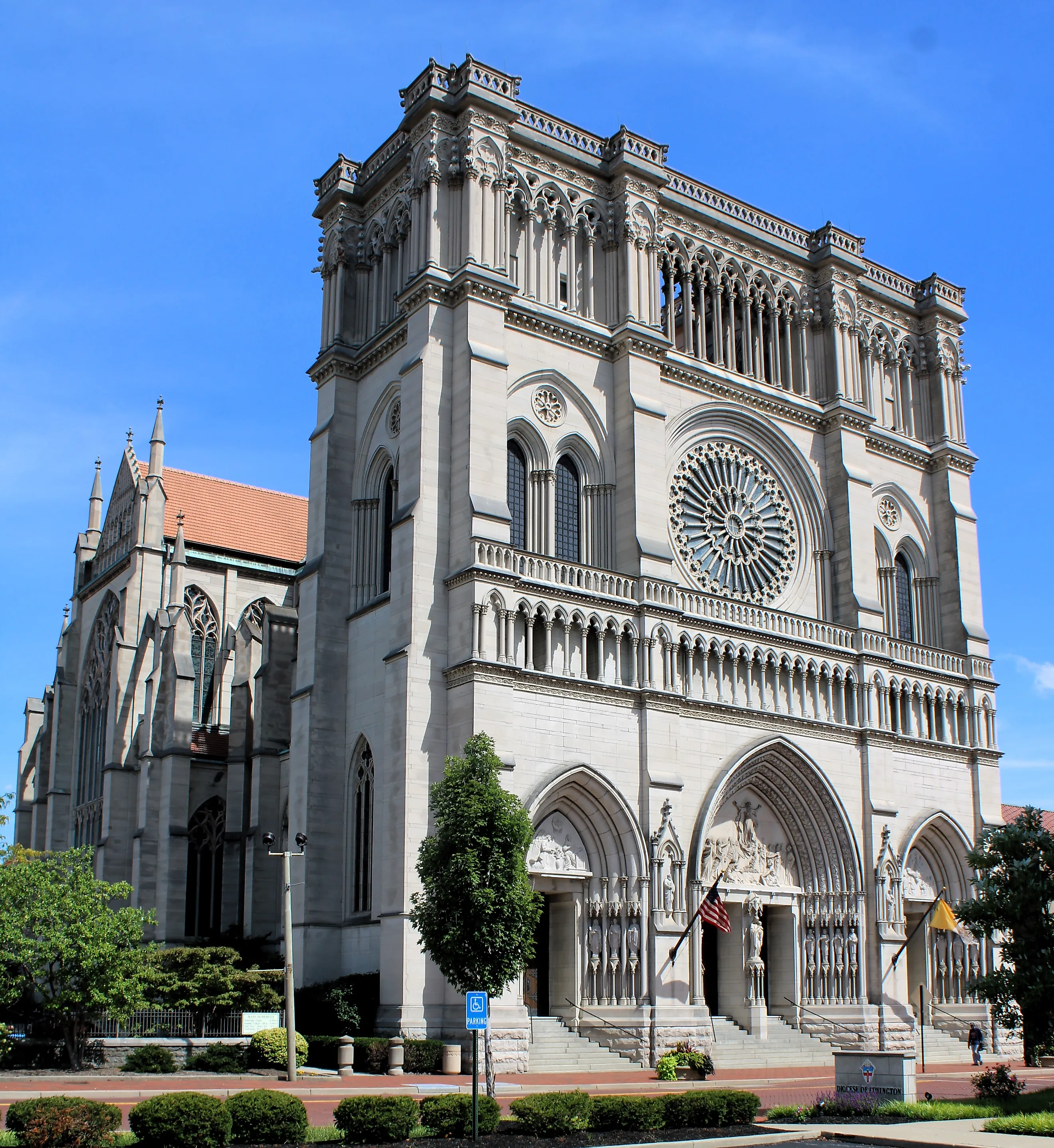
The Cathedral Basilica of the Assumption: Covington

St. Mary's Cathedral Basilica of the Assumption in Covington is a minor basilica that began construction in 189. The project was terminated in 1915, although it remains incomplete, as towers that were in the original plans were never built. Nevertheless, it serves the community as a gorgeous art and architectural monument for generations to come. Like many cathedrals, this one utilizes the Gothic architectural style to reflect the economic and cultural worldview of the Middle Ages.
The cathedral has a fabled history dating to 1834, when Covington received its first Catholic church, St. Mary's, which the population quickly outgrew. The Delaney residence was purchased in 1890 on Twelfth Street and Madison Avenue for what would become the Cathedral Basilica of the Assumption. Architect and artist Leon Coquard designed the original plans, which were approved in 1893, and the ground was broken the following year.
The nave, apse, and transept were completed, but installation of the stained-glass windows was delayed due to a lack of funds for construction. A brick wall and plain windows were erected in its place, and the cathedral was dedicated for use in 1901. The stained-glass windows were installed in 1910 by the bishop, who focused on interior beautification rather than the exterior. Today, St. Mary's Cathedral Basilica of the Assumption stands as a stunning testament to Covington's spirit of persistence as much as its faith.
The Cathedral of the Assumption: Louisville

The Cathedral of the Assumption in Louisville is an excellent example of 19th-century Neo-Gothic architecture with a distinctive steeple and accompanying spirelets. The property was consecrated in 1830, the site of the former St. Louis Church. Its Neo-Gothic style was designed by William Keeley and Isaiah Rogers, two premier architects of the century.
Finished in 1852, the Cathedral of the Assumption is the fourth-oldest public building in Louisville and the third-oldest Catholic Cathedral in the US in continual use. The original steeple and spire were damaged by fire and rebuilt in 1857. It is 287 feet tall, the tallest in the US at the time. It has witnessed tumultuous times, including when it was used to honor Civil War soldiers, and now it is the center of the oldest inland diocese in America.
Christ Church Cathedral: Lexington

The original Christ Church Cathedral was the first Episcopal church constructed in Kentucky, built in 1796. Its present Gothic structure was completed in 1848 by John McMurtry and architect Thomas Lewinski. It features Gothic Revival elements, including pointed arches, a pitched roof, and lancet windows, along with buttresses and a prominent tower that draw the eye toward the heavens.
The edifice is in the heart of the historic district near Gratz Park and serves as the Diocese of Lexington, having been designated a cathedral in 1897. The interior is as noteworthy as the exterior, featuring polished wood box pews and a relatively flat ceiling in a distinctly Greek Revival style, showcasing the cathedral's growth. Grisaille and pictorial stained-glass windows illuminate and define the sacred space, along with acoustics that carry liturgical music from the Holtkamp organ for a resonant effect.
St. Paul's Episcopal Church: Newport

Newport's St. Paul's Episcopal Church was founded on Easter Sunday, 1844, and admitted to the union with the Episcopal Diocese of Kentucky in the following year. The cornerstone was laid on the grounds of the former Methodist Church in 1871, and the new church, designed by J.R. Neff, would become a Kentucky landmark. Parishioners were first summoned to worship in August 1873, and the Parish House was added in 1927.
The Gothic Revival design embodies the spirit of the classic Gothic style, featuring a prominent corner tower topped by a stone steeple. The church has withstood a number of natural disasters, including floods, tornadoes, and earthquakes, but today it continues to serve the community via the refurbished Parish House in addition to the church itself.
Old Trinity Centre: Owensboro

Owensboro's Old Trinity Centre was originally the Trinity Episcopal Church, dedicated in 1875, and is Western Kentucky's oldest example of Gothic architecture, built in the early Lancet style with several prominent features, including a large stained-glass window above what used to be the choir balcony, designed by and executed by Charles Stewart Todd. The church's pointed-arch windows and strong vertical emphasis are signature elements of the Gothic style, evoking a sense of wonder for the congregation.
The church operated as such until the congregation recognized a need for a larger, newer space in the mid-20th century. Since 1973, it has been the home of the Theater Workshop of Owensboro, undergoing substantial renovations in 1999. Local legend has it that Old Trinity Centre is one of the most haunted locations in town.
First United Methodist Church: Frankfort

Frankfort's First United Methodist Church was completed in 1858 after replacing a livery stable. The Gothic Revival edifice emphasizes verticality, a cornerstone of any Gothic rendition, with buttresses and towers that represent the English Gothic style. Despite these traditional features, the church is perhaps best known for its modern "Divine Light Chandelier" by Brook Forrest White Jr. The sculpture comprises three bowls representing the Holy Trinity and hangs from a metal frame. The bowls contain more than 50 pieces of red, yellow, and orange blown glass, which represent the Holy Spirit's fire.
Gothic cathedrals are a benchmark of physical beauty from the Middle Ages, inspiring awe in those who gaze upon them, with their spires reaching seemingly forever skyward. Gothic designs were often chosen because they represent prosperity, signalling to the world that the local community is growing.
These churches in Kentucky have storied pasts that add context to their physical beauty. Some, like the Cathedral Basilica of the Assumption in Covington, have had to move multiple times as the congregation outgrew the church building. But one does not have to be religious to appreciate the grandeur that Gothic architecture conveys. From the nave to the steeple, from stained glass windows to flying buttresses, the aesthetic is favored by many architecture buffs for its creative spaces and sense of ancient wonderment.