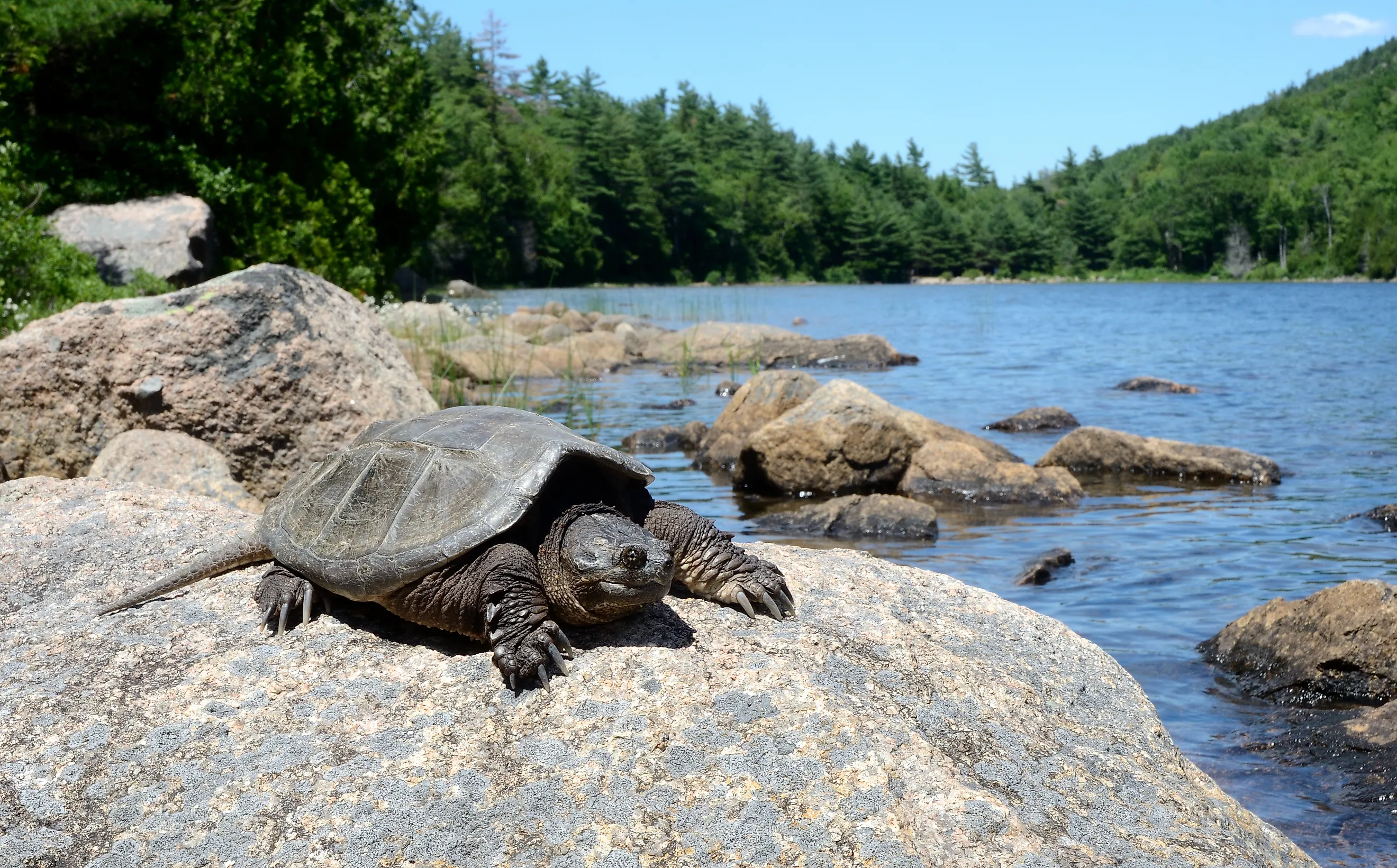
The Lakes With The Largest Snapping Turtles
A snapping turtle can spend most of its life on the muck at the bottom of a lake, surfacing for a gulp of air and sinking out of sight again, which makes naming the lake with the most of them genuinely hard to prove. Researchers have spent years on each one, trapping, tagging, recapturing, and even reading turtle DNA to estimate how many are really down there. Most of that research follows the common snapping turtle (Chelydra serpentina), the wide-ranging heavyweight of the eastern and central United States; the exception is a Louisiana lake studied for its bigger, stranger cousin, the alligator snapping turtle (Macrochelys temminckii). These are the lakes where those numbers run largest and best documented.
Medicine Lake, Minnesota

Medicine Lake has the largest population range found in the published U.S. lake research reviewed here. A multi-year Minnesota study trapped 314 turtles in the lake, including 76 common snapping turtles. Researchers also collected genetic samples and analyzed 10 microsatellite loci from the snapping turtles. Their genetic work found no population subdivision within the lake, indicating that the animals sampled belonged to one continuous population.
The striking figure came from the population analysis. Researchers derived an estimated population range of 406 to 2,028 snapping turtles from their effective population-size calculations. That number needs an important qualification: it was derived from genetics and is not equivalent to physically counting hundreds or thousands of turtles in the lake. The field team directly trapped 76 snappers, and its hoop traps were also unable to capture the smallest size classes effectively. Even with those limits, the Medicine Lake study provides unusually detailed evidence for a large snapping-turtle population inside an urban Minnesota lake.
Island Lake, Nebraska

Island Lake has one of the clearest conventional population estimates available for a U.S. lake. Researchers studied common snapping turtles at the 298-hectare lake on Crescent Lake National Wildlife Refuge during 2008 and 2009. They marked 250 adult and subadult turtles and recorded 69 recaptures. Three separate mark-recapture calculations produced estimates of 580, 606, and 622 turtles. Their average came to 603 adult and subadult snappers.
That was not quite the whole population. Immediately before the study began, 87 adult and subadult turtles had been removed from Island Lake for dietary research or relocation. Adding those animals back led the researchers to describe approximately 690 adult and subadult snapping turtles as the more justifiable estimate for the lake before removal. That worked out to 2.32 turtles per hectare across the entire lake. Few named American lakes have snapping-turtle abundance supported by such a large sample and several independent population estimators.
Round Pond, Illinois

Round Pond is an example of how a relatively small lake can support an impressive concentration of snapping turtles. Researchers sampled the roughly 30-hectare floodplain lake in Gallatin County during six summers between 1994 and 1999. Their methods included fyke nets, trammel nets, hoop traps, and hand captures. Across the study, they recorded 93 common snapping-turtle captures.
The more useful number is density. The researchers calculated an average of 4.99 snapping turtles per hectare and snapping-turtle biomass of 19.01 kilograms per hectare. That density was more than twice the 2.32 adult-and-subadult turtles per hectare reported at Nebraska's much larger Island Lake. Applying 4.99 turtles per hectare across Round Pond's 30 hectares gives roughly 150 turtles, although the study itself reported density and captures, not a formal lake-wide population estimate of 150. Round Pond also supported ten turtle species, making it an unusually rich freshwater turtle community as well as a strong snapping-turtle site.
Black Bayou Lake, Louisiana

Black Bayou Lake is the strongest entry here for alligator snapping turtles. Biologists from the University of Louisiana Monroe conducted trapping surveys at Black Bayou Lake National Wildlife Refuge from 2004 through 2020. Across those 17 years, they captured 90 individual alligator snapping turtles. That figure represents unique animals encountered during the surveys, not an estimate of the entire number living in the lake.
The long time span allowed something a short trapping project could not: a comparison of the population decades apart. Data from 2004 and 2005 were compared with surveys from 2019 and 2020, and the researchers found no evidence that the population had declined between those periods. Juveniles were relatively uncommon in the catches, however, which raised questions about future recruitment. Alligator snapping turtles mature slowly and can live for decades, so the age structure of a population matters as much as the number of adults present at one moment. Continued monitoring was recommended.
Lake LaMoure, North Dakota

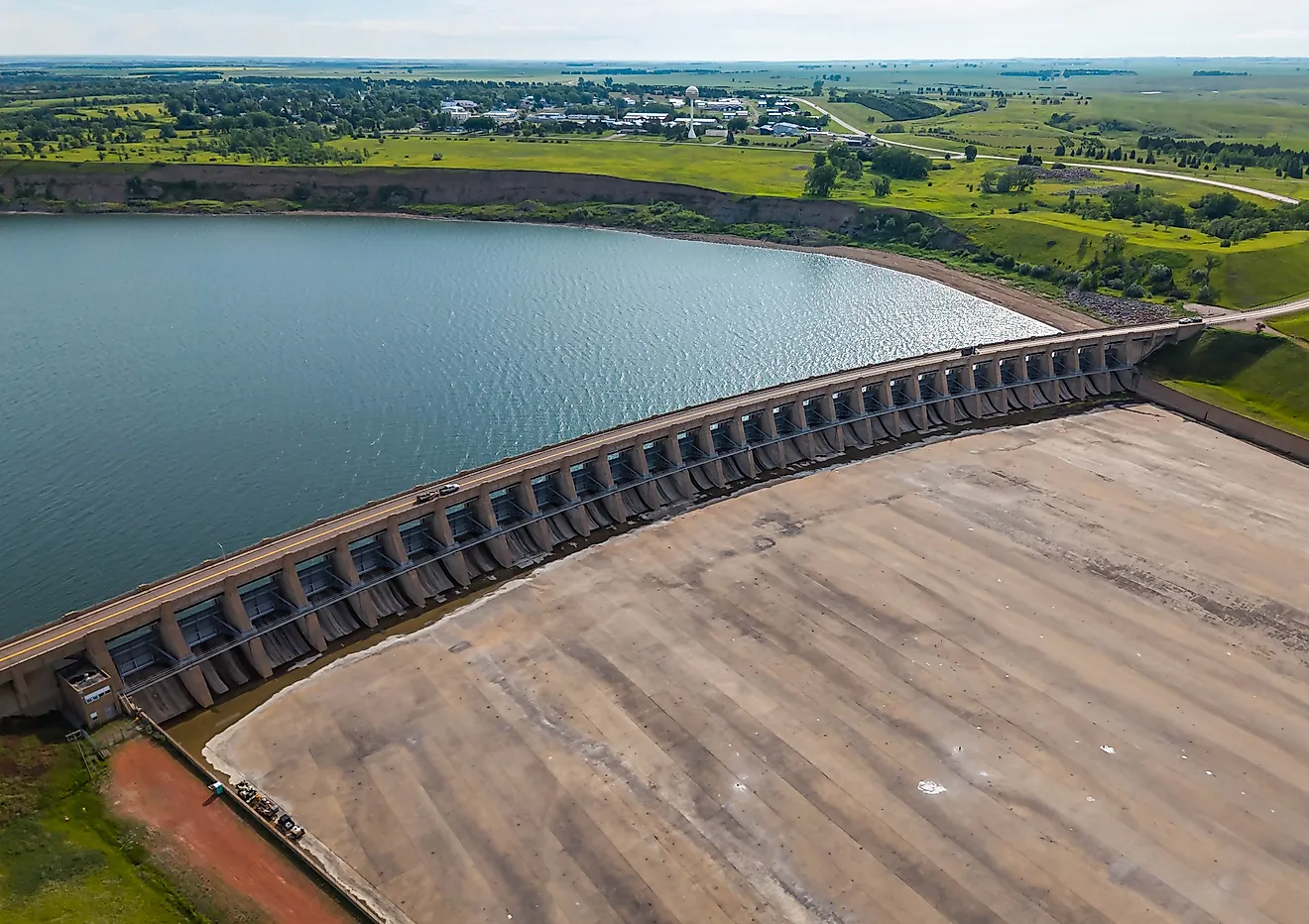
Lake LaMoure has a smaller documented population than the headline numbers from Medicine Lake or Island Lake, but its inclusion is supported by an actual population estimate. Researchers studied common snapping turtles in Lake LaMoure, Nelson Lake, and Patterson Lake during the 2012 and 2013 field seasons as part of a North Dakota population assessment. Only 62 individual snapping turtles were captured across all three reservoir systems, illustrating how difficult these animals can be to sample.
Lake LaMoure had the highest number among the study sites and an estimated population of 40 snapping turtles. Researchers also fitted turtles there with radio transmitters. Eleven of 15 tagged animals located during winter sampling were found clustered within 45 meters of one another. Females made longer movements, including migrations upstream from the bay, while males generally remained close to the areas where they had previously been captured. The population is much smaller than the estimates from Nebraska and Minnesota, but its size is supported by targeted field research instead of incidental sightings.
What The Numbers Actually Show
Snapping-turtle abundance does not scale neatly with lake size. Island Lake supported hundreds of adult and subadult turtles despite a density of only 2.32 per hectare, while the much smaller Round Pond reached 4.99 per hectare. A review published with the Island Lake research found that densities in previously studied U.S. lakes were generally far below some values reported from tiny ponds and marshes. Small, shallow wetlands can concentrate turtles into a much smaller usable area.
That is also why these five lakes should not be presented as a literal national top-five ranking. Medicine Lake has the largest derived population range in the research examined here, Island Lake has an unusually strong mark-recapture estimate, and Round Pond has one of the clearest high lake-density measurements. Black Bayou Lake has rare long-term evidence for alligator snapping turtles, while Lake LaMoure has another direct population estimate. Together, they are better described as U.S. lakes with some of the largest and best-documented snapping-turtle populations scientists have measured.