7 Must-See Historic Forts In Ohio
The historical forts located in Ohio mark pivotal moments in the state and the U.S.'s history. They served as essential locations during the American Revolution, the War of 1812 and ancient Indigenous ceremonies. Some of these forts represent crucial battlegrounds that ultimately defined the nation's territory. Each fort represents a different milestone in the shifting of control within the Midwest during times of war and peace. While some are still standing and others are marked only by memorial plaques or monuments, you won't want to miss these seven must-see historic forts in Ohio.
Fort Meigs

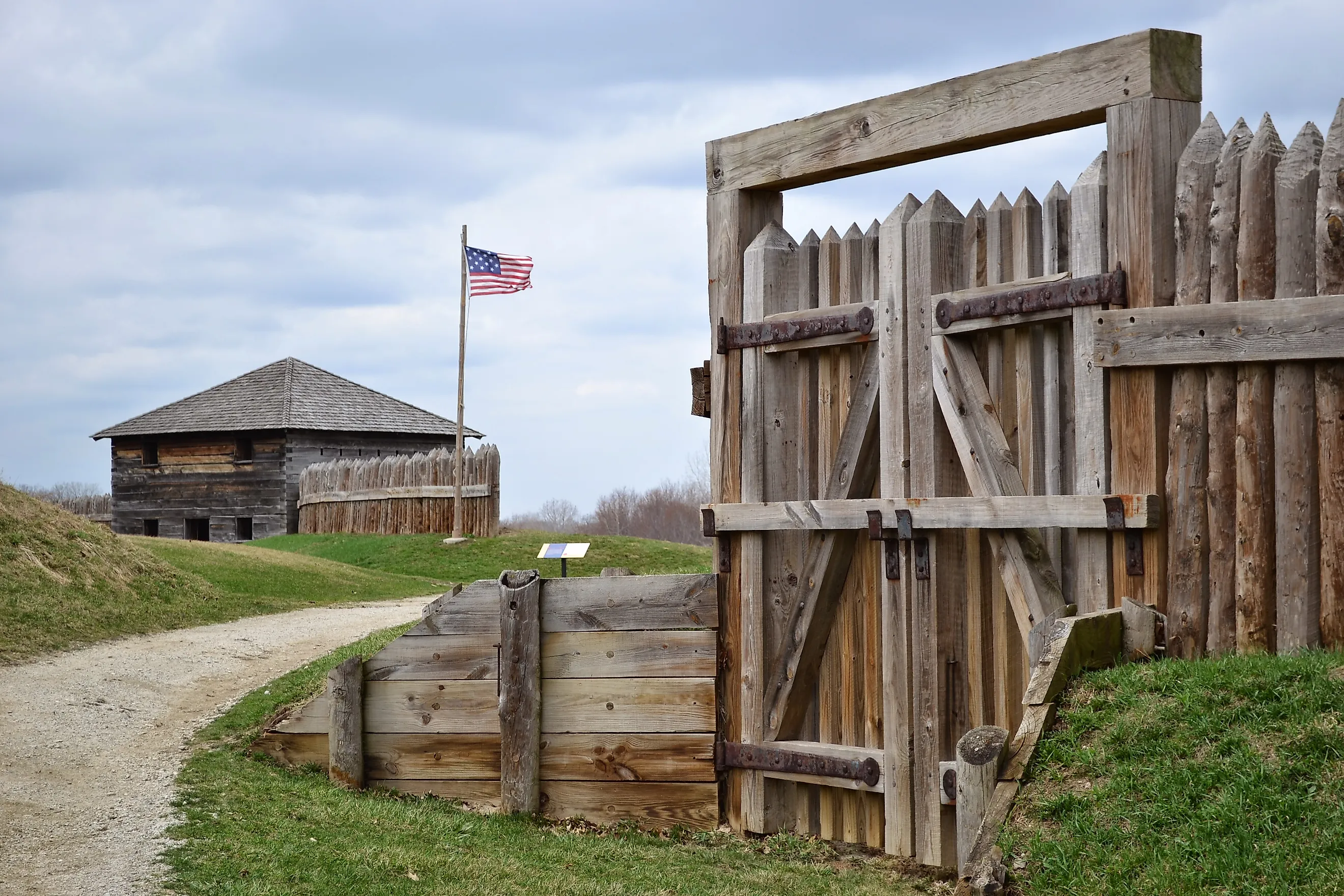
Fort Meigs was built on a bluff overlooking the Maumee River by American troops in response to an attack from the British during the War of 1812. The attacks across forts in the Northwest Territory prompted General William Henry Harrison to spring into action and reinforce the area against attacks. A reconstructed wooden wall fort, built by the Ohio Historical Society in the 1960s, and a museum currently occupy the grounds. Visit the museum to catch a glimpse of life in the early nineteenth century through the hundreds of historical artifacts on display, found through on-site archaeologists' discovery.
Historic Fort Steuben

In 1786, an order came from the Continental Congress to protect the surveyors mapping the Northwest Territory. The First American Regiment complied, and Historic Fort Steuben was constructed to keep out hostile Native Americans. Settled next to the Ohio River on a slope of land with hills on either side, the location proved most desirable for detecting enemy attacks. The reconstructed camp is housed on the original site and includes blockhouses, officers' quarters, the quartermaster and the artificer's shops, guardhouse, a hospital, and the commissary, all of which are open to the public.
Fort Laurens

Standing as the only fort in Ohio during the Revolutionary War, Fort Laurens was built as a wilderness outpost in 1778 to serve multiple purposes. Fort Laurens was designated as a base to attack the British garrison, to deter Native Americans pledging British allegiance, and to offer protection to neutral parties. Only one year later, the fort was abandoned after a siege by the British, and the original remains were demolished. The outline of the fort is still visible, and the grounds are open for visitors to explore via the 80-mile-long Ohio and Erie Canal Towpath Trail that runs through the site of the former fort.
Fort Hill Earthworks & Nature Preserve

A truly unique and rare fort, built from the earth, Fort Hill is one of the most well-preserved ancient hilltop enclosures made by the Hopewell people. Designated as a fort, but not a common one used for trading or warfare, Fort Hill was intended as a ceremonial gathering place for the Hopewell people who resided in Ohio over 2,000 years ago. The 1.5-mile-long earthwork is located within the 1,300 acres of the nature preserve and is believed to have contained at least two ceremonial buildings and a village in the Brush Creek Valley. The preserve is open today for visitors to enjoy the 11 miles of hiking trails, the largest mature forest in southern Ohio, and a museum featuring geological and archaeological exhibits.
Fort Ancient Earthworks & Nature Preserve

Ohio is home to another earthworks fort, created by the ancestors of many modern American indigenous tribes. Fort Ancient Earthworks and Nature Preserve is the oldest state park in Ohio and the largest hilltop enclosure in North America. Similar to Fort Hill, Fort Ancient was also developed for ceremonial purposes and was originally built by the Hopewell people, and later inhabited by an indigenous tribe called the Fort Ancient people (named after the site). Settlers built a village in the area in the late 1800s, and a historic stone tavern remains from that time. Hike the steep bluffs for a scenic view of the Little Miami River below, or take to the miles of trails to enjoy the 23-foot-high earthen embankments. One of the highlighted segments of the park is Morehead Circle, which indicates relics of a woodhenge where sacred ceremonies happened.
Fort Recovery

Established for the U.S. Army during the Northwest Indian War, Fort Recovery, built along the Wabash River, held off an attack from combined Native American forces in 1794. Two years later, the fort was abandoned. Today, a village of the same name stands amongst the fort site and along the river. Sites and monuments along the town commemorate the fort and significant historical battles in the area. A replica of General Anthony Wayne's blockhouses and a connecting stockade have also been established to commemorate the site. Additionally, the Fort Recovery State Museum features life-size displays of soldiers and Native American tribes involved in the battles, military and Indian artifacts, uniforms, maps, paintings, and more.
Old Stone Fort

One of the oldest structures in the Midwest and believed to be the oldest standing building in Ohio is Old Stone Fort. The small building holds a lot of mystery, as historians are not quite sure of its exact establishment or creator. Presumed to have been erected between 1679 and 1689 by French explorer D'Iberville, the fort is settled along a quiet country road in Coshocton. This building may have been built for defense or possibly as part of a farmstead. The restored and preserved building allows visitors to step inside and decipher for themselves what the actual history of the unique fort stood for.
Ohio's Layered Fort History
For history lovers craving a unique, original experience, Ohio contains forts, memorials and monuments created for more than just warfare. Some were built for peaceful, harmonious celebrations among the local Native Americans. Some forts are restored or repaired, others have been completely demolished and others are preserved exactly as they were in the past. No matter the condition, each location has a story to tell, so don't miss out on these seven must-see historic forts in Ohio.