6 Must-See Historic Forts In Michigan
Michigan is home to almost 20 historic forts, some of which predate the signing of the Declaration of Independence. Forts such as Fort Holmes and Fort Mackinac have histories reaching back to the War of 1812 and earlier, while installations like Colonial Michilimackinac trace to French colonial administration of the Upper Great Lakes in the early 18th century. Others, including Fort Gratiot and Fort Wayne, historically guarded strategic waterways such as the St. Clair River and the Detroit River. This guide covers six forts from Michigan's past that have been preserved, restored, or reconstructed for the public to visit today.
Fort Mackinac

Fort Mackinac was established by the British in 1780 during the American Revolutionary War and houses the Officers' Stone Quarters, widely cited as the oldest building in Michigan. The fort sits on Mackinac Island, which straddles the strait between Lake Michigan and Lake Huron. Its position on a limestone bluff rising above the island gave it a strong defensive advantage over the former British post at Colonial Michilimackinac on the mainland.
The fort played a central role in British and American control of the region. After the end of the Revolutionary War, it remained under British control until 1796, when it was formally transferred to the United States under the Jay Treaty. During one of the earliest engagements of the War of 1812, on July 17, 1812, British forces and their Native American allies regained control of the fort without firing a shot. The fort was returned to the United States in 1815 following the Treaty of Ghent.

Fort Mackinac is open seasonally to align with Mackinac Island's peak tourist season from May to October. Several buildings within the fort house museum exhibits on military uniforms, equipment, weapons, and soldiers' personal effects. Costumed interpreters and reenactors portray soldiers, officers, and civilians, with daily demonstrations helping visitors understand military life, daily routine, and the fort's broader historical context.
Fort Holmes

Fort Holmes sits on the highest point of Mackinac Island, about 170 feet above Fort Mackinac itself. The fort originated during the War of 1812. British forces and Native American allies landed on the island under cover of darkness in July 1812 and took advantage of the high ground behind Fort Mackinac, forcing its surrender. After the British established themselves on the island, they built a small earthwork on the summit and named it Fort George in honour of King George III. When the Americans regained control at the end of the war, they renamed it Fort Holmes after Major Andrew Hunter Holmes, who was killed during the failed American attempt to retake the island at the Battle of Mackinac Island on August 4, 1814.

Like Fort Mackinac, Fort Holmes is best visited during the island's tourist season from May through October. At roughly 320 feet above Lake Huron, it is the highest accessible point on the island. Spring offers cooler walking conditions for the climb. The fort's original wooden construction deteriorated over the years, prompting restorations in the 1930s and again in the 2010s. The walls and blockhouse have been rebuilt to resemble the original plans, including port holes for musket and cannon fire. Interpretive panels inside the fort detail its short but dramatic history.
Colonial Michilimackinac

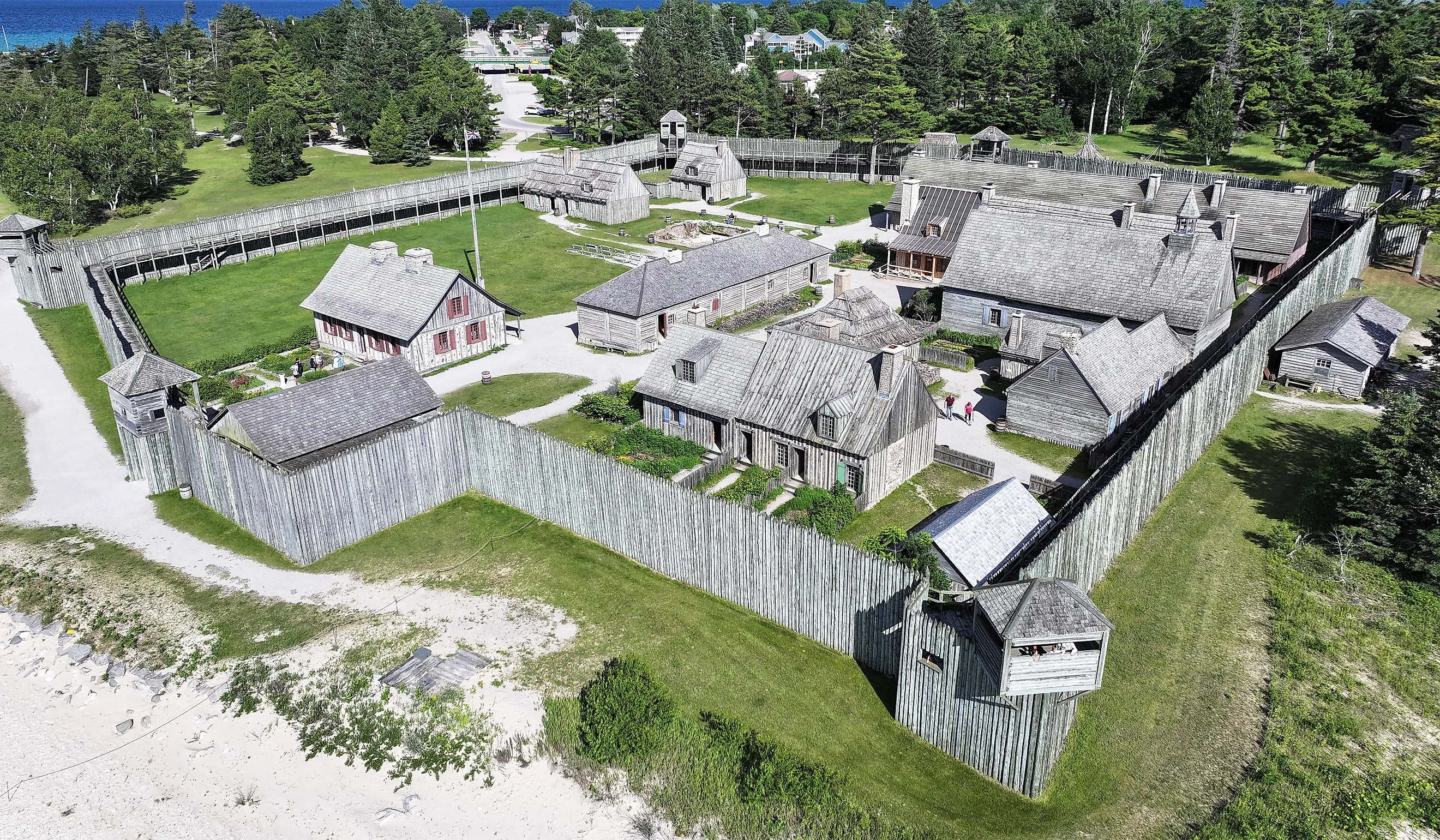
Colonial Michilimackinac sits on the northernmost tip of the Lower Peninsula of Michigan and was established by the French around 1715 at the Straits of Mackinac. The site functioned as a fur-trading post and strategic outpost under French and then British control after the 1763 Treaty of Paris. One of its most dramatic moments came on June 2, 1763, when Ojibwe warriors staged a game of baggatiway (an early form of lacrosse) outside the walls during Pontiac's Rebellion, then chased the ball inside the gates and overwhelmed the British garrison.
During the American Revolutionary War, the British concluded the mainland fort was indefensible against potential American attack from the south, and relocated the garrison across the Straits to Mackinac Island between 1779 and 1781. After removing what they needed, they burned the original fort to prevent enemies from using it.

The site was abandoned until 1904, when it became Michigan's second state park. Archaeological excavations began in 1959 and have continued since, producing one of the longest-running ongoing archaeological programs at a historic site in North America. Today, roughly 60 to 65 percent of the structures within the reconstructed walls have been rebuilt based on the documentary and archaeological evidence. Costumed interpreters demonstrate frontier life, while museum displays cover the French and British periods, the Great Lakes fur trade, and active excavations underway on-site. The site is open between May and early October.
Fort Wilkins

Fort Wilkins was established in 1844 on the Keweenaw Peninsula during the Michigan copper rush. Federal officials built the post as a precaution against potential conflict between copper miners and the local Ojibwe population, though historians today generally agree that the anticipated threat never materialized. The fort comprised officers' and enlisted men's quarters, workshops, storehouses, and other support buildings. Military units largely abandoned the post by 1846, and it was not reoccupied until after the Civil War, when it briefly housed soldiers serving out their enlistments before being permanently abandoned in 1870.

Today, the fort preserves 19 buildings, 12 of which are original log-frame structures dating to the 1840s. Museum exhibits, audio-visual programs, and costumed interpreters offer insight into mid-19th-century military life on the Upper Peninsula frontier. Visitors can also explore nearby copper mine sites, lighthouses, and multi-use outdoor interpretive trails suitable for hiking and biking. The fort is open seasonally from mid-May through mid-October. The surrounding Fort Wilkins Historic State Park includes a year-round campground supporting fishing, cross-country skiing, and camping well beyond the fort's open season.
Historic Fort Wayne

Fort Wayne was used by the United States Army between 1841 and 1972. Construction began in 1842 and was completed by 1851, originally designed to defend against potential British invasion from across the Detroit River in Canada. The fort never saw direct combat. It served as a training camp for Michigan's volunteer infantry and artillery regiments during the Civil War, then as a garrison for the 366th Infantry Regiment (a segregated African-American unit) during World War I. During World War II, the fort operated as a motor supply depot where civilian employees prepared vehicles and parts for overseas shipment. It later served as one of the largest military induction centers in the Midwest during the Korean and Vietnam Wars.
The fort is located on a bend in the Detroit River in Detroit. From the first weekend in May through the last weekend in October, the fort is open every Saturday and Sunday. Visitors can see the 1848 limestone barracks building, the original Star Fort earthworks, the Commanding Officer's House, and the Spanish American War Guard House.
Fort Gratiot

Fort Gratiot was built in 1814 during the War of 1812, engineered under the direction of Captain (later General) Charles Gratiot, for whom the post was named. The fort guarded the strategic junction of the St. Clair River and Lake Huron, a key chokepoint controlling shipping between the upper and lower Great Lakes. The site also became home to Fort Gratiot Lighthouse, the oldest lighthouse in Michigan, built just north of the fort in 1825 and rebuilt in 1829 after the original structure collapsed. Some soldiers who served at the fort stayed on and settled the area, contributing to the early population growth that led to Port Huron's establishment in 1866. The fort was intermittently occupied and finally decommissioned in 1879. It had also served as a training post for soldiers who went on to fight in the Civil War, and its Post Hospital was built during that era. Today, both the lighthouse and the Post Hospital are open for public tours.
Michigan's Forts And The Great Lakes
These six historic forts reflect how control of waterways and trade routes shaped the region's early development. Positioned along the Great Lakes and other key waterways including the Detroit and St. Clair Rivers, each installation played a role during periods of shifting alliances, active conflict, and westward expansion. Today, the surviving structures, reconstructed buildings, and living-history reenactments at these sites preserve more than just military history. They provide a clear record of how Michigan and the Upper Great Lakes evolved from a contested frontier into a stable region, and they highlight the strategic geography that made Michigan such a consistent military priority for French, British, and American powers across nearly three centuries.