6 Must-See Historic Forts In Kansas
For most of the 19th century, Kansas sat at the very edge of the American frontier. The territory saw constant conflict between settlers and Native Americans. Pro- and anti-slavery forces fought each other across the same prairie. Forts were built to keep the peace and often became lightning rods for fighting instead. The fascinating and often tragic history of these military installations can be seen firsthand at six historic forts in Kansas.
Fort Harker Guardhouse Museum Complex

Fort Harker sits to the west of the Missouri River and was one of the key distribution areas for other military installations on the frontier, and would house many soldiers who fought in the Indian Wars. Built in 1866, it remained active until 1872. It was constructed to replace Fort Ellsworth. The fort has had a tragic history, as a cholera epidemic in 1867 killed nearly 50 soldiers stationed there.
The fort shut down in 1872 as many of the Native Americans had already left or been forced out of Kansas. Today, the fort's guardhouse is maintained through the Guardhouse Museum Complex with artifacts and information about this western installation. Visitors to the complex can also check out the Commanding Officer's Quarters and Junior Officer's Quarters, along with a railroad depot used for the salt mines of Kanopolis, Kansas.
Fort Wallace Museum

Much like Fort Harker, Fort Wallace was built primarily to protect travel and freight routes, particularly the Smoky Hill Trail, against Native American resistance to westward expansion. It was used by the US Cavalry from 1865 to 1882. At its heyday, it could house up to 500 men. One of the primary jobs of these men was to protect wagon trains that would travel through prime buffalo territory, which angered Native Americans who depended on the shrinking buffalo herds for food and clothing.
Although the fort was demolished in the 1880s, the Fort Wallace Museum maintains its history by housing artifacts and weapons recovered from the fort. It also runs the Fort Wallace Cemetery, which dates back to the days of the fort and includes both soldiers who died there and settlers who were slain by the Cheyenne tribe.
Fort Larned National Historic Site

Unlike many historic forts, which have faded over time or been reborn through replicas, Fort Larned has remained standing since its construction in 1859. That's because many of the buildings were made of sandstone, which is more resilient to natural forces.
The fort was positioned right on the Santa Fe Trail, a wagon road that connected Franklin, Missouri, to Santa Fe, New Mexico. It was meant both to protect the trade routes and to communicate with local Native American tribes. Several men known as Indian agents would meet with tribal leaders to give out annuity payments. These relationships deteriorated over time and, as most Native American tribes in Kansas had already been removed or relocated to Indian Territory by the late 1860s, the fort lost much of its purpose and was abandoned in 1878.
Today, visitors can tour the sandstone buildings by themselves or get a ranger to show them around. The History & Nature Trail at the site goes around several of the stables and remnants of the older buildings, which were made of wood and succumbed to the elements.
Fort Hays State Historic Site

Fort Hays was constructed in western Kansas in 1865 initially to guard mail wagons from the Butterfield Overland Despatch on the Smoky Hill Trail from raids by the Cheyenne and Arapaho. Back then, it was originally called Fort Fletcher, but after continued attacks on overland mail and freight operations along the Smoky Hill Trail, the Despatch ceased operations in 1865, and the post was subsequently deactivated.
However, the fort would get new life when it was moved several times, before settling on Big Creek, and was renamed to Fort Hays in 1867. Its goal this time was to protect workers with the Union Pacific Railroad. Throughout its history, famous men would come to the fort, such as Lt. Col. George Custer, who used it as his headquarters from 1868 to 1869, and Buffalo Bill Cody, who worked as a scout. Today, the Fort Hays State Historic Site maintains the blockhouse, guardhouse, and officer's quarters.
The site provides information not just on the fort and its many interesting stories, but also a broader perspective on life and war on the Great Plains, such as how wives of the soldiers and officers lived in frontier forts.
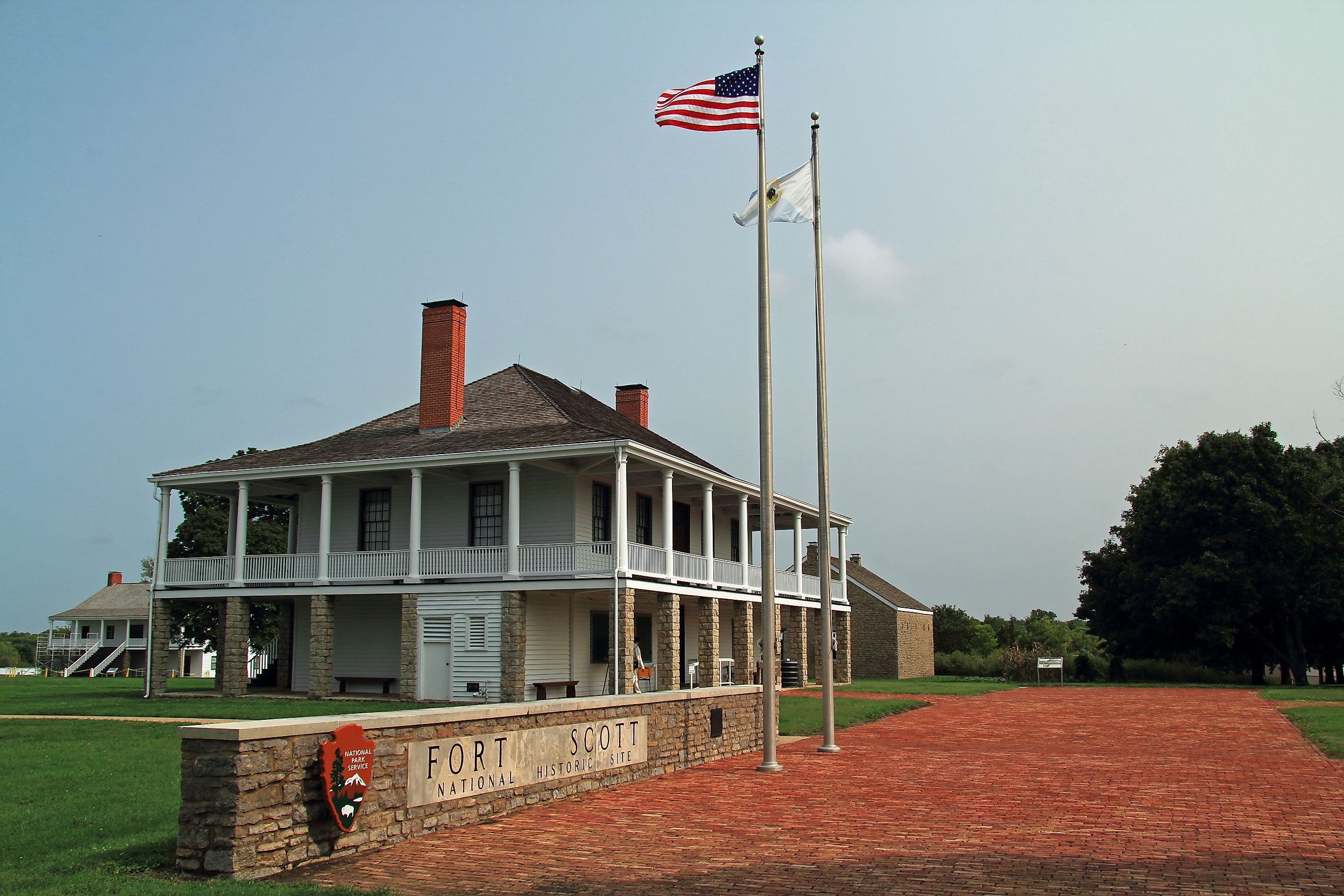
Fort Scott National Historic Site

First built in 1842, Fort Scott is one of the early frontier forts in Kansas, though Fort Leavenworth predates it by 15 years. It was set up right on the eastern border of the territory meant to keep settlers from intruding on Native American lands. However, due to the sheer number of settlers, this mission became a losing battle, and the fort was temporarily closed in 1853.
However, the fort became a battlefield during the Bleeding Kansas conflict in the 1850s, when pro-slavery and anti-slavery forces battled over whether the territory would enter the Union as a slave state or a free state. Federal troops had to return regularly to deal with the combatants, and when the American Civil War exploded, the fort became active once again as a Union Army supply depot. The fort would remain a military outpost until 1873, when it was abandoned.
These are just a few of the stories visitors can hear by taking a tour of the 20 structures at Fort Scott National Historic Site or by walking through the restored tallgrass prairie. The site hosts exhibits and reenactments of African American soldiers during the American Civil War, the fort's later role in breaking up a railway strike, and other momentous occasions in American history.
Fort Leavenworth

Fort Leavenworth is unique among Kansas' historic forts as it is both the oldest American fort in Kansas and is still active today as a military installation. It was built in 1827 to guard the Santa Fe Trail, and throughout its long history, the soldiers here would embark on many missions.
For example, soldiers from the post took part in the Utah War of 1857-1858 when the US government sent federal troops into Utah Territory (then commonly referred to as Deseret by Latter-day Saints) to assert federal authority amid rising tensions with Mormon settlers over governance and sovereignty.
Not long after, during the Civil War, the fort was threatened by a Confederate army led by Gen. Sterling Price. However, Price never made it to the fort; instead, he lost a battle in modern-day Kansas City.
Visitors can tour some of the historic grounds at the fort if they obtain a visitor's pass first, as Fort Leavenworth is still in use. One spot to see is the Fort Leavenworth National Cemetery, which was established by Abraham Lincoln in 1862. One of the men buried here is Captain Thomas W. Custer, the brother of George Custer, who died alongside his older brother at the Battle of the Little Bighorn.
These Forts Tell Historic Tales
If these forts could speak, they would have many stories to tell. They could speak about optimistic settlers moving west on the Santa Fe Trail, or the imagination of Buffalo Bill Cody forming in his early days as an Army scout. They could also speak of more somber lessons, such as the gradual removal of Native Americans, the failure of the Army to protect their lands, or even the violent clashes of Bleeding Kansas. Visitors can still learn from these stories by speaking to park rangers or visiting the blockhouses and museums contained within these historic forts.