The Historic Forts Of Wisconsin
In its early days, before Wisconsin became a state, rivers like the Mississippi and the Fox were the main routes for travel, trade, and communication. Leading up to and after the War of 1812, the United States began building a chain of forts across the Upper Midwest, many placed along key waterways to strengthen control over the region, manage the fur trade, and oversee relationships with Indigenous nations, especially in preparation for incoming settlement by the British. These outposts were often built in strategic locations where rivers met or trade routes crossed, having a real impact on the early development of towns and travel corridors that still exist today. While some of these forts stood for decades and played major roles in military and settlement history, others were short-lived, tied to specific events such as the Black Hawk War. Read on to learn more about six historic forts in Wisconsin worth visiting, each offering a window into a time when Wisconsin was still being mapped, contested, and built.
Fort Crawford Museum, Prairie du Chien

On the Mississippi River in Prairie du Chien is Fort Crawford, offering one of the most layered looks at Wisconsin’s early history. The fort was an active military post on the frontier between 1816 and 1856, built specifically to secure American control over important waterways that linked the Great Lakes to the Mississippi River.
Fort Crawford had its share of well-known figures pass through during its time as an active post. Zachary Taylor served here before becoming president, and Jefferson Davis, who would later become president of the Confederacy, spent time posted at the fort before the Civil War. It also became the place where Sauk leader Black Hawk surrendered at the end of the Black Hawk War in 1832. Fort Crawford played a role in early medical science, too. Army surgeon William Beaumont ran groundbreaking experiments here that changed how people would come to understand the body’s digestive process.
Today, the fort fully operates as a museum, exploring frontier life, early medical research, and how the town of Prairie du Chien has grown over time. The site includes three main buildings: the Hospital, the Guardhouse, and the Officer’s Quarters. You can explore all three buildings between May and October at your own pace via a self-guided tour, or you can opt for a guided tour. You can expect to spend about an hour to an hour and a half here if you want to see all three buildings.
Fort Winnebago Surgeons Quarters, Portage

Long before highways and bridges, getting through south-central Wisconsin meant traveling by water and carrying your boat across land to move between rivers. The area between the Fox and Wisconsin Rivers was once a major route for trade, travel, and the military, connected by a key portage that made this one of the most important transportation corridors in early Wisconsin. Fort Winnebago was built here to maintain order and oversee this critical crossing at a time when settlement was increasing, and tensions were rising. It played a role during the Black Hawk War and helped control movement through the region. The fort remained in use until the mid-1840s, when its strategic importance declined and it was eventually abandoned.
While Fort Winnebago itself no longer stands, the Surgeons Quarters remain. Originally built as a private residence before the fort was established, it was later used to house the post’s physician and is now one of the oldest surviving structures connected to an early US Army fort in Wisconsin. Inside, the space has been restored to reflect life at the fort in the 1830s. The museum campus also includes the Garrison School, a historic one-room schoolhouse that was later moved to the site. Today, the museum operates seasonally, open from May through October, with volunteer-led and self-guided tours available. It also hosts special events throughout the season, including historian talks, re-enactments, and hands-on demonstrations.
Fort Howard (Heritage Hill State Historical Park), Green Bay

Unlike the other forts on this list, Fort Howard is no longer preserved in its original location, its story having been pieced back together at Heritage Hill State Historical Park. Fort Howard was built in 1816 along the Fox River, though its structures quickly began to deteriorate. In 1820, troops temporarily relocated to Camp Smith, located on the site of today’s Heritage Hill, but the original fort operated until 1852, when it was officially closed by the War Department. The buildings were then moved, sold, or destroyed to make way for the Chicago and Northwestern Railway.
Several buildings were preserved or reconstructed at Heritage Hill and can be visited today. The Guardhouse, built in 1833, served as the fort’s main entrance, housing on-duty guards and a small prison. The Hospital was designed by Army Surgeon William Satterlee and built just outside the fort’s walls. Both reconstructed in 1982, the Officer’s Quarters reflects a 1830s surgeon’s residence, while the Fort Howard Post School represents the fort’s original schoolhouse. The Detached Kitchen, built in 1834, is now interpreted as a Company Kitchen and Orderly Room, though it is listed on the National Register of Historic Places as an officer’s quarters.
Beyond the fort buildings, Heritage Hill is home to many other 19th-century structures depicting early Wisconsin life. The site is open year-round, though access and programming vary depending on the season. Heritage Hill also hosts all kinds of events, including living history demonstrations, workshops, and seasonal celebrations like the Barrels, Boards, & Bootleggers event, featuring rare bourbon tastings and a speakeasy.
Forts Folle Avoine Historical Park, Danbury

This stop is different from the others on this list because Forts Folle Avoine Historical Park is not a military fort. Rather, it is a site made up of two reconstructed fur trading posts, highlighting a different side of Wisconsin’s history. Situated on 80 acres along the Yellow River, the park showcases two competing winter trade posts, the North West Company and XY Company. These posts operated side by side between 1802 and 1805, just 95 feet apart, making this one of the only known places in North America where rival fur trade companies set up so close together. At the time, this area was part of a major fur trade network. Traders worked closely with the Ojibwe, exchanging various goods, but primarily beaver pelts, which were then transported in the spring to markets in Europe via Montreal.
Although the posts were abandoned centuries ago, Forts Folle Avoine now sits on the original footprint. The location was rediscovered in the 1960s through old journals, and excavations uncovered thousands of artifacts, allowing the buildings to be reconstructed with a high level of accuracy. Today, you can walk through the trading posts, a recreated Ojibwe village, and additional buildings like a schoolhouse and interpretive exhibits. Self-guided tours include interpreters in period dress, and you can take part in demonstrations, like cooking and tasting traditional recipes the way they did in 1802, using a Quebec clay oven.
Fort Koshkonong (Rock River Park), Fort Atkinson

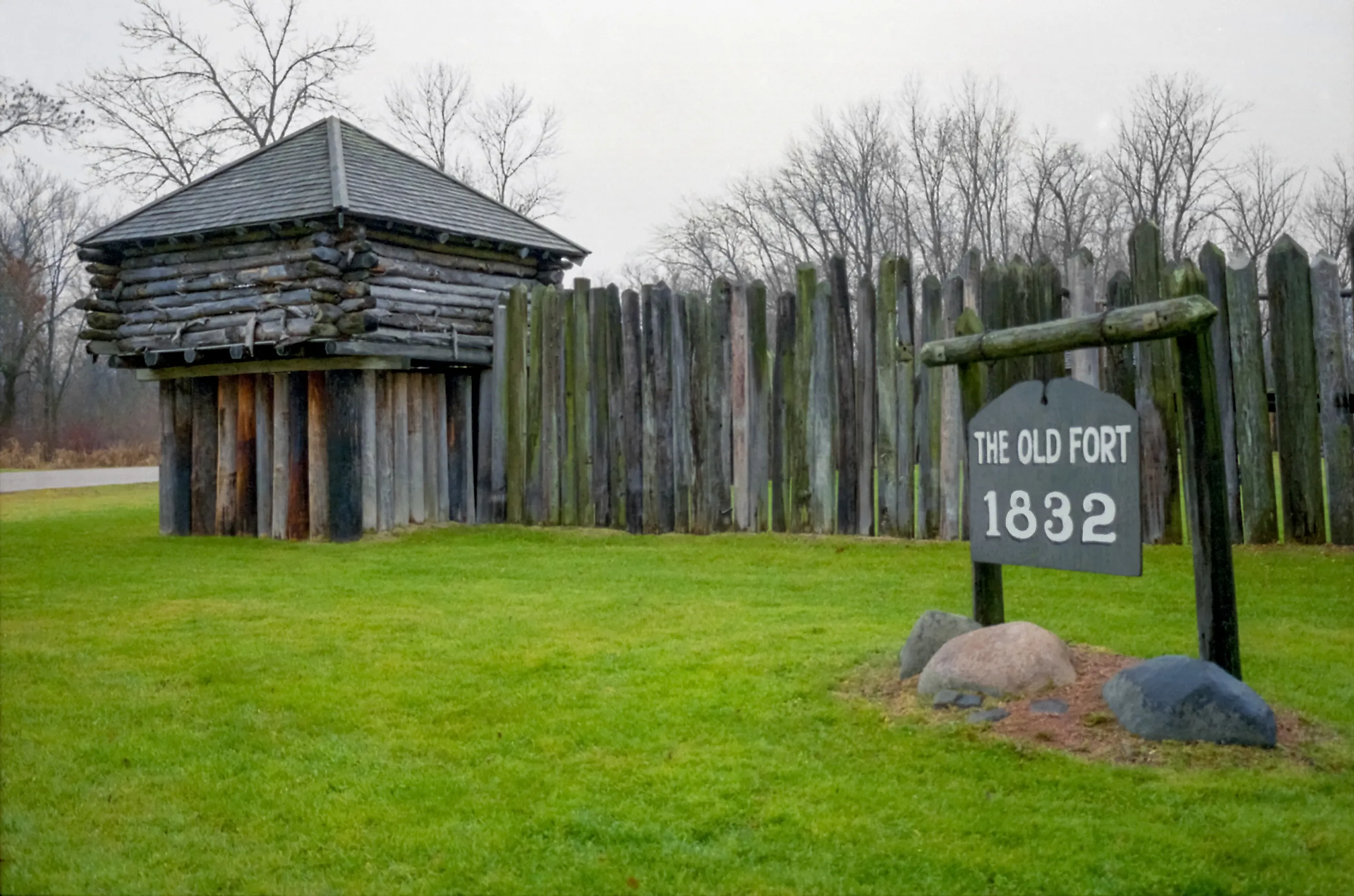
Established in mid1832 at the junction of the Rock and Bark Rivers, Fort Koshkonong was originally built as a small, temporary stockade during the Black Hawk War. General Henry Atkinson was in pursuit of Black Hawk and his band, who had retreated up the Rock River, and he needed the space as a short-term base to store supplies and coordinate movements. The Black Hawk War ended on August 2nd, 1832, at the Battle of Bad Axe, at which point the Army left Fort Koshkonong, having only occupied it for about two months. The site continued to be used by Indigenous groups in the area, including the Potawatomi, before it was ultimately abandoned.
The fort’s materials were taken apart and reused by settlers as firewood or to build log cabins. In 1907, a monument was put up at the fort’s original location, and in 1966, a replica of the fort was built in the nearby Rock River Park. The replica fort, built slightly larger than the original, is open to the public and available to visit during Rock River Park’s hours of operation. There are no admission fees or formal tours, allowing you to walk through at your own pace. The park also sits along the river, providing a great opportunity to pair your visit to the fort with a quiet stroll or picnic.
Fort McCoy, Monroe County

Unlike the other sites on this list, Fort McCoy is still an active US Army installation. In fact, it is the largest of its kind in Wisconsin. However, it does welcome visitors to book tours of select areas, offering a rare chance to experience a military site that is not just historic, but still very much in use. Established in the early 1900s as a training ground for the Army, Fort McCoy acted as an important hub for preparing troops, particularly during World Wars I and II. During WWII, tens of thousands of soldiers trained here before being deployed overseas. Today, the base continues to support training soldiers for active-duty and reserve forces. b The fort’s history also stretches beyond its military use, sitting on land rich with archaeological significance. Archaeologists have uncovered a huge number of artifacts here, offering evidence of Indigenous communities who lived, traveled, and traded across the region for generations.
Because it is an active base, visiting takes a bit more planning than your typical historic site. Tours can be booked in advance, Monday to Friday, for groups of 15 or more, lasting approximately one to one and a half hours. You could also opt to attend the annual Armed Forces Day open house in May. No appointments are required; all Commemorative Area buildings are open, guided bus tours are available, and special activities are scheduled throughout the day.
Plan Your Wisconsin Fort Road Trip Today
Wisconsin's forts reveal the many sides of the state's early history. Some stood to protect waterways and trade routes, others trained soldiers or managed the fur trade, and each left its mark on the communities that grew around them. These were real places where real decisions were made, and that comes through when you are standing on the grounds. Whether you visit one or, even better, build out a full road trip that takes you through all six, take the time to explore the buildings, walk the land, and read the full history. The intricate stories these sites hold are worth the trip.