11 California Towns With Unforgettable Main Streets
Most of California was built around freeways and strip malls that keep everything spread out. The eleven towns on this list are the exceptions. Nevada City’s Broad Street rises past an 1856 hotel and an 1865 theater within the same block. Ocean Avenue in Carmel-by-the-Sea has carried foot traffic to the same bakery since 1899. Some grew up around the Gold Rush and others around missions, wine country, railroads, or the coast. Below are eleven small towns where the main street still feels like the whole town.
Ferndale

Along Ferndale’s central commercial strip, Victorian storefronts, painted facades, preserved signs, and wooden trim give the sidewalks an almost theatrical feel. Those with a sweet tooth can linger at Sweetness & Light, where handmade chocolates, caramels, truffles, toffee, and small gifts fill a Main Street shop just steps from the Victorian storefronts. Art and craft take over at The Blacksmith Shop, where jewelry, metalwork, glass, ceramics, and other pieces by regional and national artists fill the space. Round out the afternoon at The Old Steeple, a former church that now hosts intimate concerts and performances.
Nevada City

Nevada City’s Broad Street rises through the old quarter, passing brick Gold Rush landmarks at nearly every turn. The National Exchange Hotel, dating to 1856, anchors the stretch with a refurbished balcony, saloon, and Lola restaurant. Just down the block, the Nevada Theatre has been part of community life since 1865, still drawing crowds for films, plays, concerts, and Wild & Scenic Film Festival screenings. Start the morning at Fudenjüce on Commercial Street before the galleries and shops fill up, then return later in the day when Golden Era Lounge brings cocktails, local wine, beer, and live music to Broad Street near the theater. Plaques along the route and a stop at the Nevada City Chamber of Commerce office help connect the storefronts to the community’s mining past.
Sutter Creek

Brick storefronts, iron balconies, wine rooms, and Gold Rush architecture give Sutter Creek’s old commercial core a compact period feel that doesn’t take long to settle into. Hotel Sutter occupies one of the more prominent landmarks on the main block, pairing lodging with a saloon and restaurant. A few doors away, the Sutter Creek Theatre, which started life as a 1919 movie house, now hosts live music and other performances. For a quieter change of pace, Sutter Creek Gallery fills a Main Street space with rotating work by regional artists. Wine tasting is close at hand too, with BellaGrace Vineyards pouring Amador County wines from its central sampling space.
Murphys

Murphys’ downtown corridor brings together 19th-century structures, shaded wooden porches, wine counters, and places to eat in a walkable Sierra foothills setting. The historic side of things is hard to miss at the Murphys Historic Hotel, built in 1856, where a brick facade, saloon, restaurant, and displays tied to past guests like Mark Twain and Ulysses S. Grant all remain part of the experience. For a meal, Grounds Restaurant covers breakfast, lunch, dinner, and regional pours. Wine rooms add much of the town’s everyday rhythm: Hovey Winery pours Calaveras County selections from the Albert Michelson House, while Newsome Harlow Wines focuses on Calaveras County reds just nearby.
Julian

False-front storefronts, timeworn facades, and the smell of apple pie drifting out from local bakeries keep the past close in this mountain community. The classic stop is Julian Pie Company, known for apple pie, cider doughnuts, and whole pies to take home. Across Main Street, the Julian Gold Rush Hotel occupies a late-1890s landmark with a porch that looks out over the town, a good place to slow down between stops. Julian Town Hall has long served as a community gathering place, and for a fuller meal, Julian Café & Bakery handles breakfasts, burgers, sandwiches, and, fittingly, more apple pie.
Solvang

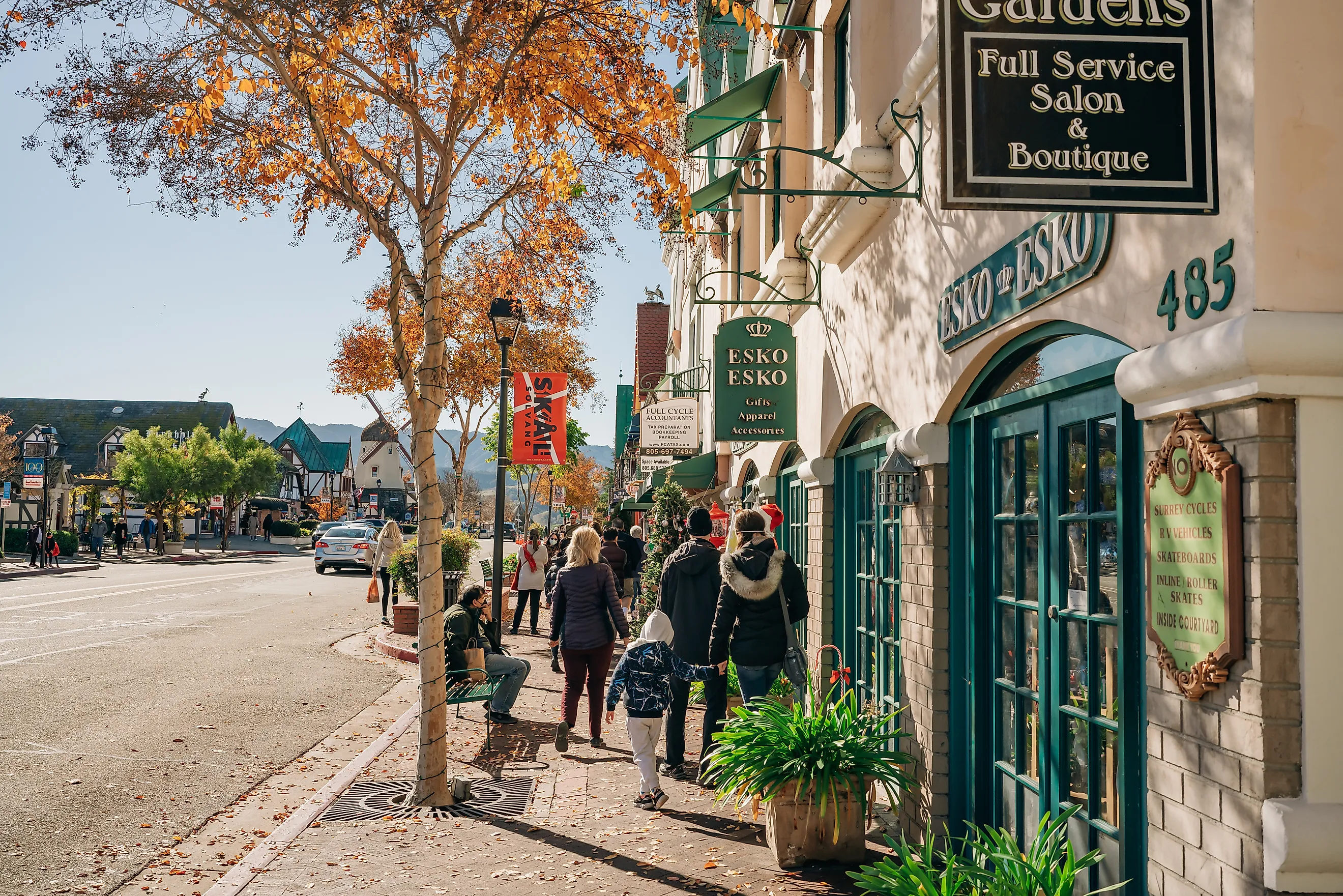
Along Mission Drive and the surrounding blocks, Danish-style facades, windmills, bakeries, and small museums give Solvang its distinct character. Old Mission Santa Inés reaches further back into early California history through its chapel, whitewashed arches, gardens, and museum artifacts. A few blocks away, Elverhøj Museum of History & Art, housed in a Danish-style former residence, brings the town’s Danish-American story into sharper focus. Food is very much part of the route: Paula’s Pancake House draws steady morning traffic for Danish pancakes, breakfast plates, and lunch dishes, and Mortensen’s Danish Bakery keeps the pastry cases full with kringles, butter cookies, and cakes.
Carmel-by-the-Sea

Walking down Ocean Avenue toward Carmel Beach, the galleries, dining rooms, courtyards, and storybook buildings with steep roofs and irregular stonework have a way of slowing the pace. Carmel Plaza adds an open-air cluster of boutiques, wine bars, and eateries just off the main drag. For a bakery stop with history behind it, Carmel Bakery on Ocean Avenue dates to 1899 and still draws visitors for giant pretzels, pastries, cannoli, sandwiches, and coffee. Cottage of Sweets manages to pack English toffees, licorice, fudge, and imported candy into a small half-timbered storefront nearby. Come evening, Dametra Café pairs Mediterranean dishes with live music during lunch and dinner.
St. Helena

St. Helena’s central thoroughfare brings together stone commercial architecture, sampling counters, dining spots, and a handful of Napa Valley food landmarks worth seeking out. The Cameo Cinema, opened in 1913, is still showing independent, foreign, documentary, and first-run films for anyone who wants a break from the tasting rooms. Model Bakery draws steady foot traffic for its English muffins, croissants, breads, and pastries, and Woodhouse Chocolate is just up the street with truffles, caramels, and molded chocolates. The Culinary Institute of America at Greystone fills out the stretch, occupying a former Christian Brothers winery building with public dining at the Gatehouse Restaurant, culinary programs, and food-focused retail.
San Juan Bautista

Near Mission San Juan Bautista, Third Street forms the heart of a small downtown where adobe-style storefronts and wooden porches set the tone. Jardines de San Juan makes good use of its courtyard setting with margaritas, enchiladas, chile verde, and other Mexican dishes, making it a natural first stop before wandering further. For baked goods, San Juan Bakery & Grocery carries Mexican sweet breads, cookies, and loaves, and Vertigo Coffee Roasters handles espresso drinks and pastries in the old core. Margot’s Ice Cream Parlor rounds things out with cones, sundaes, shakes, and other frozen treats.
Mendocino

Mendocino’s seaward-facing lane looks out toward the headlands, where preserved 19th-century structures recall the community’s logging and shipping years. A good place to start is the Ford House Museum and Visitor Center, which puts the town’s architecture, local stories, and surrounding coastal landscape into context. From there, the white steeple of Mendocino Presbyterian Church, an 1868 landmark still used by its congregation, is visible from much of the village. Out of This World adds a different kind of stop with telescopes, science kits, minerals, puzzles, books, and nature-themed gifts.
Truckee

Along Donner Pass Road, brick structures, former railroad hotels, shops, and eateries keep Truckee’s rail history close at hand. The depot anchors the scene, and next to it, the Truckee Railroad Museum uses a preserved caboose to tell part of the community’s railroad story. Cabona’s, in business since 1918, is worth a look for Western wear, outdoor clothing, boots, hats, and gifts. When hunger sets in, Jax at the Tracks occupies a revived railroad-period diner near the tracks with omelets, breakfast plates, burgers, and other classics. Bar of America fills a vintage downtown building with cocktails, burgers, steaks, and seasonal dishes well into the evening.
What these towns share isn’t just history. It’s the rare quality of having life concentrated along a single walkable stretch, where a bakery, a gallery, a saloon, and a theater exist within easy steps of each other. That kind of main street doesn’t just anchor a town; it becomes the town. In an era when so much has sprawled, scattered, or moved online, finding a place where everything worth experiencing still happens along one good block feels quietly remarkable.