The Sunken Forests Beneath American Lakes
Looking out on one of the many lakes across the United States, it's not unusual to wonder what lies beneath the surface. A lake's surface can hide anything from fish and plant life to amphibians like frogs and even aquatic mammals like beavers and otters. Underneath some American lakes, though, there is something truly unexpected: sunken forests. While these forests are no longer growing, the underwater woods lying beneath some of America's lakes are scientific wonders and can make for beautiful underwater photography. Learn more about America's sunken lake forests.
Clear Lake

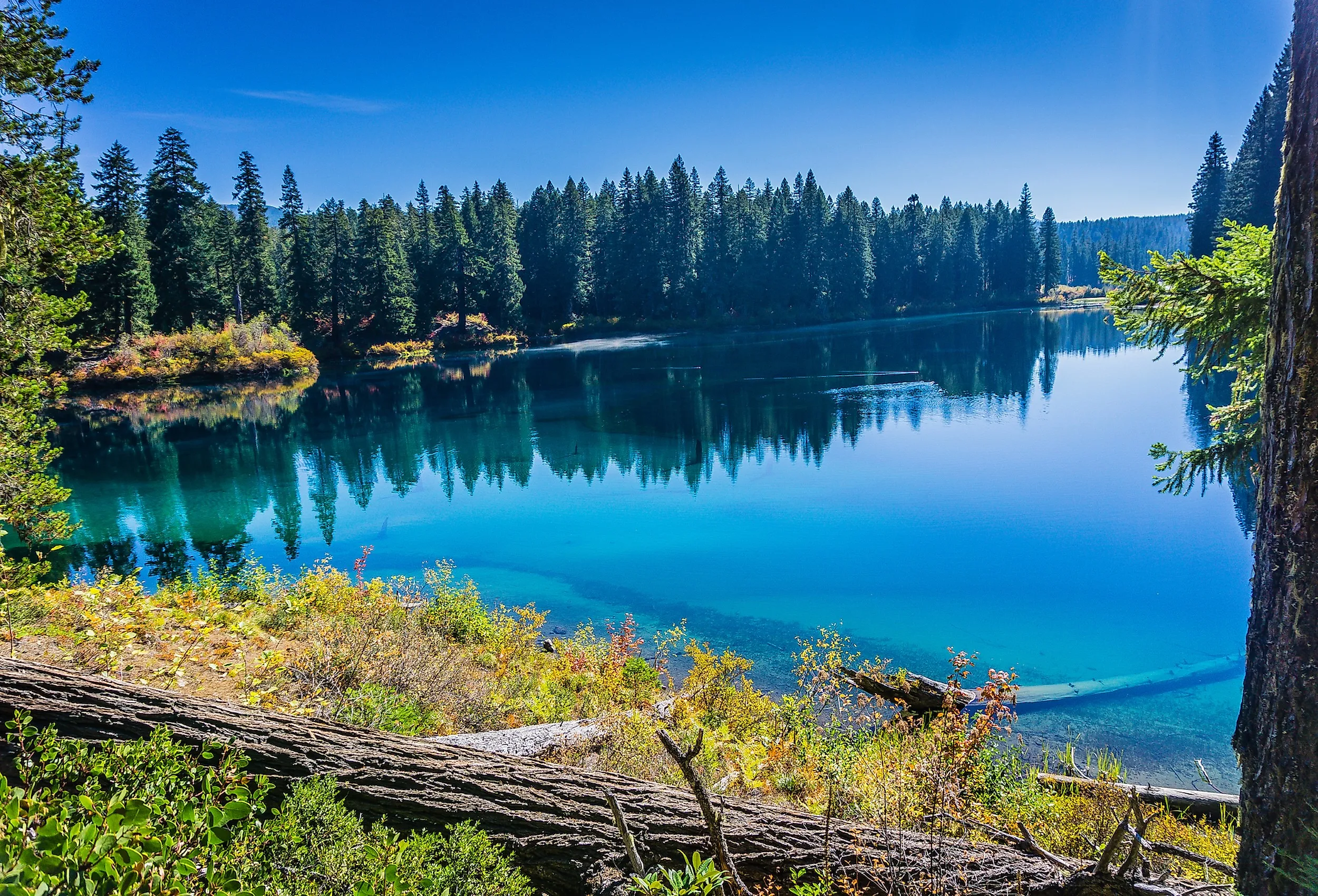
Located in Oregon, Clear Lake is inside the boundaries of Willamette National Forest and contains a prehistoric forest of its own. The name "Clear Lake" is also a descriptor of the lake, which has waters so clear that the sunken forest beneath its surface is actually visible from a boat on the lake.

The sunken forest at Clear Lake attracts cold-water divers who explore trees drowned roughly 3,000 years ago when lava flows dammed the ancestral McKenzie River. Clear Lake's cold water reveals preserved trunks against volcanic terrain associated with the lava flows that dammed the lake.
Lake Huron

Lake Huron is one of the Great Lakes, and one fascinating fact is that it's home to multiple sunken forests. Lake Huron's Sanilac drowned forest was discovered in 1988, about 2.8 miles east of Lexington, Michigan, in roughly 41 feet of water. In 2012, NOAA-assisted divers sampled another submerged forest site at a depth of 20 to 25 feet, about 30 miles north of Thunder Bay in northern Michigan. This is one of Lake Huron's oldest documented submerged forest sites; a red-pine sample collected there was radiocarbon-dated to approximately 8,370-8,410 calibrated years before present.
Lake Sammamish

The Pacific Northwest is known for its natural beauty, and at Lake Sammamish in Washington, a prehistoric landslide left an underwater forest that still breaks the lake's surface. One of the "youngest" sunken forests in the United States, relatively speaking, the sunken forest in Lake Sammamish has only been underwater for roughly 1,000 years. The Lake Sammamish sunken forest didn't sink gradually, but more or less all at once. About 1,100 years ago, a major earthquake on the Seattle Fault system triggered landslides into Lake Sammamish and Lake Washington. One of those landslides caused great chunks of forested land to slide into Lake Sammamish, trees and all, where they remain to this day. Divers have explored the preserved underwater forest, while several jagged gray trunks remain visible above the water near Greenwood Point.
Lake Washington

Not far from the heart of Seattle, Lake Washington's sunken forests have been the site of scientific speculation and even a major legal controversy in the 1990s. But that's not where the story of these forests begins. Early settlers knew about Lake Washington's submerged forests, and workers removed 186 preserved trees from three navigation hazards in 1919. Earthquake-triggered landslides carried forested slopes into Lake Washington, where the preserved trunks later became navigation hazards. But the forests weren't controversial until the 1990s, when they made headlines for two reasons. The first was that scientists used the sunken forests and the trees they contain to help put together the modern understanding of the Seattle fault. The second, though, was a legal case. A Kirkland businessman was convicted on multiple charges, including profiteering, theft, and trafficking in stolen property, after illegally removing timber from Lake Washington.
Fallen Leaf Lake

Just south of Lake Tahoe in California, Fallen Leaf Lake contains the remains of a forest that grew during a prolonged medieval drought. Researchers have documented upright trees still rooted beneath the lake's surface, along with more than 80 fallen trunks. Radiocarbon analysis dates one submerged stand to around 1250 CE. The trees grew when the lake stood 130 to 200 feet below its modern level and were submerged when wetter conditions returned. Tree rings and drowned shoreline features indicate that the low-water period lasted more than 220 years. The forest now provides scientists with rare evidence of the severe megadroughts that once affected the Lake Tahoe Basin.
Caddo Lake

While not technically a "sunken forest," as the trees of Caddo Lake can be seen above the water's surface, it's nevertheless one of the most unique combinations of lake and forest in the United States. Unlike true drowned forests, which contain preserved remains of trees submerged by rising water or geological events, Caddo Lake's many trees are alive. Caddo Lake covers 26,810 acres, while approximately 20,000 acres in and around the lake carry Ramsar Wetland of International Importance status. These bald cypress, some of which can reach 400 years old, have buttressed trunks and knobby root projections called knees that let them grow in the freshwater bayou of Caddo Lake, on the Texas-Louisiana border. Visitors can even take canoes out onto the lake, navigating around the living forest emerging from it and keeping an eye out for wildlife like beavers, snapping turtles, and great blue herons.
While not all the sunken lake forests of the United States are accessible to visitors, especially not visitors who don't have diving equipment and relevant training or a guide, all are part of the country's natural and even human history. Each one has its own story, and can be a valuable part of the modern ecosystem that surrounds it, while also contributing to human understanding of the natural world thousands of years ago. These submerged landscapes preserve evidence of past forests, changing lake levels, earthquakes, and regional environmental history.