The Strangest Traditions Around The World
Every culture marks life's big moments in its own way, and some of those customs can look startling to people who did not grow up with them. A funeral where the family dances with the dead, a coming-of-age test measured in ant stings, a festival that lays out a banquet for wild monkeys: practices like these can seem baffling from the outside, yet each one carries real meaning for the community that keeps it. These twelve traditions reach across the globe and vary widely in spirit, some joyful and some genuinely painful. A few are centuries old and still thriving, while others have been curtailed or banned outright. What they share is that, to the people who practice them, they are not strange at all.
Famadihana: Turning Of The Bones In Madagascar

In the central highlands of Madagascar, the Merina and Betsileo peoples practice Famadihana, the "turning of the bones." Every five to seven years, families open the ancestral tomb, lift out the wrapped remains of their dead, and rewrap them in fresh silk shrouds. Far from somber, the occasion is a celebration: relatives carry the bundled ancestors on their shoulders and dance with them to live music before returning them to the crypt. The custom rests on a belief that the dead remain part of the family and watch over the living, so the gathering is treated as a reunion rather than a burial. The word "Malagasy," sometimes mistaken for the name of a single group, actually refers to all the people of Madagascar.
The Bullet Ant Glove Of The Sateré-Mawé, Brazil
For the Sateré-Mawé people of the Brazilian Amazon, becoming a man means enduring the sting of the bullet ant, which sits at the very top of the Schmidt pain index. Elders gather dozens of the ants, sedate them, and weave them into a glove of palm fronds with the stingers turned inward. A boy slips his hand inside and keeps it there for roughly ten minutes while he performs a dance, the ants stinging him the whole time. One session is not enough. To be recognized as a man, he repeats the ordeal about twenty times over the following months and years. The sting is often compared to being shot, which is how the ant got its name. This rite of passage is practiced in the rainforest of northern Brazil.
Eating The Ashes Of The Dead: The Yanomami

The Yanomami, who live in the rainforest along the border of Venezuela and Brazil, hold that no physical trace of a person should remain after death. When someone dies, the body is cremated and the bones are ground down, and the ashes are carefully kept. At a memorial gathering, those ashes are mixed into a soup made from fermented plantains and shared among the kin group. The Yanomami do not regard death as a natural event but as the work of a rival's sorcery, and they believe the soul cannot reach peace until the ritual is complete. Consuming the ashes, a practice known as endocannibalism, is understood as a way of keeping a loved one present among the living.
Fire-Walking In Chinese Folk Religion

At certain temple festivals in China and across Chinese folk-religion communities, devotees and spirit mediums walk barefoot over a bed of glowing coals. Tied to Taoist practice, the rite is meant to purify the participants and the temple's deity and to drive away evil and misfortune. Walkers hold that faith protects them and that only those who doubt will be burned. Versions of the ceremony appear wherever these communities have settled, including Taiwan and parts of Southeast Asia, and the coal-bed crossing is often the dramatic centerpiece of a much longer festival.
Camel Wrestling On Turkey's Aegean Coast

Across the Aegean region of Turkey, winter is camel wrestling season. The timing is deliberate: it lines up with the bull camels' mating period, when the animals are naturally inclined to spar. Two males are brought together in an arena, dressed in embroidered saddles and bells, and they push and lean against each other while spectators watch. There is no bloodshed by design, and a camel loses when it flees, falls, or cries out. The largest meets, such as the festival at Selçuk near the ruins of Ephesus, draw thousands of onlookers and reach back generations.
The Mourning Of Muharram

During the Islamic month of Muharram, Shia Muslims commemorate the death of Husayn ibn Ali, a grandson of the Prophet Muhammad, who was killed with his companions at the Battle of Karbala in 680 CE. The mourning peaks on Ashura, the tenth day, with processions, recitations, and reenactments of the events at Karbala. Some participants express their grief through matam, the rhythmic striking of the chest, and a smaller number practice more severe forms that draw blood. Many Shia religious authorities discourage the bloodletting and instead urge mourners to donate blood, and the observance as a whole centers on remembrance and sacrifice rather than spectacle.
The Monkey Buffet Festival Of Lopburi, Thailand

Every year on the last Sunday of November, the town of Lopburi in central Thailand lays out a feast not for people but for monkeys. Long tables are piled with fruit, vegetables, sticky rice, and sweets, and the town's resident long-tailed macaques are turned loose to gorge themselves among the ruins of the Phra Prang Sam Yot temple. The macaques are linked in local belief to Hanuman, the monkey deity of the Ramayana, and are treated as a blessing on the town. A local hotelier started the event in 1989, partly in gratitude for the tourism the monkeys bring, and it has grown into one of Thailand's best-known festivals.
Thaipusam And The Kavadi

Thaipusam is a Tamil Hindu festival held on the full moon of the Tamil month of Thai, in January or February, in honor of Lord Murugan. Devotees prepare with weeks of fasting and prayer, then fulfill vows by carrying a kavadi, a physical burden that may be as simple as a pot of milk or as elaborate as a frame anchored to the body with skewers. Many pierce their cheeks, tongue, or skin with small hooks and spikes as an act of devotion and penance, entering a trance-like state that they say spares them the pain. Some of the largest gatherings take place in India, Malaysia, and Singapore.
Baby Tossing At Indian Shrines
At a handful of shrines in the Indian states of Maharashtra and Karnataka, a centuries-old ritual involves dropping infants from a height into a sheet stretched out below. Despite the way it is often exaggerated, the drop is roughly thirty to fifty feet, and experienced handlers do the tossing while the parents wait in the crowd. The custom is shared by both Hindu and Muslim families at sites such as the Baba Umer Dargah in Solapur and the Sri Santeswar temple near Indi, and it is believed to bring the child health, long life, and good fortune. Accounts trace it back about seven hundred years, to a period of high infant mortality. Child-welfare authorities have tried to halt the practice since 2009, and today it continues only on a small scale.
La Tomatina: Spain's Tomato Battle

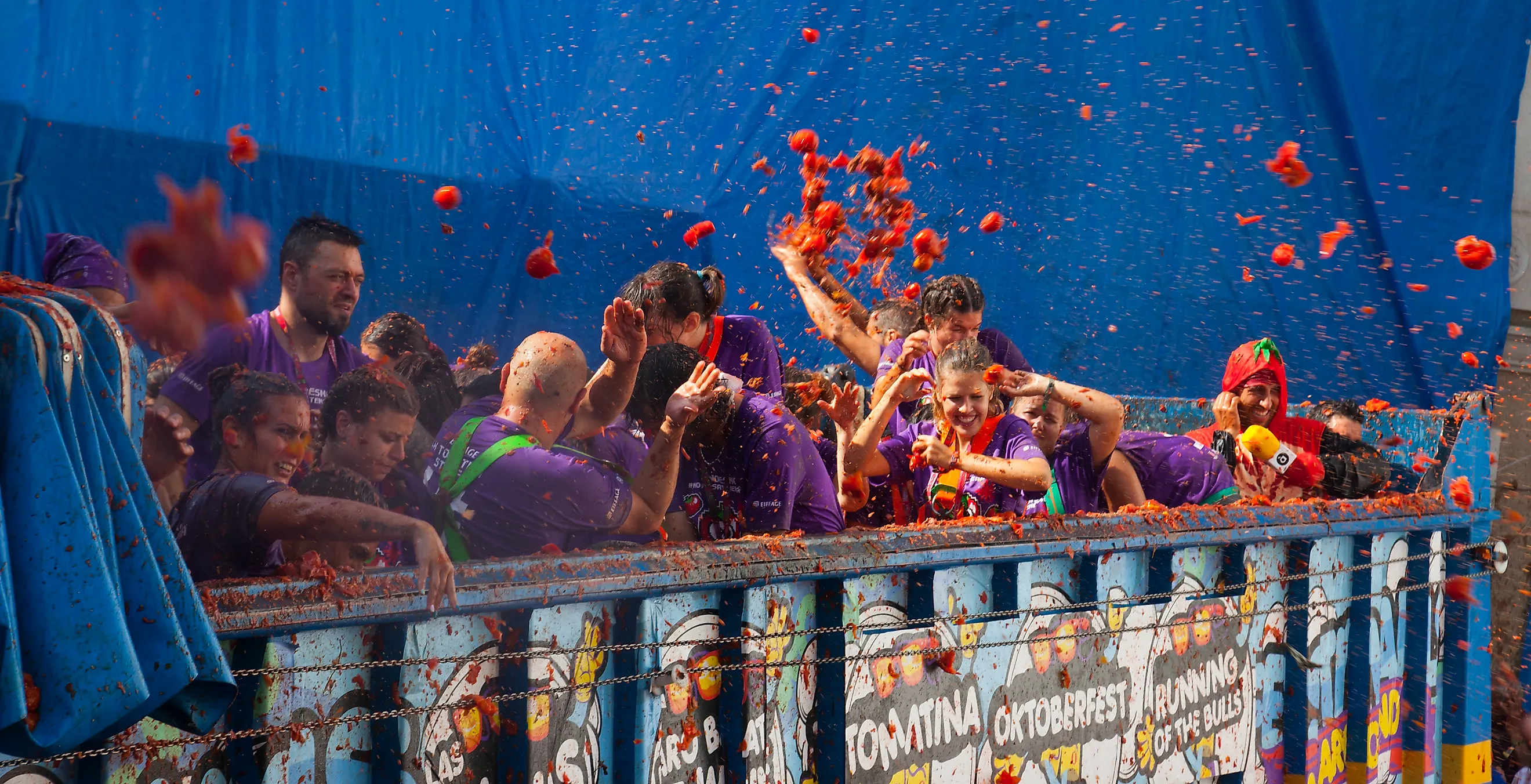
On the last Wednesday of August, the small town of Buñol near Valencia, Spain, hosts what is billed as the world's largest food fight. For one hour, tens of thousands of people pelt one another with crushed tomatoes until the streets run red, working through well over a hundred tonnes of overripe fruit. La Tomatina began in 1945, reportedly when a scuffle broke out during a parade and someone grabbed tomatoes from a nearby market stall. It has been an annual fixture ever since, and since 2013 it has been a ticketed event capped at around twenty thousand participants to keep the crowds manageable.
Cheese-Rolling Down Cooper's Hill, England

Each spring bank holiday, crowds gather at Cooper's Hill near Brockworth in Gloucestershire, England, for a contest that is exactly what its name suggests. A round wheel of Double Gloucester cheese, about nine pounds, is sent rolling down a steep slope roughly two hundred yards long, and competitors throw themselves after it. The cheese quickly outruns everyone, reaching speeds close to seventy miles an hour, so the real race is among the runners, with the first person to the bottom winning the wheel. Tumbles, bruises, and the occasional broken bone are routine. The event was first recorded in 1826 and is thought to be far older.
The Night Of The Radishes In Oaxaca, Mexico

On the evening of December 23, the main square of Oaxaca City in Mexico fills with sculptures carved entirely from radishes. Artists work with oversized roots, grown on land set aside for the occasion, shaping them into nativity scenes, saints, animals, and scenes of Oaxacan life, then display them for a single night before the vegetables wilt. The tradition grew out of the local Christmas market, where vendors carved radishes to draw customers, and the city turned it into a formal competition in 1897. Today it draws thousands of visitors, with cash prizes for the best work.
Customs Worth Understanding, Not Just Watching
Set side by side, these traditions can read like a catalogue of the extreme, but that view misses the point. A bullet-ant glove, a tomato fight, and a radish carved into a saint all do the same basic work that customs do everywhere: they mark time, bind a community together, honor the dead, or ask for protection and good fortune. Some, like Famadihana and Thaipusam, remain central to the people who hold them. Others, like baby tossing, are fading under legal and ethical pressure. In the end, strange is mostly a matter of where you happen to be standing.