The Mississippi Delta Counties Time Forgot
Beyond Mississippi's interstates and growing cities lies a flat, fertile stretch of the Delta where life still moves at the pace of a two-lane highway. Along Highway 61 and the back roads that branch off it, small county seats, cotton fields, and cypress swamps hold the stories of the blues, the civil rights movement, and the river that shaped it all. Hike the bottomland forest of Sharkey County, follow the path of the Mule Train in Marks, join the World Catfish Festival in Belzoni, or trace B.B. King's roots near Itta Bena. These eight Mississippi Delta counties that time forgot offer an unhurried, off-the-grid look at one of the most musically and historically rich corners of the South.
Sharkey County

Sharkey County is home to the Delta National Forest, the only bottomland hardwood forest in the National Forest System. Its roughly 60,000 acres of cypress swamps, sloughs, and hardwood stands show what the Delta looked like before the land was cleared for farming, and its trails, campsites, and seasonal birdwatching make for an easy escape into the woods. Nearby, the Rolling Fork Mounds preserve prehistoric Native American earthworks. The second-smallest county in Mississippi, Sharkey is the site of Theodore Roosevelt's 1902 bear-hunting trip that inspired the name "Teddy Bear." It is also home to the official Muddy Waters Birthplace historical marker at Rolling Fork, although the blues great was actually born in Issaquena County, just over the line.
Quitman County

Quitman County sits in the northern reaches of the Delta, where its county seat, Marks, a town of about 1,400 people, lies on a bend in the Coldwater River. Marks holds a proud place in civil rights history. Martin Luther King, Jr. visited in 1968 and chose the town as the starting point for the Poor People's Campaign's "Mule Train," a caravan of mule-drawn wagons that left Marks for Washington, D.C., on May 13, 1968. Today, wagon wheels along a Mule Train trail in town mark that journey. The town's 1904 railroad depot still stands, and since 2018, Amtrak's City of New Orleans has stopped at a new station in Marks, giving this small town a direct rail link to Chicago and New Orleans. Quitman County is also the birthplace of Charley Pride, one of the first Black country music stars.
Tallahatchie County

Tallahatchie County, named for a Choctaw word meaning "river of rocks," is one of 10 Mississippi counties with two county seats: Charleston, on the east side of the Tallahatchie River, and Sumner, on the west. Sumner is home to the restored Tallahatchie County Courthouse, where the 1955 Emmett Till murder trial was held, and its surrounding landscape still resembles that of the 1950s. Today, this courthouse is a designated unit of the Emmett Till and Mamie Till-Mobley National Monument. Across the river, Charleston is where actor Morgan Freeman was raised by his grandmother. In the small town of Tutwiler, murals recall W.C. Handy's account of first hearing the blues at the town's railroad station, and the Tutwiler Quilters, a program started in 1988, carry on a quilting style specific to the Delta.
Holmes County

Holmes County contains the towns of Tchula and Lexington, which grew up as cotton trade stops along river and rail lines, and both still hold 19th-century buildings from those early days. North of Lexington, the rural community of Acona sits at the transition point where the eastern bluff hills meet the flat Mississippi Delta. It is home to the Acona Church, Cemetery, and School, a National Register of Historic Places complex whose 1903 schoolhouse is one of the oldest rural schools still standing in the state and was among Mississippi's first consolidated schools. For time outdoors, Holmes County State Park, also listed on the National Register, offers room to slow down and unwind.
Humphreys County

Belzoni, in Humphreys County, grew up as a cotton shipping point along the Yazoo River. In 1976, Governor Cliff Finch declared it the "Catfish Capital of the World," and the town celebrates that title each April with the World Catfish Festival, which draws thousands of visitors downtown for catfish plates, arts and crafts vendors, live music, and the Miss Catfish pageant. Painted fiberglass catfish sculptures dot the town year-round. Blues musicians Pinetop Perkins and Elmore James grew up in Humphreys County, adding to its deep musical roots.
Tunica County

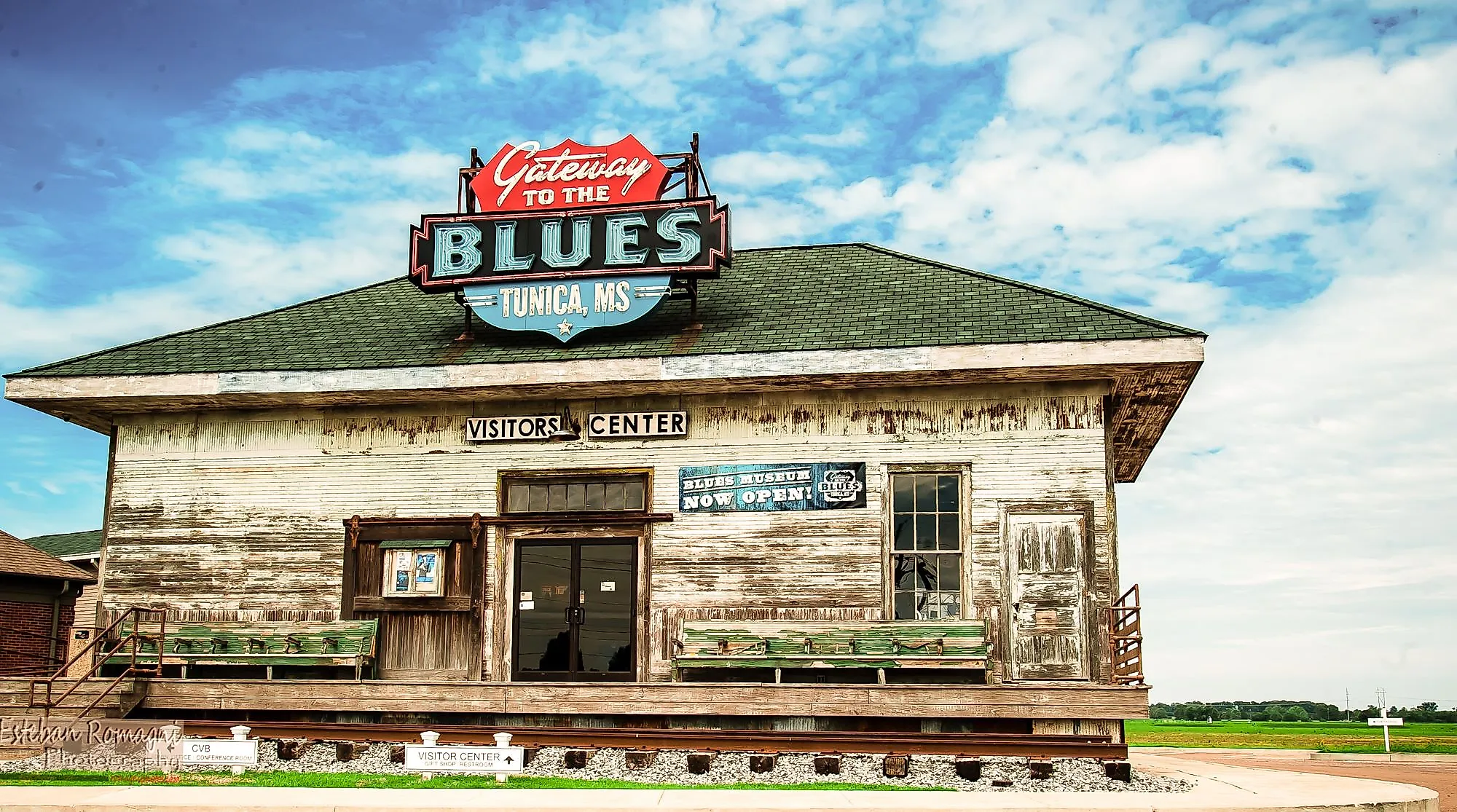
Tunica County sits along the northern stretch of the Blues Highway, U.S. Route 61. Here, the Gateway to the Blues Visitors Center and Museum occupies a train depot dating to around 1895, with interactive exhibits on the music's Delta origins, a collection of guitars, and a studio where visitors can record their own blues song. It is one of six Mississippi Blues Trail sites in and around Tunica, the county seat. Along the Mississippi River in Tunica Resorts, known as Robinsonville until 2006, five of the 11 casino resorts that once operated during the area's 1990s boom still welcome visitors, set amid wide-open cotton fields.
Leflore County

Leflore County and its county seat, Greenwood, were once known as the "Cotton Capital of the World," and many of the large cotton warehouses from that era have since been repurposed. Outside Greenwood, tiny towns of old 19th-century storefronts, gin mills, and railroad tracks sit among flat, open fields, making for an unhurried drive. Blues legend B.B. King was born near Itta Bena in 1925, and singer Bobbie Gentry, best known for "Ode to Billie Joe," spent part of her childhood in Greenwood with her father. Catfish farming is one of the county's main industries today.
Issaquena County

The least populous county east of the Mississippi River, Issaquena County is home to just 1,338 people, according to the 2020 Census. The river runs along the county's entire western boundary, and thick bottomland hardwood forest grows in its rich, clay-heavy soil. Mayersville, the county seat and its only incorporated town, has about 430 residents and an easy, quiet pace that belies its past as a booming river port. The town also holds a place in civil rights history: Unita Blackwell, the first Black woman elected mayor in Mississippi, led Mayersville from 1976 to 2001. The county's name is Choctaw for "deer river," and with far more fields and woods than storefronts, it remains one of the most off-the-grid corners of the state.
Slow Days in the Mississippi Delta
If you're looking for a quieter side of Mississippi, the Delta's back roads lead to a slower, simpler pace of life. From the bottomland forest of Sharkey County to the blues landmarks of Tunica and the catfish festival in Belzoni, these counties share deep musical roots, a proud civil rights history, and wide-open farmland dotted with close-knit small towns. Whether you come for the music, the history, or the open road, the Mississippi Delta's off-the-grid counties are the best way to experience a corner of the South that time forgot.