The Counties That Touch Two Great Lakes
While traveling through Michigan, one might notice that the state borders on the most Great Lakes. Yet, what one might not expect is that there are only two counties that truly encompass the shoreline.
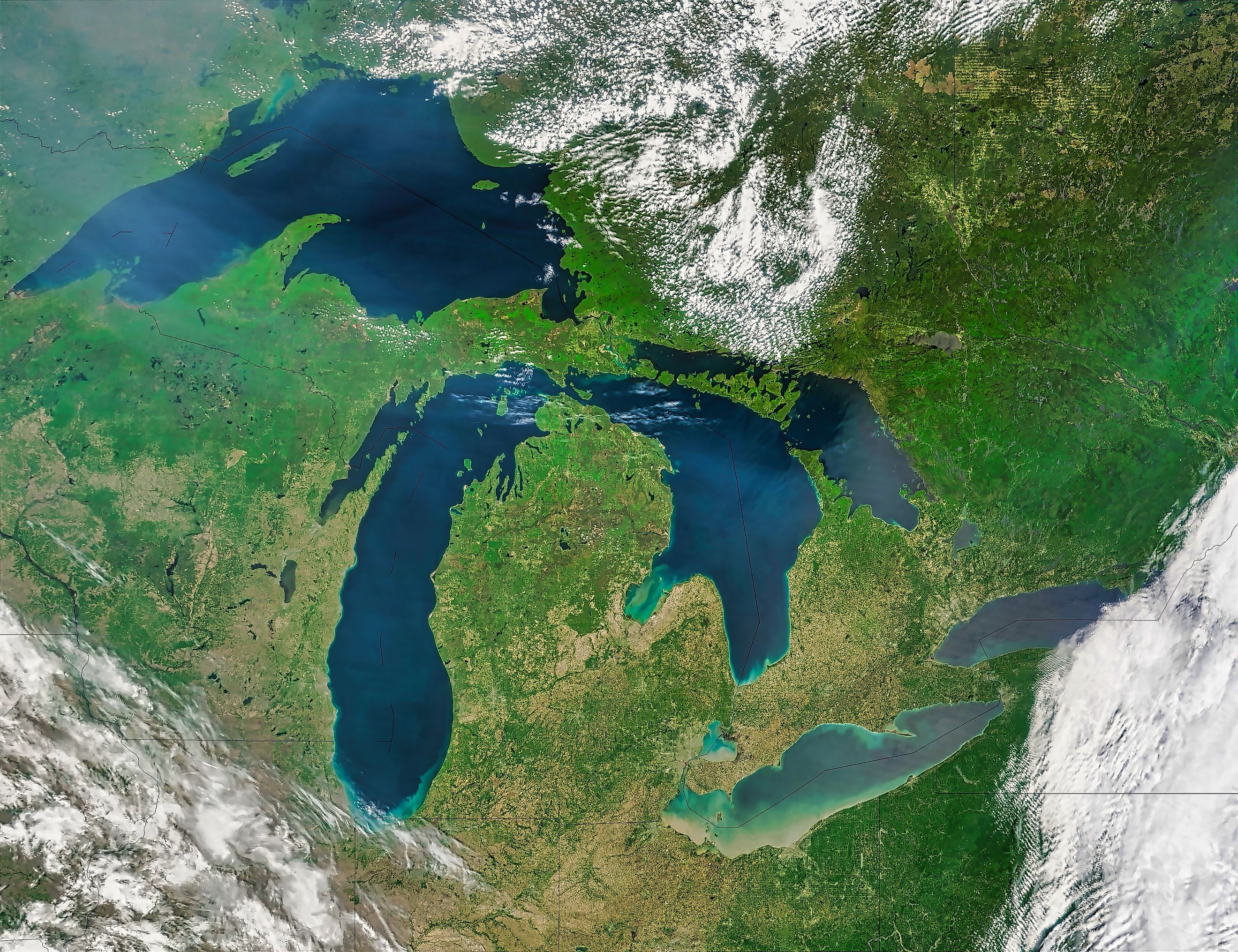
Mackinac and Chippewa Counties are among the few counties in the US with shorelines on two Great Lakes. These counties are both located in the Upper Peninsula of Michigan and are right next to each other, with Chippewa sitting on Mackinac's northern and eastern border.
Chippewa County's geography

Chippewa County is situated on the northeastern end of the Upper Peninsula, bordering Lake Superior to the north and Lake Huron to the southeast. In total, the county has 456 miles of shoreline on both Great Lakes and is the second largest county in Michigan by land area at 2,698 square miles. In fact, this county has the most shoreline on the Great Lakes.
The county was first established on February 1st, 1826, but its history dates back to the 1600s when French fur traders and missionaries came to this part of Michigan to trade with and spread Catholicism to Native tribes. In 1668, Jesuit missionary Father Jacques Marquette named a French settlement here Sault Ste. Marie, making it the first city in Michigan. Today, Sault Ste. Marie is the county seat of Chippewa County.

In addition to the two Great Lakes, Chippewa County contains the portion of the St. Marys River that connects Lake Superior to Lake Huron. However, at the time, this section of St. Marys River was dangerous, as there were rapids and waterfalls. To address this issue, in the mid 1850s, the Fairbanks Scale Company took charge of constructing a series of locks to allow ships to pass through the St. Marys River safely on the way to Lake Huron. These locks were completed in 1855 and later turned over to the federal government under the name Soo Locks.
These locks have undergone several updates over the years, but their role remains the same: to provide a crucial connection across the Great Lakes.
Chippewa County's lakefronts

As befits its shipping history, one well-known lakefront attraction in Chippewa County is the Great Lakes Shipwreck Museum. Located on the northeastern corner of the county on Lake Superior, it is open seasonally from May to October, telling the stories of the various shipwrecks that have taken place on Lake Superior. It also maintains several historic buildings such as a lighthouse, surfboat house, and fog signal building. It also has a bell from the SS Edmund Fitzgerald, which sank in 1975.
Further on in the Whitefish Bay section of Lake Superior, there is Brimley State Park, a 100-acre lakeside park that was first established in 1923, making it one of the oldest state parks in the Upper Peninsula.
On Lake Huron, Chippewa County has the lesser-known Drummond Island, which is especially renowned for its shorelines, hiking trails, and off-road trails for ATVs. One of its best beaches is Big Shoal Beach, named after Big Shoal Bay.
Mackinac County's geography

Just south of Chippewa County is Mackinac County, with shoreline on Lake Michigan to its west and Lake Huron to its east for a total of 298 miles of Great Lakes shoreline. In its center is the Straits of Mackinac, a 4-mile-wide by 30 miles long waterway that directly connects Lake Michigan and Lake Huron. Due to this direct connection, some consider Lake Michigan and Huron to be one lake.
Much like Chippewa County, Mackinac was originally settled by French fur traders, with explorers first reaching the region in 1668. They encountered many types of Native American groups such as the Ojibwe, Ottawa, and Potawatomi who lived semi-nomadic lives, settling in different places depending on the season. In late 1671, the famed Jacques Marquette established Saint Ignace, making it the second oldest city in Michigan.

The county would trade hands to the British after the French and Indian War, and then to the Americans after the end of the American Revolutionary War. Fur trading was replaced by logging, fishing, and water transportation.
What truly transformed the county was the construction of the Mackinac Bridge in 1957. At 5 miles long, this suspension bridge is the longest suspsension bridge in the Western Hemisphere, connecting the Lower and Upper Peninsulas of Michigan. Prior to this bridge, residents had to use ferries to cross the Straits of Mackinac. The bridge utilizes heavy cables that each hold 16,000 tons of tension to keep the 1-million-ton bridge standing over the water.
Mackinac County's lakefronts

Just to the west of the Mackinac Bridge is the Sand Dunes Beach Park on Lake Michigan. This is known as a quieter beach, with no off-road vehicles allowed on the fragile dunes. There are also no facilities or lifeguards, meaning one should swim at their own risk, but the lack of noise makes this a highly sought-after park.
The county's best-known lakeside destination is the historic Mackinac Island, surrounded by Lake Huron. French missionaries established a small mission on the island in the late 1600s, which today is located at the reconstructed Missionary Bark Chapel within Marquette Park, named after Jacques Marquette. During the War of 1812, the island was the site of a battle between the British and Americans, and was only turned over to the Americans after the war.

Today, the island maintains this historical feel by banning the use of cars. Only horse-drawn carriages, bikes, and foot traffic are allowed to see its 14 historic buildings, museums, hiking trails, and beaches such as Sunset Rock, which sits on the southwestern part of the island. A total of 80% of the island is part of the Mackinac Island State Historic Park, featuring rock formations, nature trails, and the 18th-century Fort Mackinac.
These counties are key connection points

Neither of these counties has a large population, with the US Census estimating that Mackinac County has about 11,000 residents, and Chippewa County has 36,081 residents as of July 1, 2025. What they lack in numbers, they make up for in crucial connection points on the Great Lakes, enabling transportation between the Upper and Lower Peninsulas and allowing ships to pass through Lake Superior to the other four Great Lakes.
These counties are also popular connection points for those looking to explore historic landmarks, from the horse-drawn carriage streets of Mackinac Island to the tragic shipwrecks of Lake Superior. With their shoreline on three Great Lakes, no other counties can claim as much shoreline as Chippewa and Mackinac.