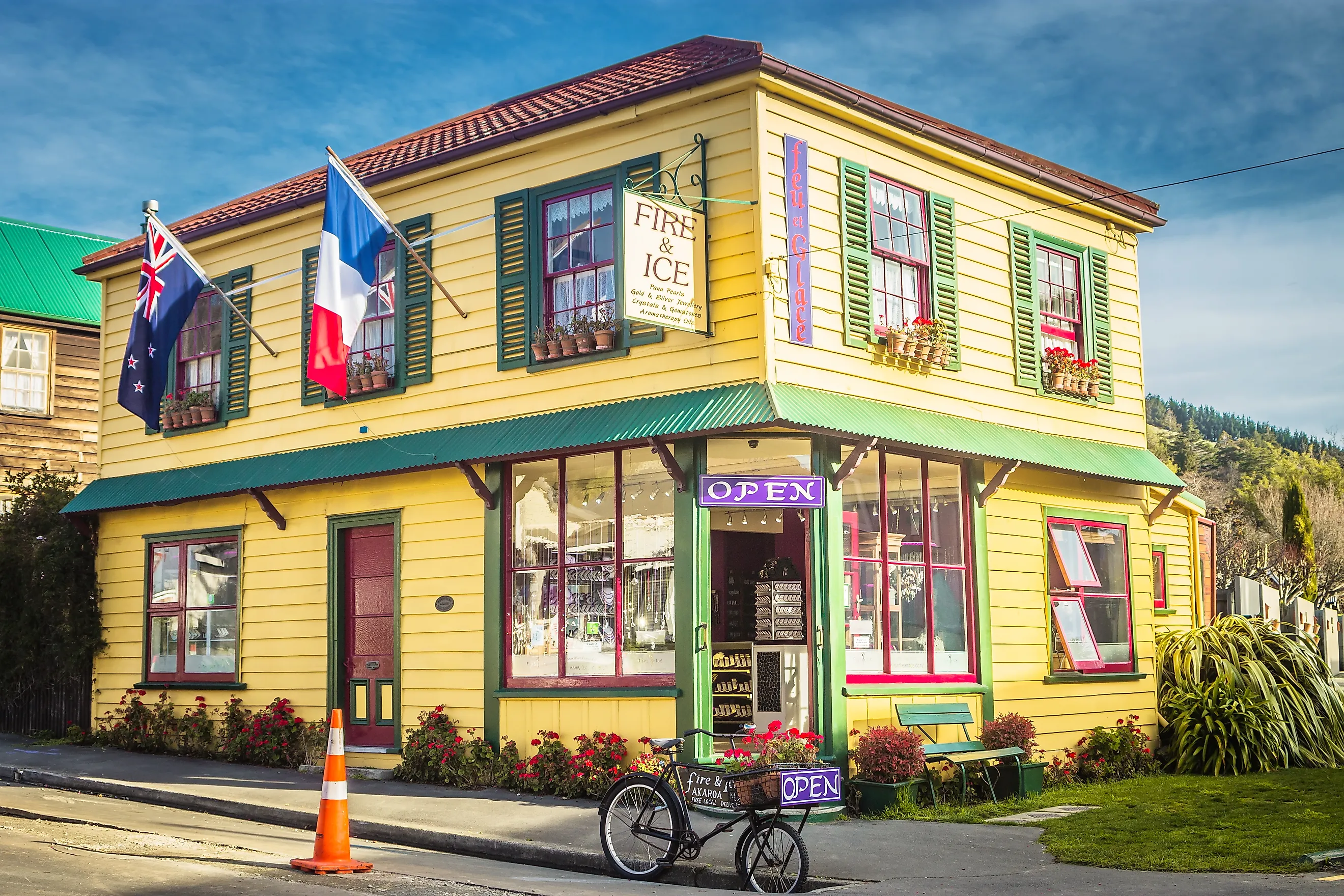
You Won't Believe This Town Is In New Zealand
New Zealand’s older urban architecture leans heavily British. The country signed the Treaty of Waitangi in 1840 and became a British colony, with many towns still carrying red brick storefronts and Victorian architecture from that era. Full independence came more than a century later in 1947. Akaroa is the quirky exception. Street signs run in both English and French. Lavender-covered hillsides and cafés serving local cheeses and wines create an almost Mediterranean atmosphere unlike anywhere else in the country.
Akaroa Adopted a French Identity

Akaroa is home to fewer than 1,000 residents who essentially live inside an ancient volcanic crater. At first glance, the French influence stands out over the British, with bilingual street signs and European casement windows. French explorer Captain Jean-François de Surville arrived in New Zealand in 1769, the same year as James Cook. Later, French navigator Jules Dumont d’Urville visited New Zealand several times during the 1820s and 1830s. His voyages contributed to European maps and descriptions of areas such as Akaroa Harbour.

French interest in New Zealand grew during this period, and the Nanto-Bordelaise Company organized a group of French settlers to establish a colony at Akaroa on Banks Peninsula. By the time the settlers arrived in 1840, the Treaty of Waitangi had already been signed and British sovereignty had been declared. Despite this, the French settlers were permitted to remain and they established a community in Akaroa that retained a distinct French cultural influence.
Several French-style buildings remain in Akaroa today, dating to the 19th century. These structures preserve the town’s history alongside its everyday character. Visitors find a town with a Māori name but cafes and shops that lean into its French heritage with French wines and pastries. There is also the annual Akaroa French Festival in October, which celebrates all things French, including music and fine food.
A Location As Unique As Akaroa’s Heritage

Akaroa is protected by the volcanic rim of the crater in which it sits. The rim acts as a barrier against the dry northwesterly winds that blow off the Canterbury Plains. The geological oddity creates a microclimate that feels worlds apart from New Zealand’s typical alpine flora and temperate rainforests. The hillsides that surround the town support lavender fields and olive trees. In summer, the grass dries out and turns bright yellow. Set against the deep blue waters of the harbour, it gives the town a southern European look in the Pacific.
A Lack of Urban Sprawl

The town holds proudly to its French history and invites visitors to explore some of its most distinctive buildings. These include the Langlois-Eteveneaux Cottage, built in the 1840s, making it one of New Zealand’s oldest homes. The cottage features a steep roofline and timber detailing common in French colonial construction. In 1964, the Akaroa Museum was established around the cottage and now includes four exhibition galleries, the Custom House, and the Akaroa Court House.
On the quirkier side, Akaroa is also home to The Giant’s House. The historic manor was converted into an art installation and features what is called the “happiest garden on Earth.” The estate is perched on a hillside, with garden rooms that look out over the sea. Some of the plants grown there include roses, succulents, and lavender. There are also several mosaic sculptures throughout the garden.
Things to See and Do in Akaroa

Beyond its French flair, Akaroa offers experiences that visitors would be hard-pressed to find anywhere else. Akaroa Harbour and Banks Peninsula are home to the highest concentration of Hector’s dolphins in one place. The species is named after the New Zealand scientist Sir James Hector and can be spotted in Akaroa at any time of the year. Swimming with Hector’s dolphins is allowed, and visitors can also go on catamaran cruises to see them in the water. Kayaking is also permitted in the harbour, where visitors may spot seals and penguins. Snorkellers can head to the Pōhatu Marine Reserve, paddling through volcanic bays past cormorants, crayfish, and even seals.

A hike up the path leading to the Akaroa lighthouse offers strong views of the harbour and mountains, and Banks Peninsula is home to boutique vineyards and traditional cheesemakers where visitors can enjoy tastings and tours. From French Peak Vineyard’s cellar door overlooking the hills to the family-run Barrys Bay Cheese factory producing handcrafted varieties, the region has developed a reputation for small-scale food and wine experiences that reflect its rural character. For dinner, there is The Seafood Kitchen or Ma Maison, where the town’s French heritage runs through dishes like truffle seafood pasta. When night falls, you can join guided experiences with Akaroa Stargazing to explore the dark skies of Banks Peninsula while learning about Southern Hemisphere constellations and Māori perspectives on the night sky.
Akaroa Defies the New Zealand Stereotype

Visitors who arrive in Akaroa expecting a typical New Zealand experience are often surprised by just how distinct the town feels. Alongside its New Zealand character, Akaroa reflects its French heritage in its architecture, history, and atmosphere. Rather than fitting neatly into familiar expectations, the town leans into the qualities that set it apart. If you want to spend time in an ancient volcanic crater surrounded by a community proud of its French roots, Akaroa deserves a place on the list. It is one of the more distinctive destinations in the country, with a blend of history, scenery, and culture that lingers long after you leave.