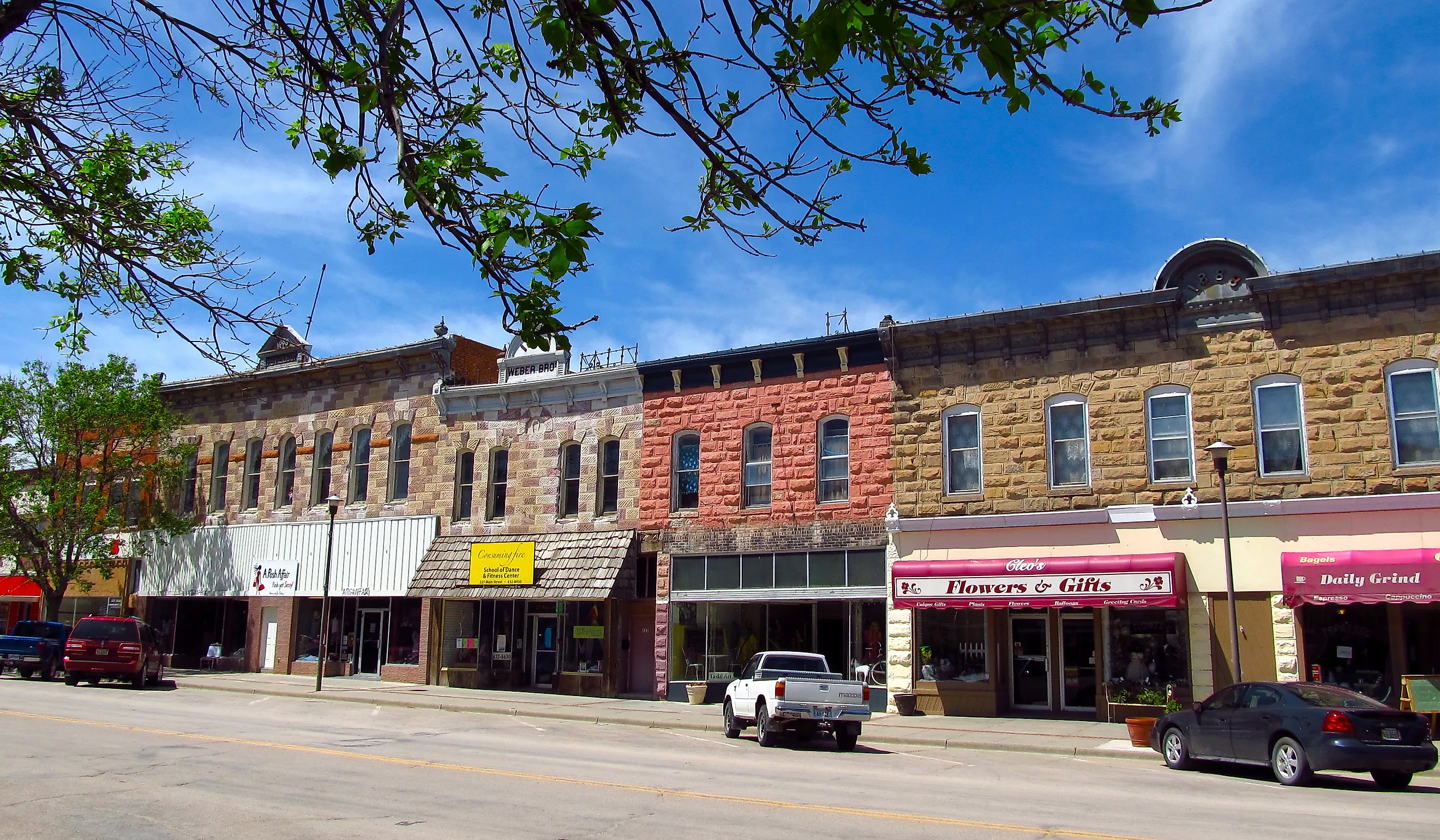
10 Cutest Small Towns In Nebraska For 2026
Nebraska doesn’t get pitched as a small-town destination, which is part of what makes it one. The ten towns ahead sit a long way from the interstate hum, and each built its reputation over decades. Chadron has the most comprehensive fur trade collection on the planet. Red Cloud holds the largest set of historic sites tied to any American writer. Beatrice protects the original homestead Daniel Freeman filed for on New Year’s Day 1863. Nebraska saves its best stops for travelers willing to go looking.
Chadron

Chadron is a small city in Nebraska’s northwestern panhandle that combines history with outdoor recreation. Three miles east of town on US Highway 20, the Museum of the Fur Trade stands on the original site of James Bordeaux’s 1837 trading post, established for the American Fur Company. The reconstruction is so carefully done that the site earned a place on the National Register of Historic Places. The museum holds over 6,000 authentic artifacts, including the oldest known point blanket from 1775 and firearms once owned by Kit Carson and Tecumseh. It is the most comprehensive fur trade collection in the world.

Nebraska’s first state park, Chadron State Park, offers over 100 miles of trails for hikers and mountain bikers through the Pine Ridge buttes and canyons, plus trout fishing, disc golf, horseback rides, and more than 20 rustic cabins. Trout are stocked monthly from April through August in the park’s pond. Toadstool Geologic Park, managed by the U.S. Forest Service within the Oglala National Grassland, features clay and sandstone formations (some in the shape of toadstools) alongside fossil deposits and interpretive trails.
Crawford

Crawford is a small ranching town near the South Dakota border that serves as the gateway to one of Nebraska’s most historically layered state parks. Fort Robinson State Park, managed by the Nebraska Game and Parks Commission, encompasses more than 22,000 acres of Pine Ridge terrain and preserves the site of a military post that operated from the 1870s through World War II. It was here that Sioux Chief Crazy Horse was killed in 1877. The park commemorates this history alongside its role as a cavalry remount station, K-9 training center, and prisoner of war camp. Original buildings still stand and remain in use, with others reconstructed. The park supports its own bison and longhorn herds, and guests can stay in historic lodging once occupied by officers and soldiers.
Toadstool Geologic Park also sits near Crawford and connects to the Hudson-Meng Education and Research Center, the site of a Bison antiquus bonebed that represents one of the most significant paleoarchaeological discoveries in North America. The center is open Fridays from Memorial Day through Labor Day.
Red Cloud

Red Cloud has become one of the most significant literary heritage destinations in the United States. The Willa Cather Foundation, operating through its National Willa Cather Center on Webster Street, manages the largest collection of nationally designated historic sites dedicated to any American author. Guided town tours take visitors through recently restored properties, including the Willa Cather Childhood Home, a National Historic Landmark and the site most closely associated with the Pulitzer Prize-winning novelist’s formative years. The home went through its first comprehensive restoration in over 50 years in December 2023 and now includes preserved original wallpaper in Cather’s attic bedroom.
The 1885 Red Cloud Opera House, fully restored and in active use, hosts performances, book signings, and art exhibitions throughout the year and was the site of Cather’s high school graduation speech. The Willa Cather Memorial Prairie covers 612 acres and gives visitors the chance to walk the same landscape that shaped novels like My Ántonia and O Pioneers!.
Nebraska City

Nebraska City is a tree-lined town best known as the birthplace of Arbor Day, with more to offer than a single afternoon can cover. Arbor Lodge State Historical Park, on the grounds of Arbor Day Farm, was the estate of Arbor Day founder J. Sterling Morton. The original four-room frame house was remodeled seven times and ultimately grew into a 52-room mansion, donated to the state by the Morton family in 1923. It’s open for guided tours and filled with authentic period furnishings. On the same grounds, the park’s lilac collection spans more than 200 cultivars and ranks as one of the largest public lilac collections in the country. The Tree Adventure at Arbor Day Farm offers a family-oriented outdoor experience with treehouses, elevated walkways, and a giant WonderNet.
Beatrice

Beatrice is a county seat town with an outsized connection to one of the most significant pieces of federal legislation in American history. Homestead National Historical Park, managed by the National Park Service, preserves 211 acres in Gage County on land that Daniel Freeman, one of the first claimants under the Homestead Act of 1862, filed for on New Year’s Day 1863. The park protects the landscape of Freeman’s original homestead and includes a restored tallgrass prairie, interpretive trails, the 1867 Palmer-Epard cabin, and a Heritage Center whose roofline is designed to resemble a plow breaking through sod.
The Heritage Center houses exhibits on the Homestead Act and the diverse populations it affected, from immigrant families to formerly enslaved people. Ranger-led programs, films, and self-guided trails bring the homesteading era to life across different seasons. The surrounding community of Beatrice has a well-preserved downtown, the Gage County Courthouse square, and direct access to the Blue River State Recreation Area for fishing and trail use.
Ogallala

Ogallala is a western Nebraska town on the North Platte River known as the gateway to the state’s largest body of water. Lake McConaughy State Recreation Area, managed by the Nebraska Game and Parks Commission and located eight miles northeast of town, covers 30,000 surface acres. It’s Nebraska’s largest reservoir, with white sand beaches, clear water, and some of the most productive sport fishing in the state. The lake draws swimmers, boaters, windsurfers, scuba divers, campers, and anglers pursuing walleye, striped bass, and several state-record fish.
On the east side of Kingsley Dam, Lake Ogallala offers a calmer, smaller-scale complement. The 320-acre lake is known for fast-growing rainbow trout and excellent kayaking. A two-mile hike-bike trail runs along the northern dike. Ash Hollow State Historical Park preserves a key stopping point on the Oregon-California Trail where visible covered wagon ruts remain alongside prehistoric cave dwellings and over two miles of hiking trails.
Scottsbluff

Scottsbluff is the largest city in Nebraska’s panhandle and home to one of the most recognizable geological landmarks on the old emigrant trails. Scotts Bluff National Monument, managed by the National Park Service, rises 800 feet above the North Platte River and served as a major waypoint for travelers on the Oregon, California, and Mormon Pioneer National Historic Trail. The 3,000-acre monument features nearly four miles of hiking trails, a 1.6-mile Summit Road through the only three auto tunnels in Nebraska, and the world’s largest collection of works by western artist William Henry Jackson.

Wildcat Hills State Recreation Area, a short drive south of Scottsbluff, offers additional hiking through a pine-clad butte landscape with a nature center and wildlife viewing. The Scottsbluff area also hosts the Legacy of the Plains Museum, which documents farming and ranching history in the North Platte River Valley.
Kearney

Kearney is a Nebraska city along the Platte River that hosts one of the most extraordinary seasonal wildlife events in North America. Each spring between February and April, more than 500,000 sandhill cranes converge on the Central Platte River Valley to rest and refuel during their northward migration. Kearney is the best base from which to witness it. Fort Kearny State Recreation Area, located southeast of Kearney, provides one of the most accessible crane viewing experiences in the region.
The adjacent Fort Kearny State Historical Park was established in 1848 as the first fort built to protect Overland Trail travelers. Its interpretive center doubles as a Crane Information Center during the migration to direct viewers. Reconstructed buildings include the stockade, parade grounds, and blacksmith shop. The Iain Nicolson Audubon Center at Rowe Sanctuary, located nearby on the river, offers guided overnight blind experiences for those wanting a closer look.
Valentine

Valentine sits near the South Dakota border and is the natural launching point for exploring the Niobrara River, one of the most scenic and biologically diverse waterways in the Great Plains. Smith Falls State Park, located 19 miles east of Valentine along the river, is home to Nebraska’s tallest waterfall. Smith Falls drops more than 63 feet from a convex sandstone face. The Jim MacAllister Nature Trail winds through the canyon past nine additional waterfalls in the park.

Multiple outfitters near Valentine offer canoe, kayak, and tube rentals for river floats. The Fort Niobrara National Wildlife Refuge sits on 19,131 acres and features a wildlife drive through habitat supporting bison, elk, deer, and prairie dogs.
Broken Bow

Broken Bow is a quiet Sandhills town that serves as one of the best access points for Calamus Reservoir State Recreation Area, one of the most popular outdoor destinations in the state. Calamus covers a 5,123-acre lake surrounded by 4,958 acres of gently rolling native grass and Sandhills terrain. The area offers camping, boating, fishing, swimming at white sand beaches, and kayaking.
Nearby Fort Hartsuff State Historical Park, managed by the Nebraska Game and Parks Commission, preserves Nebraska’s most intact frontier-era military post. Original stone buildings date to the 1870s, with living history programming offered seasonally.
The towns on this list stretch from Nebraska’s panhandle to its Missouri River border, and what connects them is not geography but quality of place. Scotts Bluff National Monument rises 800 feet above the North Platte River. Valentine gives visitors access to Nebraska’s tallest waterfall. Nebraska rewards travelers who arrive with specific destinations in mind rather than a vague sense of what the state is supposed to look like. The ten towns covered here are proof that the most interesting stops in any state are rarely the ones that get top billing.