8 Main Streets Where California's Sierra Nevada Comes Alive
Beneath the peaks and pine forests of California’s Sierra Nevada, the historic main streets of foothill towns still carry the spirit of the California Gold Rush with a modern glint on it. Grass Valley’s Mill Street runs on craft breweries and colorful murals set against preserved brick and stonework. Murphys built one of the richest mining camps in the state and now runs on wine bars and bistros. Downieville and Sonora show how that boomtown grit has been put to new use. Restored saloons, hotels, and mining-era foundries now anchor the character of the Sierra Nevada.
Grass Valley

In the northern Sierra foothills, Grass Valley sits among rolling hills shaped by hard-rock mining, where gold was once extracted from quartz deep underground rather than sifted from river gravel. Nearby, Empire Mine State Historic Park preserves mine buildings, the mine owner’s home and gardens, and the entrance to miles of abandoned shafts. In town, Mill Street reflects that history through granite commercial buildings and brick storefronts built during the mining boom.
Grass Valley Brewing Company and a range of cafes and shops now occupy many of those same historic spaces, with strings of twinkling lights suspended above the pedestrian street. While exploring downtown, check out the public art and colorful murals along the storefronts. In summer, the Thursday Night Markets bring out music, artisan vendors, and tasty treats. A specialty in town are the Cornish pasties filled with beef, potatoes, and onion that once filled Cornish miners’ lunch pails.
Placerville

Rafters have long flocked to Placerville before or after exploring Marshall Gold Discovery State Historic Park, where gold was first discovered in California in 1848. The town rises along ridges above Weber Creek, and Main Street still reflects its rough Gold Rush beginnings. Shops, bars, and cafes line the street today inside historic structures, with nearby orchards at Apple Hill supplying cider, pies, donuts, and baked goods during harvest season.
Placerville’s early nickname, “Hangtown,” came from the frontier justice carried out here in the late 1840s, and the stump of the original Hangman’s Tree is still preserved beneath a Main Street saloon, marked by a plaque. The Bell Tower remains the street’s best-known landmark, while the Fountain & Tallman Soda Works Museum focuses on Gold Rush commerce and daily life. Other historic landmarks include the blacksmith shop where John Mohler Studebaker rented workspace and made wheelbarrows for miners before founding the wagon company that became Studebaker.
Nevada City

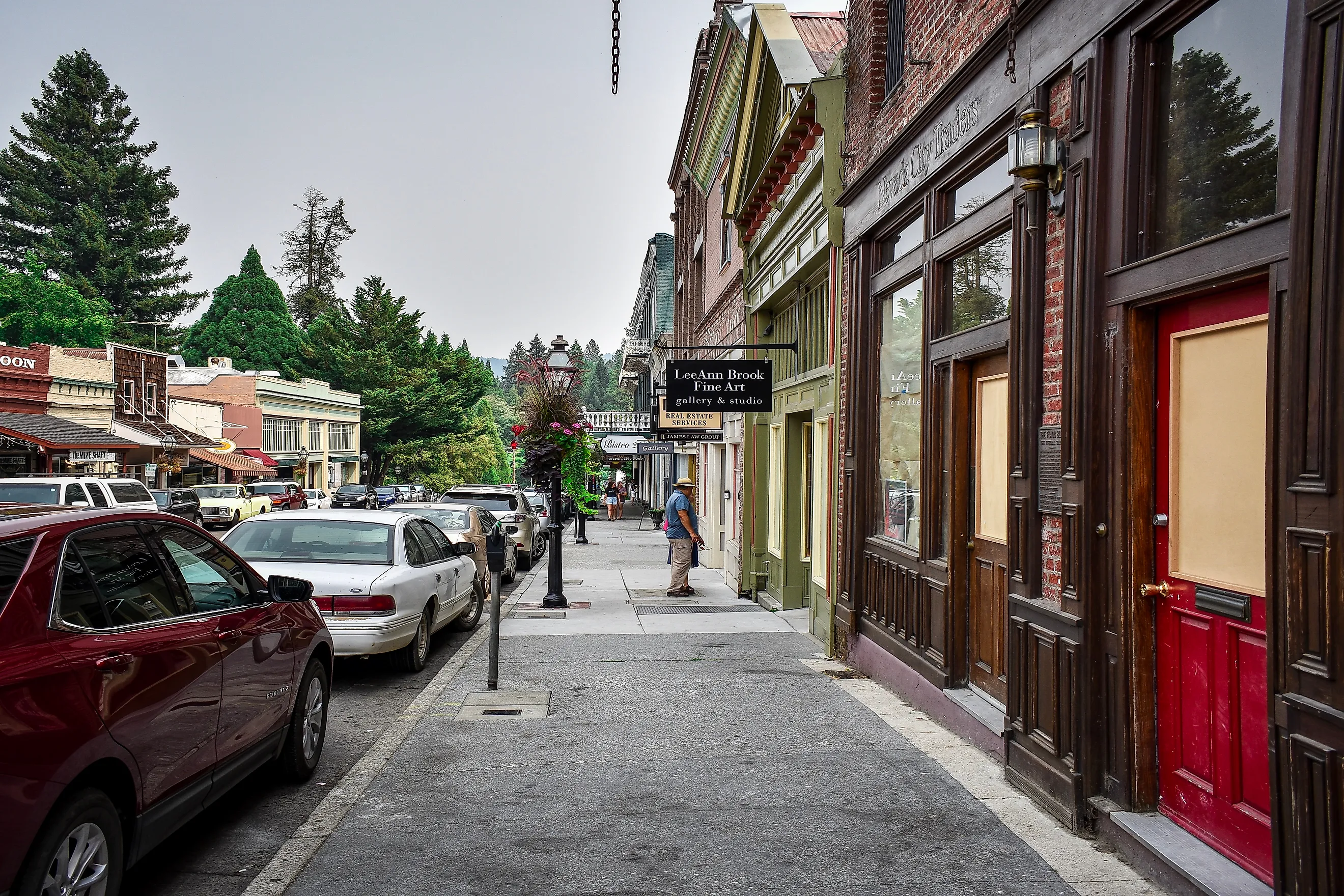
Visitors often use Nevada City as a home base for outdoor adventures, like swimming in the South Yuba River or hiking through Malakoff Diggins State Historic Park, where hydraulic mining once blasted away entire hillsides with high-pressure water cannons. Tucked into the Sierra foothills along Deer Creek, the town is surrounded by pine forest and the remnants of mining-era landscapes. Broad Street holds one of California’s best-preserved Gold Rush business districts, with antique shops, bookstores, candy stores, and small bistros filling former Victorian-era hotels and saloons.
Some Gold Rush-era businesses still operate today. The National Exchange Hotel, opened in 1856, is one of the oldest continually operating hotels west of the Rocky Mountains, with restored guest rooms, a dining room, and a tavern that runs live entertainment. Nearby, the Nevada Theatre still hosts films and performances a century and a half after its 1865 opening. Pioneer Cemetery, established around 1851, makes for a reflective morning or afternoon stroll.
Sutter Creek

If you recognize the name of this town, you might be a wine lover. Sutter Creek is closely tied to Amador County wine production, especially Zinfandel. Spend the day touring foothill vineyards before heading into Sutter Creek’s Main Street for dinner or a glass of wine. Tucked into the county’s oak-covered foothills, the town sits beside Sutter Creek itself, with historic storefronts housing tasting rooms, boutiques, and restaurants. While wine is the headliner, history is everywhere. Businesses operate inside period interiors with thick masonry walls. At Knight Foundry, America’s last water-powered foundry and machine shop, visitors can watch demonstrations of mining-era machinery once used to manufacture equipment for nearby mines. Historic lodging is part of the downtown landscape too, including the Hotel Sutter, which incorporates portions of the original American House hotel built in 1851, parts of which survived the fire that nearly leveled the town in 1865.
Sonora

Sonora’s proximity to Yosemite National Park makes it a popular stop for travelers, who often pause for a meal or rendezvous with fellow vacationers before heading into the mountains. Founded by miners from Sonora, Mexico, the town still carries strong traces of that early heritage, including the historic Gunn House Hotel, one of the oldest surviving adobe buildings in the region. A plaque on Washington Street marks the site of the original Sonoran camp, and the street itself follows part of the old route connecting early mining settlements.
The Tuolumne County Museum, set in the former county jail, includes preserved cells and exhibits on mining life, Native American culture, and frontier justice. At the center of town is Sonora’s Opera Hall, known at its completion in 1885 as the “Jewel of the Mother Lode.” The restored venue now hosts events throughout the year, while restaurants, breweries, galleries, and shops fill the surrounding storefronts along Washington Street, where murals and historical markers reflect Sonora’s Mexican-American mining heritage.
Murphys

Not far from Calaveras Big Trees State Park and Mercer Caverns, Murphys sits in the lower foothills near Angels Creek, surrounded by oak- and pine-covered slopes. During the Gold Rush, Murphys was one of California’s richest mining camps, with early miners reportedly pulling millions of dollars in gold from a few acres of placer deposits. Many stayed after the richest claims faded, helping build a lasting and well-preserved town. Today, Main Street stretches beneath mature trees that shade storefronts and outdoor gathering areas. Visitors can spend the day moving between wine bars, galleries, and bistros like Alchemy Cafe. A favorite photo spot is the statue of a frog panning for gold outside one of the downtown outfitters, a nod to Mark Twain’s frog-jumping story. After a long day of exploring, many visitors stay overnight at Murphys Historic Hotel, operating since 1856 and known for hosting Twain, Ulysses S. Grant, and the outlaw Black Bart.
Downieville

Main Street Downieville is the heart of a renowned mountain biking community, with weathered historic buildings housing cafes, inns, and outfitter shops that cater to outdoor enthusiasts. Long before the biking crowd, the town operated as a busy mining center where river gravel was worked for gold. That no-nonsense heritage shows in the original wooden porches and practical storefronts that still dominate the street. Visitors can stop into Sierra Hardware, operating since 1947, to pick up a copy of The Mountain Messenger. The paper was first published in 1853 and is recognized as California’s oldest weekly newspaper. More early Gold Rush history is on display at the Downieville Museum, housed in a historic 1850s Chinese store and dwelling. Behind the nearby courthouse, the Sierra County Sheriff’s Gallows still stand.
Auburn

Northeast of Sacramento in the lower Sierra foothills, Auburn sits above a canyon formed by the North and Middle Forks of the American River, near the Auburn State Recreation Area. Westward emigrants and Forty-niners flooded the Auburn Ravine area during the Gold Rush, and Auburn later became a major hub on Sierra mining and emigration routes. Today, Auburn’s Old Town Washington Street district combines stone commercial blocks, wooden storefronts, and restored historic buildings overlooking the surrounding hills.
Visitors can step into the Gold Rush Museum to explore mining exhibits, a recreated mining tunnel, and an indoor panning stream. Nearby, the Placer County Courthouse Museum and the Chinese History Center / Joss House Museum preserve artifacts, documents, and stories from the region’s westward migration and Gold Rush heritage. Locals and visitors fill the cafes, wine bars, breweries, and shops that now occupy many of the street’s oldest structures. A favorite stop is the Auburn Old Town Gallery, a longtime artist-run cooperative where visitors can browse work by dozens of locals.
Today, the historic main streets of California’s Sierra Nevada foothills have become some of the region’s most memorable weekend destinations. Gold Rush history mingles with river rafting, mountain biking, wine tasting, hiking, and old-fashioned small-town character. Behind restored brick storefronts and weathered wooden shutters, visitors can still feel the mining camps, frontier justice, immigrant communities, and rugged mountains that shaped Sierra Nevada history. Whether stopping in for a day trip or staying for a long mountain weekend, these towns hold up as some of the most atmospheric destinations in Northern California.