Where People Are Moving To In Northern Ireland In 2026
Northern Ireland added about 7,500 residents between mid-2023 and mid-2024, bringing its population to approximately 1.93 million. Migration accounted for most of that increase: net migration added an estimated 5,800 people, or 77.2% of the year's population growth, according to the Northern Ireland Statistics and Research Agency (NISRA). Growth was widespread but uneven, with 10 of Northern Ireland's 11 Local Government Districts gaining residents and Derry City and Strabane recording the fastest percentage increase. The pattern extends beyond Belfast itself, with population gains appearing in the capital's suburban and commuter districts as well as employment centers farther west. Housing construction, major investment projects, higher education, and established employment corridors are helping concentrate that growth in the seven districts below.
Derry City and Strabane

Derry City and Strabane recorded Northern Ireland's fastest population growth between mid-2023 and mid-2024, increasing by 1.0% to approximately 152,400 residents. More importantly, the increase was overwhelmingly migration-driven: NISRA found that positive net migration and other changes contributed 0.9 percentage points of the district's growth. That makes the northwest district one of the clearest examples of population gains being sustained by newcomers rather than births alone.
The increase coincides with an unusually large investment pipeline. More than £300 million in City Deal and Inclusive Future Fund investment is targeting digital industries, health research, innovation, regeneration, and other projects, with local officials projecting 6,300 additional jobs by 2033. Housing construction is beginning to respond as well. In March 2026, the council approved two developments totaling almost 750 homes in Derry, including 259 affordable homes and a community center at Springtown Road. Together, the employment and housing projects give the district capacity to accommodate continued population growth.
Antrim and Newtownabbey

Antrim and Newtownabbey's population reached approximately 148,100 in mid-2024, an increase of around 800 residents in one year. Unlike districts where births still contribute substantially to population growth, the borough's increase was essentially a migration story: NISRA's local figures show negligible natural change and an approximately 800-person gain from net migration.
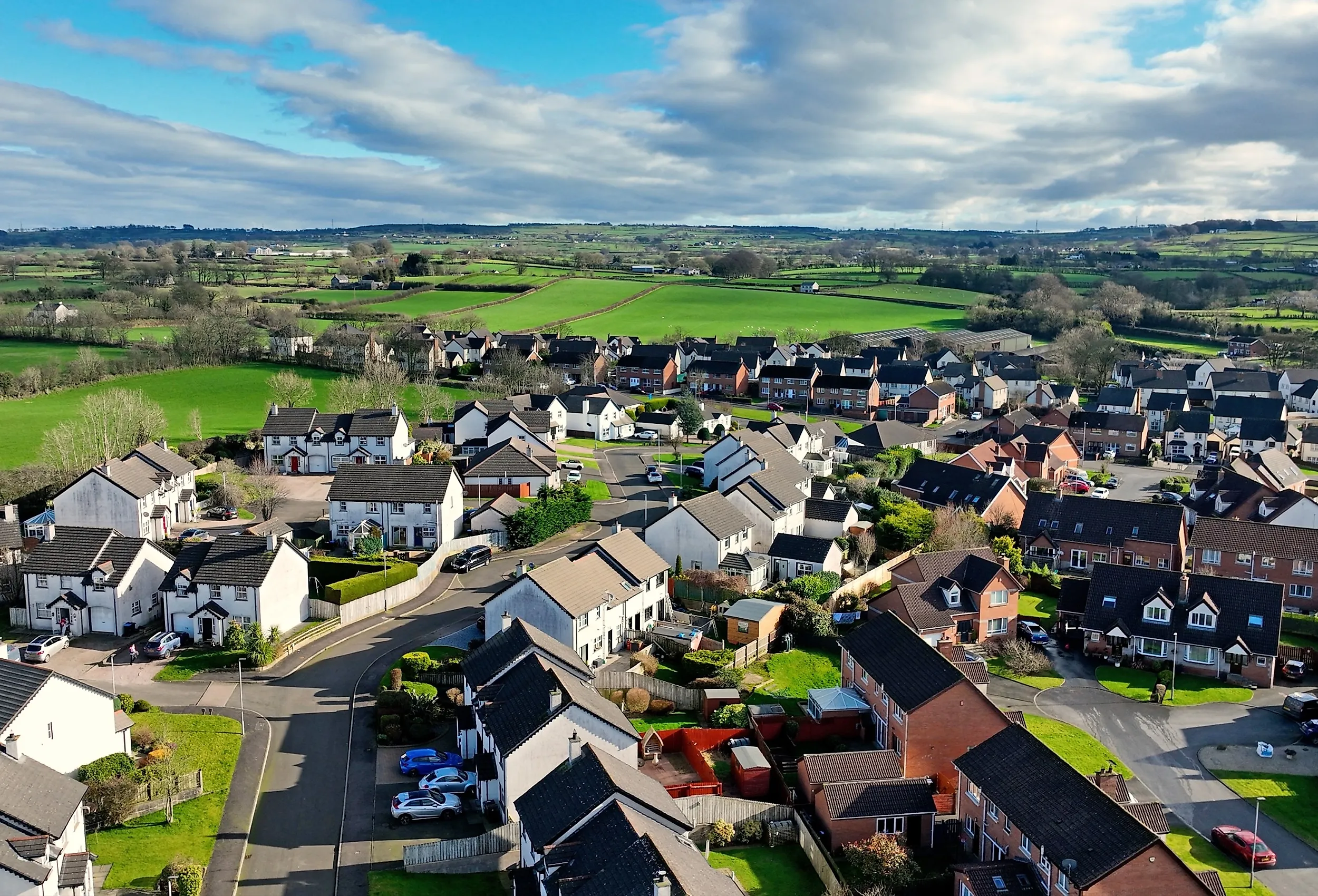
Its location helps explain the movement. Newtownabbey forms part of the Greater Belfast urban area, while rail and bus connections place communities across the borough within the capital's wider commuter network. Mossley West, for example, has developed into what Translink describes as a busy commuter station serving the growing Newtownabbey area. The borough is also preparing for additional development. Antrim and Newtownabbey adopted its Local Development Plan 2030 Plan Strategy in July 2025, establishing a framework intended to support new homes, employment, and investment. Rather than functioning independently of Belfast, the district is increasingly part of a wider metropolitan residential market in which households can live outside the capital while retaining access to its jobs and services.
Lisburn and Castlereagh

Lisburn and Castlereagh had an estimated population of approximately 151,700 in mid-2024. Its latest annual increase continues a much longer growth trend: between 2014 and 2024, the district's population expanded by 9.0%, the largest percentage increase among Northern Ireland's 11 Local Government Districts over the decade. Positive migration continues to drive that growth, reinforcing Lisburn and Castlereagh's position within the Belfast metropolitan corridor.
New housing provides some of the clearest evidence of how the district is accommodating additional residents. During 2024/25, 568 dwellings were completed across its settlements, including 263 in Lisburn City, 119 in Carryduff, and 91 in the Castlereagh Greater Urban Area. Almost 8,000 potential dwellings also remained on monitored development sites. The geography of that construction matters: Carryduff and Castlereagh sit immediately beside Belfast, while Lisburn has direct transport connections to the capital. The result is a district capable of absorbing households moving around the Greater Belfast area without severing their connections to the region's largest employment center.
Ards and North Down

Ards and North Down had approximately 165,400 residents in mid-2024. Its migration story is particularly significant because the district has Northern Ireland's oldest population profile: 23.3% of residents were at least 65 years old, while its median age reached 45.3. With an older population producing weaker natural growth, positive migration has become important to maintaining the district's overall population.
The district also sits firmly within Belfast's eastern commuter orbit. Bangor, Holywood, Newtownards, and Comber have transport connections to the capital, allowing residents to combine coastal or suburban housing with access to Greater Belfast. Bangor is simultaneously undergoing one of the district's largest regeneration projects. Work on the Queen's Parade development began in August 2025, starting with the Marine Gardens phase as part of a broader redevelopment of the city's waterfront. The project adds to Bangor's residential and commercial redevelopment at a time when migration is helping counterbalance the district's aging demographic structure. Ards and North Down, therefore, represent a different kind of growth zone: one where inward movement is helping sustain population numbers that natural change alone would struggle to maintain.
Belfast

Belfast remained Northern Ireland's largest Local Government District with approximately 352,400 residents in mid-2024, up from about 350,500 a year earlier. The capital's continued growth complicates any simple narrative that residents are merely leaving Belfast for surrounding suburbs. Belfast still attracts migrants of its own, particularly younger adults, students, and workers. NISRA reports that 36.6% of its population was between 16 and 39 years old in 2024, the highest proportion of any Northern Ireland district.
Higher education and employment help sustain that inflow. Belfast contains approximately 247,100 jobs, while around 70,000 people study in further or higher education, training, or apprenticeships. The opening of Ulster University's expanded city-center campus has also supported demand for purpose-built student housing. Belfast City Council is trying to convert more of that activity into permanent city-center living: its long-term development strategy identifies a need for 31,600 additional homes by 2035. Belfast consequently operates as both a destination and the center of a wider metropolitan migration system, attracting newcomers while some existing households relocate into neighboring districts.
Armagh City, Banbridge and Craigavon

Armagh City, Banbridge and Craigavon had approximately 222,500 residents in mid-2024, making it Northern Ireland's second-most-populous Local Government District. Its population growth combines migration with natural increase, while an unusually strong housing market has given new and existing residents considerably more capacity to settle within the borough.
Between April 2015 and March 2025, 9,181 new dwellings were completed in the district, more than in any other Northern Ireland council area over that period. Those homes represented about 14% of all new-build completions across Northern Ireland. The borough also has a substantial employment base: approximately 114,000 residents were employed in 2024, and its working-age employment rate of 79.3% exceeded Northern Ireland's 74.3%. Craigavon, Portadown, and Lurgan form the borough's principal urban and employment corridor, while manufacturing, pharmaceuticals, food production, healthcare, and transportation provide jobs across the district. The combination of employment and Northern Ireland's strongest decade-long housebuilding record makes the borough particularly well-placed to accommodate continued migration.
Mid Ulster

Mid Ulster's population reached approximately 152,700 in mid-2024, continuing growth in one of Northern Ireland's youngest districts. Children account for a larger share of the population here than in any other Local Government District, while the median age was 38.4 in 2024. Its population gains are not simply an extension of Belfast's suburban growth, however. Mid Ulster has its own employment base centered on manufacturing, engineering, construction equipment, and agri-food.
That industrial specialization is unusually concentrated. More than 40% of the world's tracked mobile crushing and screening equipment is manufactured in Northern Ireland, and the cluster responsible for it is centered on Mid Ulster. The district accounts for roughly 20% of Northern Ireland's manufacturing employment. Dungannon, Cookstown, and Magherafelt form its main population and employment centers, while investment is also reaching smaller towns. More than £10 million has been committed to Maghera's regeneration, including a business park, town-center improvements, and new recreational space. For households moving within Northern Ireland, Mid Ulster consequently provides something different from the Belfast commuter districts: employment-led growth anchored in a regional manufacturing economy.
Where Northern Ireland's Population Growth Is Heading
Northern Ireland's latest population figures show growth concentrated across several migration patterns rather than along a single corridor. Belfast continues attracting younger residents and workers even as Lisburn and Castlereagh, Antrim and Newtownabbey, and Ards and North Down absorb growth around the metropolitan area; Derry City and Strabane are emerging as a migration-led northwest growth center, while Armagh City, Banbridge and Craigavon and Mid Ulster combine population gains with substantial employment and development capacity. With migration already responsible for more than three-quarters of Northern Ireland's annual population increase, housing delivery and infrastructure will increasingly determine which districts can sustain those gains. In the fastest-growing areas, the immediate challenge is therefore less about attracting residents than ensuring that homes, transportation, and local services keep pace with them.