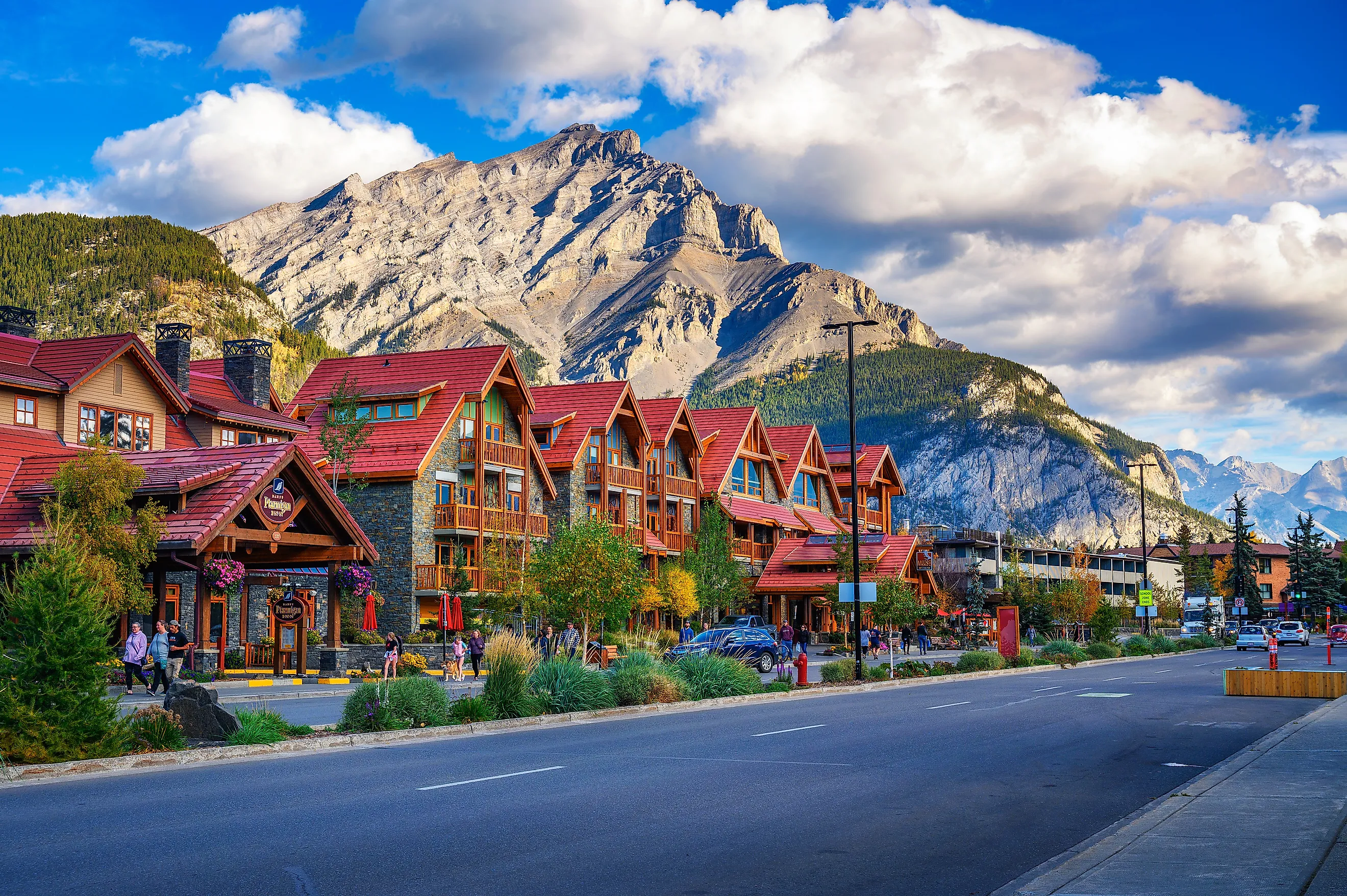
This Rocky Mountain Downtown Is Made For Strolling
Stretching from British Columbia and Alberta all the way to New Mexico, the Rocky Mountains are packed with legendary scenery. But few downtowns let you experience it on foot quite like Banff. Set inside Banff National Park, Canada’s oldest national park, this Alberta icon sits about 126-140 kilometers west of Calgary and is wrapped on all sides by the Canadian Rockies. Walk Banff Avenue, and you’re surrounded by snow-capped peaks while passing outdoor outfitters, galleries, designer boutiques, and standout restaurants. With over Banff's National Park area stretching 6,641 km², Banff’s downtown feels less like a street grid and more like a front-row seat to the Rockies.
A Rockies Ski Town Kept Small

Tucked into just under four square kilometers along the Bow River, downtown Banff is the beating heart of Banff National Park. With a permanent population of roughly 8,000 and more than 4 million annual park visitors, Banff feels busy without feeling like an absolute zoo. That balance defines the downtown core, centered almost entirely on Banff Avenue and Bear Street, where the town’s social, commercial, and nightlife energy is concentrated into a few highly walkable blocks.
Cascade Mountain looms at the end of Banff Avenue, while hotels, bars, gear shops, galleries, and restaurants stack tightly together. The town-famous Spirit of Christmas shop operates year-round, and it's unapologetically festive in the middle of ski season. A few blocks away, the Banff Park Museum, Canada’s oldest surviving federal building in a national park, houses over 5,000 botanical and zoological specimens inside a 1903 log structure.

Roughly 61 percent of residents work in tourism, many rotating between hospitality shifts and ski days, and during peak winter weekends, the overnight population can surge past 50,000. Yet the town never outgrows its footprint. Whether it’s SnowDays filling the streets with snow sculptures or summer arts spilling out from the Banff Centre, downtown Banff stays dense, magically animated, and unmistakably small by design.
A Brief History Of Banff

Long before storefronts lined Banff Avenue, this stretch of the Bow Valley was home to Indigenous peoples for more than 10,000 years. The Blackfoot Confederacy, Tsuut’ina First Nations, and the Stoney Nakoda Nations traveled, hunted, and gathered medicines here, using the Bow River, known in Blackfoot as Makhabn, the river where bow reeds grow, as a vital route through the Rockies. The hot springs beneath Sulphur Mountain were a sacred place long before they became a destination for skiers and snowboarders.

Banff’s modern history began in the 1880s with the arrival of the Canadian Pacific Railway. After workers discovered the Cave and Basin hot springs in 1883, the federal government created Banff National Park in 1885, Canada’s first national park and the third in the world. Unlike many mountain towns shaped by mining, Banff was built around tourism from the start. The townsite developed as a compact service hub for rail travelers, clustered tightly along what is now downtown Banff Avenue.
Incorporated in 1990 and legally prohibited from expanding its land base, Banff has grown inward rather than outward. As part of a UNESCO World Heritage Site, its core remains dense, walkable, and undeniably beautiful.
Restaurants

Downtown Banff’s food scene reveals itself block by block, starting right at the intersection of Wolf Street and Banff Avenue. Head south onto the pedestrian-only stretch, and the town immediately closes in around you, a compact ski village corridor that architecturally feels closer to Whistler than a typical Rocky Mountain stopover. Restaurants stack tightly together here, making the walk itself part of the experience.
Early along Banff Avenue, places like The Boss Kitchen & Bar, Indian Curry House, and Zyka Elevated Indian Restaurant establish the street’s range, sitting alongside PARK Distillery Restaurant + Bar, where Banff’s craft distilling scene meets hearty mountain dining. Across from Banff Avenue Square, the Grizzly House remains one of the street’s longest-running fixtures, known for fondue service and its unapologetically old-school mountain atmosphere. Directly opposite, the Rose & Crown has anchored the block since the mid-1980s, filling its dining room and rooftop with live music and post-ski crowds.

Farther south, the density continues with Brazen inside the Mount Royal Hotel, followed closely by COWS Banff Ice Cream, Elk & Oarsman Restaurant & Bar, The Balkan, and Chaya, all within a few minutes of each other.
Just off the avenue, Bear Street provides access to Wild Flour Bakery, which draws steady morning traffic from the Bison Courtyard, while Three Bears Brewery, Bear Street Tavern, Magpie & Stump, and The Bison create a patio-lined spine for afternoons and long dinners.
Shopping

Both Bear Street and Banff Avenue are filled with great places to shop, and getting around on foot is the best way to travel between them. EIn summer, the 100 and 200 blocks have operated as a pedestrian zone in some years. Just past Caribou Street on Banff Avenue, Monod’s stands as Banff’s go-to destination for outdoor clothing and gear. Multi-level and packed with the latest in climbing equipment, winter apparel, footwear, and gadgets. The store’s family owners are accomplished winter athletes, offering expert guidance that draws everyone from casual hikers to Hollywood celebrities and NHL players seeking private shopping hours.

Next door, Spirit of Christmas turns shopping into a full-on holiday experience. Heading further up Banff Avenue toward Wolf Street, The Fudgery tempts with its glass window showcasing handmade fudge, chocolates, candy apples, and other sweet creations. Over on Bear Street, you'll find Lole Banff and fun accessories at House of Angelica, among other shops that keep the street lively.
Downtown Heritage Sites

Many of Banff's oldest buildings are located along Banff Avenue and sit side-by-side down the street. Starting at the intersection of Wolf Street and Banff Avenue, you’re immediately greeted by St. Paul’s Presbyterian Church. Built in 1930 in the Victorian Gothic Revival style from local stone, its stained glass above the front door frames Mount Rundle in radiant color. Just a few steps south, the Banff School Auditorium, now the Parks Canada Information Centre, carries Tudor Revival echoes in its half-timbering, steep roof, and stone base.
Across the street, the Brewster Transportation Company Building stands out with its sleek Art Moderne design. The 1921 Cascade Dance Hall continues the architectural journey with Dutch Colonial flourishes, from its bell-shaped roof to arched openings and decorative parapet.
A few doors down, the Paris Tea Room, opened in 1903 by George and Ida Paris, nods to the town’s early ski culture, while the Dave White Block, built in 1908 and expanded in 1913, remains the oldest surviving commercial building on Banff Avenue.
Nature Outside Of Downtown
Downtown Banff is the perfect base for outdoor adventures, though most major attractions require a short drive. The Bow River Walk and Fenland Trail offer quick scenic escapes, and Cascade Gardens provides a calm spot to enjoy flowers and water features.
For panoramic mountain views, the Banff Gondola lifts visitors to Sulphur Mountain, while ski resorts at Mount Norquay, Sunshine Village, and Lake Louise are all accessible by car. After exploring, a soak in the Banff Upper Hot Springs or a stroll past the iconic Fairmont Banff Springs Hotel ties the day together, blending natural beauty with historic charm.
Rocky Mountain Downtowns Like Banff

Banff’s specific downtown charm is certainly unique in the Rockies; however, towns like Canmore and Aspen share a similar blend of walkable streets, historic architecture, and mountain energy. Canmore, just outside Banff National Park, has a small Main Street where restaurants, bars, and shops flourish in a seasonal pedestrian-only zone. The Policeman’s Creek Boardwalk weaves through downtown, offering glimpses of peaks like Ha Ling, while the town’s history as a coal-mining hub is celebrated at the Canmore Museum.

Aspen, Colorado, mirrors Banff's mountain-town vitality with a historic downtown lined with Victorian-era buildings, including the Wheeler Opera House and Hotel Jerome. Walkable streets showcase restaurants, galleries, and cultural landmarks, while the Silver Queen Gondola towers above, connecting urban life to the surrounding ski slopes.
Downtown Banff’s walkability isn’t just a product of its compact 2.5-square-mile layout or pedestrian-friendly streets; it’s defined by what you encounter along the way. Stroll Banff Avenue and Bear Street, and you’re immersed in Canadian history, from the 1903 Banff Park Museum to Gothic Revival churches and Edwardian commercial blocks. Shops like Monod’s and Spirit of Christmas, cafés, galleries, and award-winning restaurants punctuate every block, while bridges, riverside trails, and mountain views constantly draw you outside. Every step is a mix of culture, commerce, and pure Rocky Mountain majesty.