The Cheapest Beautiful Towns To Live In South Carolina
Beautiful usually costs money, and a walkable old downtown with river views tends to come with a price tag to match. South Carolina keeps quietly breaking that rule. All along its rivers and its old rail lines sit towns that look like a fortune and cost a fraction of one. The prettiest addresses were paid for a century ago by cotton and rice money that has long since moved on. What is left is the pretty part without the bill. Cheraw, Georgetown, and Aiken all sit below the state average on rent and home prices. Each one hands you the oaks and the history and the water at a number that still makes sense.
Cheraw

General Sherman's army spent several days in Cheraw in the spring of 1865 and, in a rare turn for that particular march, left the town standing. An accidental gunpowder explosion ended up doing more damage to the business district than the Union troops did. Cheraw has called itself the prettiest town in Dixie ever since, and it has spent the years quietly living up to the name. It sits at the head of navigation on the Pee Dee River, which is the polite way of saying this is as far as the cotton boats could get, so this is where the town grew. Before the Civil War it ran the largest cotton market between Georgetown and Wilmington. That trade paid for the historic district you can walk today, one of the largest and most intact in the state, with over 200 properties on the National Register and homes going back to the 1700s. St. David's Episcopal Church, built in 1770, was the last Anglican church erected in South Carolina under King George III, which the congregation has had two and a half centuries to feel some way about.
The other thing Cheraw produced was Dizzy Gillespie, the jazz trumpeter with the bent horn, and the town honors him every October at the South Carolina Jazz Festival. Outside town, Cheraw State Park covers more than 7,000 acres around Juniper Lake, with an 18-hole course, boat rentals, and enough trail to lose an afternoon on. All of this comes cheap. The typical home in the area runs around $160,000, which is roughly half the state average and puts a historic house within reach of people who would be priced out almost anywhere else with this much to look at.
Camden

Camden is the oldest inland town in South Carolina, laid out in 1733, and it has spent most of the years since then arranging its life around horses. The town runs on a steeplechase calendar built around the Carolina Cup, and on race weekends the population of the infield rivals the population of the town. The rest of the year it is a working county seat with a downtown of low brick storefronts and a set of Revolutionary War battlegrounds on its edge that count among the more intact colonial ground anywhere in the country.
Historic Camden preserves those grounds, and the Camden Archives and Museum keeps the paperwork, occasionally putting Revolutionary-era documents on display. All of that history comes at a discount: the typical home value sits near $219,000, comfortably under the state figure, which buys a lot of Camden for the money.
Florence

Florence exists because two rail lines crossed here in the 1850s, and the town has been the hinge of the Pee Dee region ever since. It earned the nickname the Magic City for the speed at which it went from a rail junction to an actual city, and it was named after Florence Harllee, the daughter of the railroad man who ran the line through. It is the largest place on this list, which cuts both ways. You get a real downtown, a museum with a serious collection of 20th-century Southern art, and Timrod Park with its walking paths under old canopy. You also get errands that take ten minutes instead of forty.
The other thing a city this size gives you is options the smaller towns cannot: a revitalized downtown, a regional airport twenty minutes out, and the pull of a real economic hub rather than a bedroom community. None of it comes with a big-city price. Homes here run around $226,000, comfortably under the state average, which is the payoff for living in a town built for work rather than for the view.
North Augusta

North Augusta calls itself South Carolina's Riverfront, and for once the town nickname is just accurate. It sits on the north bank of the Savannah River, directly across the water and the state line from Augusta, Georgia, which means you get a quiet residential town on one side and a mid-sized city's airport, hospitals, and one famous golf tournament on the other. The North Augusta Greeneway runs more than seven miles along the old rail corridor and the riverbank, and it is the spine of daily life here for walkers, runners, and anyone with a bike.
Just up from the water, the Living History Park recreates 18th-century life with costumed demonstrations and restored colonial-era buildings, staffed by volunteers who take the blacksmithing very seriously. The town itself stays affordable, with homes around $283,000 and rent running well under the national average, and the Georgia airport across the bridge connects to Dallas, Charlotte, and points beyond, so being on the quiet side of the river does not mean being stuck there.
Conway

Fifteen miles inland from the neon of Myrtle Beach, Conway is what the coast looked like before the coast became the coast. It sits on the Waccamaw River under live oaks so old and so draped in Spanish moss that the streets look staged. They are not. The Conway Riverwalk runs a mile and a half along the river through the historic downtown, past preserved brick storefronts and out to Riverfront Park, where there is a kayak launch and a marina and, most evenings, someone fishing who will tell you it is not biting.
Conway is part of the Myrtle Beach metro, which means it draws on beach-town amenities without paying beach-town prices, and Coastal Carolina University keeps the place younger and busier than its size would suggest. Home values run around $289,000, close to the state average but a fraction of what the same house would cost fifteen miles east with sand out the back door.
Aiken

In the late 1800s, wealthy Northern families discovered that Aiken had mild winters and sandy soil that horses loved, and they built themselves a seasonal town to ride in. They called it the Winter Colony, and the result is a place where, downtown, cars still yield the right of way to horses. Hitchcock Woods is the centerpiece: over 2,100 acres of longleaf pine and 70 miles of sandy trail, one of the largest urban forests in the country, open only to feet and hooves. Hopelands Gardens fills 14 acres with old oaks and camellias, and shares its grounds with the Thoroughbred Racing Hall of Fame, which honors the horses that trained here.
The Gilded Age money left behind grand architecture, and the last of the great Winter Colony hotels, The Willcox, is still standing and still taking guests. It once turned away the Prince of Wales during Masters week for lack of a room, a story the hotel tells with no apparent regret. For all that pedigree, Aiken stays affordable, with typical home values around $247,000, below the state average.
Georgetown

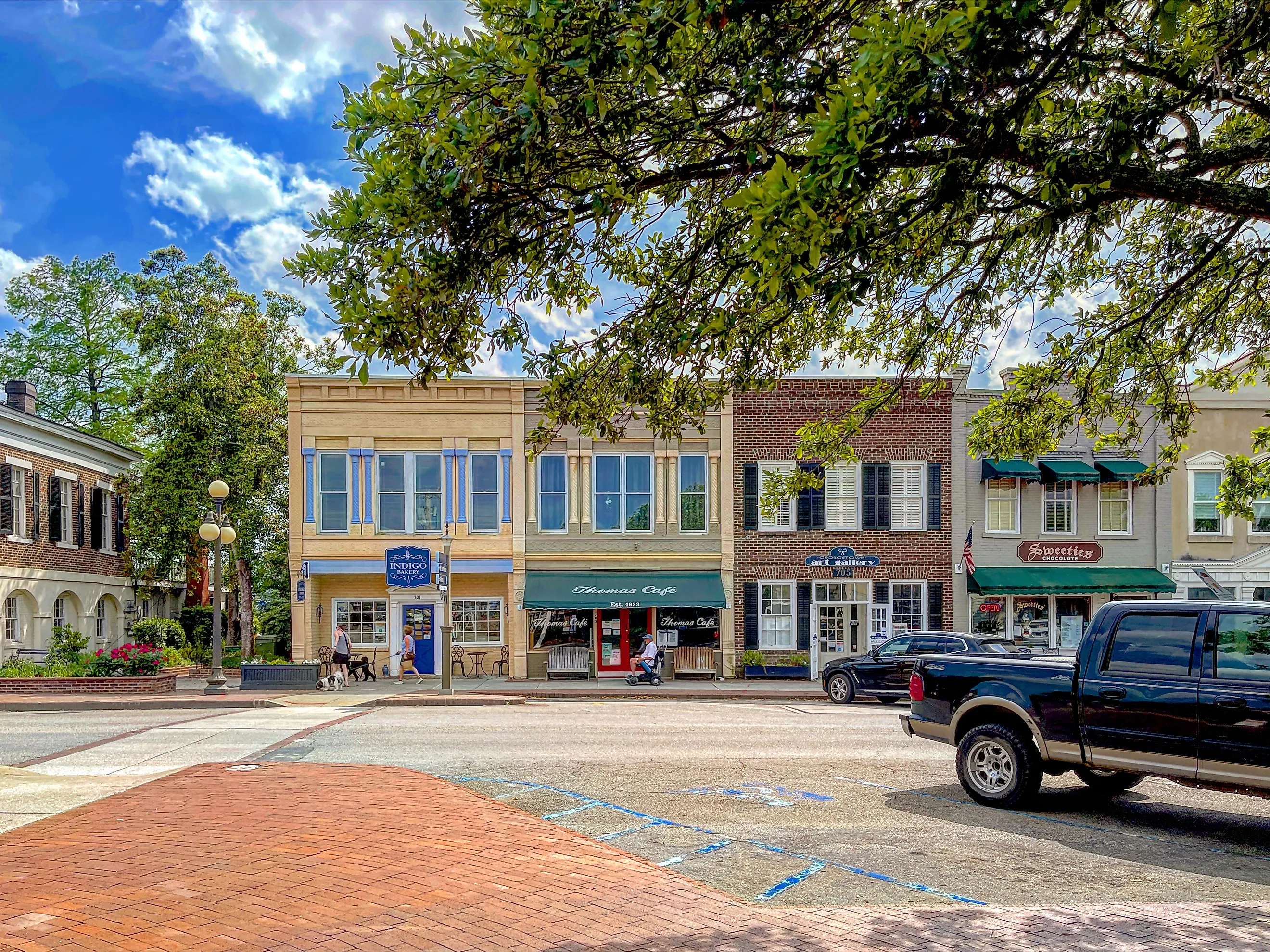
Georgetown is the third-oldest city in South Carolina, founded in 1729 after Charleston and Beaufort, and it sits at the one spot on the coast where five rivers empty into Winyah Bay. That geography made it a rice port, and by 1840 Georgetown County was producing close to half the rice grown in the entire United States. The fortunes that came from that trade built the downtown, and more than fifty buildings in the historic district now carry National Register listings, including the Georgian-style Kaminski House with its period rooms.
The working waterfront is still the heart of the place. The Harborwalk runs the length of Front Street, past the River Room and other seafood spots where the view is half the meal, and East Bay Park spreads out nearby with a boat ramp, tennis courts, and oak-shaded paths. Home values here sit around $250,000, among the lowest on the coast, which is a strange thing to be able to say about a place with three centuries of history and five rivers running through it.
The Cheap Seats Have the Best View
The pattern holds across all seven. These are towns that boomed on cotton, rice, and rail, then watched the economy that built them move somewhere else, and the leaving is exactly why they are affordable now. The real bargain is structural. You are buying into places that already spent their money on the churches, the courthouses, and the live oaks a century ago, and left the bill for someone else. The view was paid for a long time back. The rest of us just get to enjoy it below the state average.