9 Storybook Towns In Louisiana
In Louisiana, it’s easy to stumble into a town that looks like it was built for a folktale, like Natchitoches with its wrought-iron balconies and St. Martinville with its legendary Evangeline Oak, both shaded by history older than the stories it inspires! Madisonville curves along the Tchefuncte River with its 19th-century maritime streets and the 1837 lighthouse, while Opelousas’ Le Vieux Village and brick courthouse square showcase Acadian and Victorian heritage. Each of the 9 Louisiana towns layers its history, design, and even its yearly events into places that feel transported from another era or just simply belong in a Cajun folktale.
Natchitoches

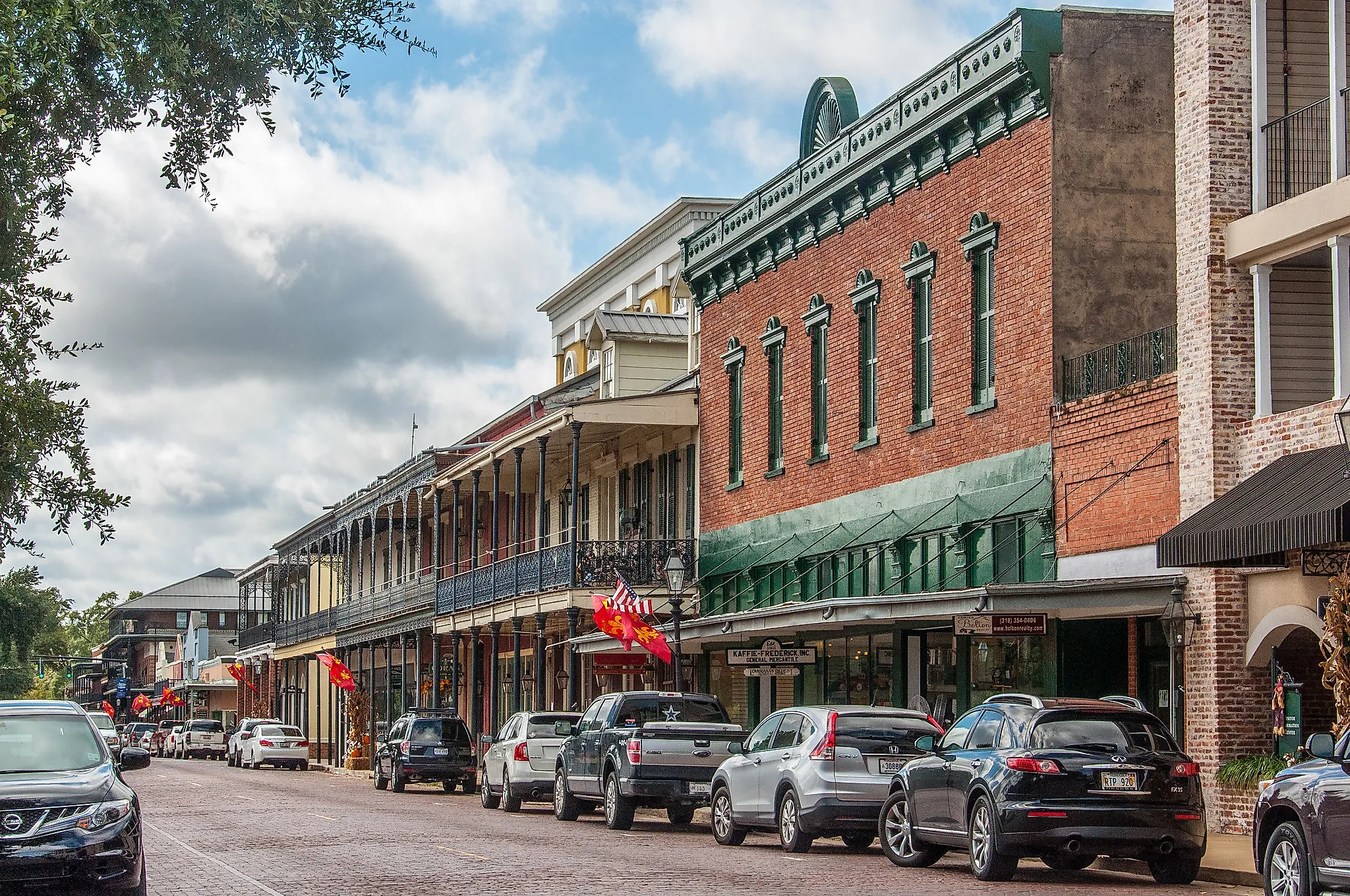
There’s a reason Steel Magnolias was filmed in Natchitoches. Along the brick-paved stretch of Front Street, wrought-iron balconies face Cane River Lake, and the buildings inside the Natchitoches National Historic Landmark District reflect French and Spanish colonial design that dates back more than three centuries. Founded in 1714, Natchitoches is recognized as the oldest permanent settlement in the Louisiana Purchase territory, and that longevity shows in preserved storefronts and townhouses that feel lifted from another era rather than reconstructed for effect. At Fort St. Jean Baptiste State Historic Site, a full-scale replica of the 1716 French fort stands near the original site, with period demonstrations that recreate colonial trade and military life. Along Front Street is Kaffie-Frederick General Mercantile, open since 1863 and recognized as Louisiana’s oldest general store, where hand tools share counter space with glass jars of candy. The history and the architecture aren't the only aspects of this town that make it feel as though it belongs in a storybook. During December, the Natchitoches Christmas Festival of Lights launches six weeks of riverfront illuminations, fireworks, carriage rides, and parades, with hundreds of thousands of lights reflecting off Cane River Lake.
Abbeville

Abbeville, located in Vermilion Parish, offers a number of distinct features that contribute to its storybook-like quality. This includes the town's annual Giant Omelette Celebration, which turns the central Magdalen Square into a whimsical stage where 5,000 eggs are flipped by French chefs in front of cheering crowds. The Square itself is a compact plaza framed by 100-year-old oak trees, a central fountain, and a gazebo where locals gather during festivals like the Cajun Christmas Celebration. Streets radiate outward from the square, lined with century-old Victorian and pre-war buildings, including the Greek Revival Vermilion Parish Courthouse and the Romanesque Revival St. Mary Magdalen Church. The Acadian influence is visible in the layout and architectural details, recalling a French village transplanted to the Louisiana prairie.
Breaux Bridge

A red crawfish crowns the steel truss over Bayou Teche, marking the entrance to Breaux Bridge and the title the town adopted in 1959: “Crawfish Capital of the World.” Each May, the Breaux Bridge Crawfish Festival turns Parc Hardy into three days of zydeco music, crawfish races, and cooking demonstrations across multiple band stages. The festival also spills out toward Bridge Street, where Lagniappe Antique Mall fills 17,000 square feet with rotating vendors, and St. Bernard Catholic Church, completed in 1934, stands a few blocks away with its twin towers facing a town that reads like a set piece from another century. Lake Martin lies just outside town, known for cypress trees and wading birds, while swamp tours depart locally to navigate the Atchafalaya Basin’s alligator-filled backwaters.
Grand Isle

Grand Isle has weathered storms for centuries, with its barrier island setting along the Gulf Coast. Hurricanes have repeatedly battered its shores, yet stilted homes in coral, turquoise, and sunshine yellow endure, framing the island in a way that feels lifted from folklore. Grand Isle State Park occupies the northern tip, 140 acres of sandy beaches and marsh where families kayak, paddleboard, and watch herons stalk the shallows. Here, a 900-foot pier stretches into the Gulf for anglers and sunset watchers alike. Each spring, the Migratory Bird Festival transforms the oaky-huckleberry groves into flurries of roseate spoonbills and songbirds. Historic traces of early Spanish land grants and 19th-century sugar and cotton plantations linger near the southern end of the island, once frequented by writers like Kate Chopin and Lafcadio Hearn. Charter boats like Cast and Catch and A Day in Paradise carry visitors into offshore waters teeming with fish and showcase the town's gorgeous vista.
St. Francisville

High above the Mississippi River on a narrow bluff about 30 miles north of Baton Rouge, St. Francisville trades flat bayou terrain for rolling ground and magical oak canopies. The trees frame the town’s Historic District along Ferdinand, Commerce, and Royal Streets, where 19th-century buildings stand within blocks of the West Feliciana Parish Courthouse and its 1909 Confederate monument. A few minutes from downtown, Rosedown Plantation State Historic Site preserves an 1830s mansion and formal gardens filled with oak allées, camellias, and multiple fountains. A short drive away, The Myrtles Plantation, one of the South's most discussed historic homes, dates to 1796 and welcomes overnight guests who want to stay in a building that may as well have been ripped from the pages of a fairytale.
Donaldsonville

Incorporated in 1806 and briefly Louisiana’s capital in 1830-31, Donaldsonville is a town filled with brick, iron, and steeples, blocks from the levee at the meeting of the Mississippi River and Bayou Lafourche. Walking from the levee into the historic district, the 1898 red-brick Ascension Parish Courthouse rises like a town hall in an illustrated storybook, its steps opening onto streets lined with wrought-iron galleries and antique façades. The Ascension of Our Lord Catholic Church towers over Mississippi Street and neighboring buildings with proportions uncommon for a town this size. Its cemetery, listed on the National Register of Historic Places, holds graves dating to the 1700s, including both Union and Confederate soldiers. On Mississippi Street, the 1877 B. Lemann & Bro. Building retains its wrought-iron gallery above the sidewalk, a reminder of when the store served plantation families and river traffic.
St. Martinville

The Evangeline Oak spreads its ancient branches over the banks of the Bayou Teche, a living landmark tied to Henry Wadsworth Longfellow’s 1847 poem. Beneath its moss-draped limbs, couples marry, families pose for graduation photos, and visitors pause beneath the shade of a 400-year-old tree that anchors a scene steeped in local St. Martinville legend. Nearby, the bronze statue of Evangeline next to St. Martin de Tours Catholic Church marks the meeting of fact and fiction, its 1840 stone walls echoing the Acadian heritage the poem immortalized. The Longfellow-Evangeline State Historic Site displays Creole plantation architecture from the early 1800s, with French and Caribbean influences visible in its columns, shutters, and wrought-iron balconies. Streets radiating from the downtown core showcase commercial and residential buildings listed on the National Historic Register, each structure layering centuries of French, Acadian, and Creole culture.
Madisonville

Madisonville follows the curve of the Tchefuncte River on Louisiana’s Northshore, about 40 miles north of New Orleans. Fairview-Riverside State Park sits along the river with moss-draped oak trees, short trails, and calm waterways where blue herons perch themselves and turtles sun on logs. The Tchefuncte River Lighthouse, built in 1837 and listed on the National Register of Historic Places, stands like a miniature sentinel over the riverfront, its brick-and-iron structure recalling 19th-century maritime life. Marinas line the banks, and public piers allow fishing, crabbing, and river watching, with restaurants such as Morton's and the Crabby Shack offering decks directly over the water. Narrow streets wind past Victorian-era homes from the town's 19th-century maritime growth. The town's annual events further celebrate this history, including the Wooden Boat Festival in October, which assembles handcrafted wooden boats along several blocks of Water Street.
Opelousas

Opelousas lies in St. Landry Parish on the prairie north of Lafayette, where streets of 19th-century brick intersect with clusters of mature oak trees. Le Vieux Village displays buildings relocated from around the parish, including the Venus House, which was built of bousillage (a mixture of mud, Spanish moss, and animal hair). Also in the village is a 1911 schoolhouse, an early 19th-century doctor’s office, and the Union Pacific Depot, now home to the Orphan Train Museum, which documents the 1873-1929 arrivals of children sent from New York to local families. Walking through this part of Opelousas is like experiencing a miniature historical tableau, a concentrated, almost stage-like scene of Louisiana's 19th and early 20th centuries. Downtown, the courthouse square features the “Hidden Capital of Louisiana,” which was the governor’s mansion during the Civil War, as well as brick sidewalks that lead past antebellum and preserved Victorian homes.
Natchitoches, St. Martinville, Opelousas, Madisonville, Abbeville, and Breaux Bridge feel storybook-like because their streets hold more than preserved buildings. Front Street in Natchitoches glows during the Christmas Festival of Lights, its wrought-iron balconies reflecting over Cane River Lake. In St. Martinville, weddings unfold beneath the Evangeline Oak, tying a 19th-century poem to a living landmark. Abbeville cracks 5,000 eggs in Magdalen Square each November. Madisonville fills Water Street with handcrafted boats. Opelousas gathers relocated Creole structures at Le Vieux Village. Each of these Louisiana towns pairs architecture, legend, and recurring spectacle in ways that echo folklore without inventing a thing.